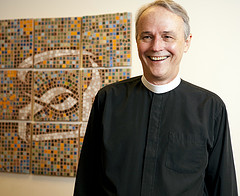
Finding Comfort Where None Is To Be Found @TheHuffingtonPost

I was asked to write something about spiritual comfort after shocking sudden death for the HuffPost Religion channel, and only had a few hours to do it. Here’s what I came up with:

It took me all weekend to get used to hearing the name Gabrielle Giffords reported in the tragic context of the Tuscon shootings. Not only was the event horrific, but I also couldn’t shake the similarity of the congresswoman’s name to that of my late son Gabriel Gifford Scheller. The endless stream of news triggered a wave of memories from when police showed up at my door in the early morning hours of March 29, 2008 to report that Gabriel had killed himself. The horror of an event like that is so vast that unless you have lived through one like it, you can’t truly comprehend it. One moment, life is mundane, ordinary, perhaps even joyful. The next, it is torn to shreds so completely that you believe with every ounce of your being that it is over. At least I did.

And I was right, in a sense. Everything I thought I believed was called into question and everyone I thought I trusted was placed into one of two categories: safe or unsafe. Safe people didn’t say much and if they did, they most certainly did not speak in spiritual platitudes or pronounce judgment on the situation or on my son. Unsafe people did and do pretend to understand, minimize the horror or its impact, express some perverse need to identify with it, or otherwise just creep me out.

My husband had absolute peace that Gabriel was with God, but he really struggled with flashback images of how Gabe killed himself. I didn’t wrestle as much with our son’s final moments as I did with where he is now and why he did what he did. A friend who is a psychiatrist counseled me early on to give up the second battle because, he declared, “Suicide is inherently an irrational act; it will never make sense.” (Likewise, random acts of public violence.) A Lutheran pastor comforted me by saying that how we die doesn’t determine where we spend eternity.

Over the past couple days, I have heard the tragedy in Tuscon blamed on irresponsible political rhetoric and mental illness, neither of which provide satisfactory answers. In situations like these, we long for some kind of solace, for someone to tell us we and our loved ones are safe. In D. Michael Lindsay’s book Faith in the Halls of Power, former George W. Bush speechwriter Michael Gerson is quoted as saying, “When people are presented with entirely unfair and unreasonable suffering, the president of the United States has to assure them … that the universe has meaning, and that the universe is not an emptying, echoing void.” Gerson goes on to say that complaints about politicians’ use of religious rhetoric don’t often emerge in the context of public tragedy. Thus we waited for our president to speak.

We don’t want just anyone to tell us that everything will be okay both in this life and in the next; we want someone with authority to say it. My husband, a former pastor and longtime Bible teacher, was too paralyzed with grief and shock to attend to the practical details of our son’s funeral, but he was able to get up and spontaneously preach a mini-sermon that comforted many, including me. I couldn’t access my faith, but I was able to take comfort in his. Conversely, as he struggled with those terrible mental images, I shared with him something that had helped me when I kept mentally replaying the final moments of friends who had died in the terrorist attacks on Sept. 11, 2001. I realized one day as I was praying that they had only lived through the horror of Flight 93 crashing to the ground for an instant and then it was over. The same was true for Gabe’s final moments.

An old friend also sent me a note encouraging me to take solace in beauty wherever I could find it. As I took her advice, the beauty around me ministered to me and reminded me, as Gerson suggests, that order coexists with chaos. The universe is not an emptying, echoing void. A glorious California sunset would break through the kitchen window as tears flowed over the dishes I tried to do. The bougainvillea came into bloom despite my grief. My other son, who had been suffering from clinical depression for five years, finally received a correct diagnosis and the help he needed. We moved home to New Jersey and to the warm embrace of the family and friends we had missed so much when we lived out west.

There was good to be found, but none of it made up for, or brought meaning to the loss. It co-existed (co-exists) with it. Violence, whether it be self-inflicted or directed outward, teaches us that ours is an undeniably broken world. Yet even in this horrible moment when one young man walked into a crowd and shattered the lives of so many, another ran toward the bullets to provide triage to his wounded boss and to others around her. Three people conspired to stop the gunman as he struggled with his weapon. In a split second everything changed again. For him, for the people present, for their families, for his family, for the Congress, and for us. As we haggle and fight over what happened and about what needs to be done in light of it, may we not forget the sustaining beauty that exists in every moment we are privileged to live on this earth. Even the dark ones.

Check out what HuffPost readers are saying here.

The Abortion Debate: Open Hearts, Open Minds and Tragedy as a Fair Minded Word @TheHuffingtonPost

Fordam University bioethicist Charles Camosy introduced Open Hearts, Open Minds and Fair Minded Words: A Conference on Life and Choice in the Abortion Debate at Princeton University on October 15, 2010 by saying that it wasn’t the conference any of its organizers wanted or envisioned. Instead many compromises were made between him and his colleagues Peter Singer (Princeton), Frances Kissling (University of Pennsylvania) and Jennifer Miller (Bioethics International) as they thought about how to find common ground amidst the debate.

In his introduction, Camosy, who is pro-life, outlined three goals: 1. better map disagreements; 2. find common ground across divides; 3. have open hearts and open minds. Kissling, who is pro-choice, compared her pre-event anxiety to preparing for a wedding that both families believe is a horrible mistake. (Perhaps such fears were eased as the conference unfolded because there were security guards at the doors on the first day but not the second.)

After the conference, Camosy described it as largely successful in meeting these goals despite pockets of incivility, while Evangelical participant David Gushee (MacAfee School of Theology, Mercer University) described it as an audacious attempt that largely failed to find common ground.

Gushee was on the first panel, “Bridging the Abortion Divide: Recurring Challenges, Emerging Opportunities,” with his Common Ground colleague Rachel Laser, Mary Jacksteit of the Public Conversations Project (which initially attempted to bridge the abortion divide in the 1990s) and both Kissling and Miller. While I learned a lot from each discussion, theirs was the only one I attended that didn’t devolve into a remix of worn-out debates. Perhaps this is because all five speakers were already committed to the goal of exploring shared values.

Laser (who is pro-choice) and Gushee (who is pro-life) became friends through their work on an abortion governing document that was submitted to President Obama’s transition team. They described themselves as comrades in arms who bonded as they fended off friendly fire from their respective sides.

In his opening remarks, Gushee described abortion as a tragedy. Kissling objected to this definition. She said the moral right of women to make decisions about reproduction is essential for them to be recognized as human beings and while she respects the “category of fetal life,” she doesn’t “have a sense of individual fetuses as possessing high value.” Even so, she’s troubled by what she sees as a coarsening of discourse over the issue.

Gushee’s use of the term tragedy initially struck me as emotionally loaded too. I did not choose abortion when I had an unplanned pregnancy, but several members of my social circle did in similar circumstances and only one of them seems to have experienced it as a tragedy. The rest have occasionally communicated feelings of guilt about their abortions, but not regret.

I have written for Christianity Today from a strongly pro-life perspective and yet I’m not sure I ever thought of abortion as tragedy either. Instead, I’ve thought of it and continue to think of it as morally wrong. When I think of tragedy now-a-days, I tend to think of my son Gabriel’s suicide. The issues are related in that he didn’t have the right to take his own life any more than I had the right to take it and yet they are different because he was mentally impaired by Depression when he did so. (Despite notions to the contrary, the American Foundation for Suicide Prevention says suicide is overwhelmingly a function of mental illness rather than free will.)

Because Gabriel’s death left his brother with no siblings in this world, I’ve become increasingly grateful for his cousins, several of whom were conceived outside of marriage and whose biological parents either never married or married and later divorced. That is a different kind of heartbreak, and yet all these young people are flourishing as are our bonds with one another despite the complications and pain common to all blended and broken families.

My gratitude for them has gotten me thinking about those other children who are missing from my social network because of abortion. I experience Gabriel’s death as tragic because I had the opportunity to know and love him, while I experience those children as mere absences because I never got the chance to know them. I’ve subjectified them as thoroughly as Kissling has.

This is an oft-cited problem with discussions about abortion that pit the life of the unborn child against the welfare of the mother. Women can speak for themselves while unborn children can’t and we are incapable of fully comprehending what we are missing, even if we can glimpse it from the joy other children bring us.

I talked to Gushee about his use of the word tragedy. He said it may not have been the most philosophically precise description, but he was trying to communicate that abortion reflects a deep brokenness in the human condition. This sounds exactly right.

When I think about how tragic my son’s death is, I’m reminded that I would much rather live with the anguish it causes me than envision a life in which I never knew him. Abortion is a tragedy in and of itself, regardless of whether or not we as individuals or we as a society feel that it is so.

1 Corinthians 13:12 says we see things imperfectly in our finite understanding, but one day we will see with perfect clarity. Only then will our perception of abortion match reality.

Check out reader reaction to this reflection at The Huffington Post.

The Politics of Hunger @UrbanFaith

Ambivalent about exercising your patriotic duty on Tuesday? I was too, until I interviewed the winner of the World Food Prize and learned why this election is so important to hungry Americans. Here’s the intro:

Hunger is a devastating problem in third-world countries, but according to Bread for the World president David Beckmann, one-quarter of all African Americans live in poverty right here in the U.S. That’s why he believes vanquishing poverty should be at the top of our “Christian” political agendas — and why he’s urging people to vote on Tuesday.

David Beckmann is president of Bread for the World and the recent winner of the 2010 World Food Prize. In addition to being an anti-hunger activist, he is a Lutheran minister and an economist who formerly worked at the World Bank. His latest book is Exodus from Hunger: We Are Called to Change the Politics of Hunger. UrbanFaith columnist Christine Scheller interviewed Rev. Beckmann about his work, hunger in the African American community, and why we should be aware of the federal policies that influence issues of poverty in America. …

And a compelling exchange from our conversation:

I tend to think that living in the United States, hunger is more invisible. How has it changed you working for the World Bank and Bread for the World?

What’s most striking is that the world as a whole has made remarkable progress against hunger, poverty and disease. I believe in God and I see that hundreds of millions of people have escaped from poverty in places like Ethiopia, Bangladesh, Brazil and Britain. That’s why, for me, it makes sense that this is God moving in our history. And then I come back to the U.S.A. where we haven’t made any progress against hunger and poverty since about 1973 and it informs, I think, the U.S. situation. If Brazil and Bangladesh can reduce poverty, it’s clear that we could do it in the U.S. We just haven’t tried for a while. But we did try as a nation. In the ’60s and the early ’70s, we had economic growth and we had a concerted effort under both Johnson and Nixon to reduce hunger and poverty and we cut poverty in half. So it’s doable here too. … I think the fact that we work on world poverty and domestic poverty together makes it all much clearer that our problem in this country is lack of commitment.

Read the whole thing here, and don’t forget to vote.

This interview was reprinted with permission at The Huffington Post on November 2, 2010.

Domestic Abuse: Coming to a Church Near You @Her.meneutics

Sin by Silence Poster“How long am I to remain in this relationship?” This is the haunting question 65-year-old Glenda Crosley asks in the documentary, Sin by Silence, about the abusive husband she killed in 1986. She has been in prison for as long as she was married — 24 years — and wonders when her ordeal will be over.

In the film, shot almost entirely inside the California Institution for Women, Crosley says the first time her husband, Sam, “truly got physical” was when she was eight months pregnant with their second child. He shoved her into a wall. Eventually she came to believe that the violence wouldn’t end until one of them was dead. According to The Bakersfield Californian, at the time of Sam’s murder, the couple was separated and having an argument in a parking lot. When Sam walked away from her car to the trunk of his, she believed he was going to get the tire iron he had threatened her with the week before. She rammed him once, drove away, then turned her car and hit him again. He died at the scene.

Elizabeth Leonard, author of Convicted Survivors and professor at Vanguard University, a Christian college in Costa Mesa, California, says in the film that women who leave abusive relationships are often subject to “separation assault” and are 75 percent more likely to be murdered than before they left. So the answer to the question: Why didn’t she just leave? is not a simple one. …

Learn why not (and what you can do to help stop domestic violence) by reading the whole article here.

On the Bridge: A Conversation Between a Pro-Lifer and an Embryonic Stem Cell Researcher @TheHuffingtonPost

hESCs@CHOC

When I investigated human embryonic stem cell (hESC) research for Christianity Today in 2005, the debate about the ethics of the science was heated and tense. I was a pro-lifer who’s child had an incurable disease. What I wanted to know was: what would I do if hESCs could cure my child’s Neurofibromatosis? As part of that investigation, I spent ten days attending a National Institutes of Health (NIH) training course for post-doctoral scientists at Children’s Hospital of Orange County (CHOC) in Southern California. Every other attendee was there to learn how to create and grow stem cell lines from five day old human embryos (blastocysts). Because it was an NIH funded course, no new embryos were destroyed to grow the lines the researchers manipulated.

I was the invited guest of Phil Schwartz, who is both director of the Human Neural Stem Cell Resource at CHOC and a Christian opposed to embryo destruction. Schwartz ran the course with Jeanne Loring, director of the Center for Regenerative Medicine at The Scripps Research Institute in San Diego, California. Loring is a cell biologist who has been working with hESCs since 1997. Before that, she worked with another Christian, Francis Collins, on mapping the human genome. She describes herself as a “cultural Catholic,” but practices no religion and has never had any doubts about the ethics of her hESC work.

In 2008, Schwartz invited me to attend the course again and I did. The political tenor had changed considerably with the advent of induced pluripotent stem cells (iPSCs), which are derived from adult somatic cells and thus are not controversial.

Writing on the Center for Genetics and Society’s blog, Project Director on Biotechnology Accountability Jesse Reynolds predicted,

“With the end of stem cell research as a political vehicle, its advocates are likely to temper expectations. They’ll not just move out the goalposts on the timeline towards treatments, but the touted uses of stem cells will shift from potential cellular therapies to models of human diseases in Petri dishes and better drug testing methods. These new purposes will win fewer votes than ‘your own personal biological repair kit,’ but they are also much more realistic.”

And yet, here we are again, with advocates lamenting a lawsuit that brought a temporary injunction against NIH funding of hESC research. (The injunction was quickly reversed.) So, I called Jeanne Loring and asked her thoughts on the lawsuit and the current state of the field. Here’s that interview, edited for space:

SCHELLER: What do you think of the legal situation?

LORING: For scientists, the embryonic stem cells have been the basis for all of the research, including the induced pluripotent stem cell research. Also, they’ve had a lot of influence over adult stem cell research, although I don’t think those guys would admit it. … There’s a gradual growing excitement … because of what you can do with them. So we have people with all sorts of different skills that are all focusing on hESCs or iPSCs or stem cells in general. What the legislation does is it puts a halt to an awful lot of research that’s ongoing right now. Maybe in another ten years, it wouldn’t have such an impact because people would have already done all these things and it would all be in the hands of companies, but right now it’s in a really frantic research phase. We’re discovering things all the time. It’s the worst possible time to have money taken away.

SCHELLER: Who brought case?

LORING: A researcher who used to be at [Harvard] MIT. Harvard [MIT] denied him tenure and he went on a hunger strike. That’s what he was famous for. I knew I’d heard of him before.

SCHELLER: Was he opposed to the research on ethical grounds?

LORING: There are two people: a woman from Louisiana, I believe, opposing the research on ethical grounds and this guy. In legal terms, in order to get an injunction, you have to show financial harm. He said he was being financially damaged because hESC research was unfairly competing with adult stem cell research at NIH. It’s outrageous. It’s foolish. It’s silly. Because research funded by the NIH is funded on merit and there’s no one pot for all stem cell research that gets divided up differently. There’s a big pot for all sorts of research and depending on the stage of the science and the urgency of the need, the research dollars go in a lot of different directions. Adult stem cell research gets far more funding than embryonic stem cell research and it continues to, mostly because it’s already well established.

SCHELLER: Do you think the spinal cord hESC therapy human trials that have been approved by the FDA [the first of their kind] at the Reeve-Irvine research Center in Southern California will work?LORING: I don’t know. Scientifically, I think there’s a possibility. As a scientist, what I really want are for those cells to not harm anybody because it’s a Phase One trial and the object of a Phase One trial is to show that it doesn’t do any harm, and that will be a huge step forward if they can show that.

SCHELLER: In 2008, we heard from Geron Corporation funded Oxford scientist Paul Fairchild that the immune challenge with hESCs wouldn’t be overcome. Has that changed?

LORING: No. They are going to have an immune problem, but they’re going to treat it like an organ transplant. They’re going to use the minimum amount of immune suppression that they can get away with. … This is not a fix for immune rejection. I just got a grant to develop of way to trick the immune system into thinking transplanted cells are theirs. There are several projects going on along those lines. The cells themselves are not going to move into another body and not cause a reaction, which is actually good because if your immune system is not aware of something and that cell became cancerous, you couldn’t do anything about it.

SCHELLER: California Institute for Regenerative Medicine (CIRM) co-founder Robert Klein is the father of a diabetic child. I’ve never understood the trade off of insulin dependency for immune suppression that diabetic patients would potentially make if hESC therapies become available. Do you grapple with that at all?

LORING
: Sure. Ranking diseases is always difficult. A lot of what diseases are going to be treated with cell therapy really depends on a balance between how serious they are and how deadly they are and how easily they can be treated with cells. So, diabetes seems to be, relatively among all diseases, probably easier than most to treat, but it’s not life-threatening. So you have to get a really good therapy, but definitely require immune suppression before you would actually use it.

SCHELLER
: So there’s a benefit/risk analysis?

LORING: Yeah, that’s right. So there is progress to be made. All this immune system stuff is sort of catching fire now, so people are not going to just stand by and let the immune system reject everything. They’re going to try to modify the immune system, not with immune suppression, but in a way that will last. Now people are also encapsulating cells so that the immune system can’t get at them.

SCHELLER: They’re still able to function when they’re encapsulated?

LORING: Yeah, in diabetes they certainly are because all they have to do is react to glucose in the blood and make insulin.

SCHELLER: Last time I talked to you, you sounded more excited about iPSCs than hESCs.

LORING: I am more excited for a lot of reasons about iPSCs because you can make them from any individual. As far as the way they act in the culture dish, they’re exactly the same as embryonic stem cells. You have the same problems and the same advantages.

SCHELLER: Is it much harder to get them to turn into other cell types than it is with hESCs?

LORING
: No. It’s very easy to get them to turn into other cell types. They’re essentially equivalent. If you look at 100 iPSCs and 100 hESCs, you’ll find there are outliers in both groups–cells that are difficult or act funny. But on the average, among those 200 cell lines, you really couldn’t tell them apart.

SCHELLER: 2009 was the last NIH funded course you directed with Phil Schwartz. Is there no longer a need to train scientists?

LORING: My lab is still running courses. We’re doing it semi-independently and also for CIRM. They are more popular than ever. We modified them so we are actually offering them every couple of months because there are so many people in line waiting to take them.

SCHELLER: So it’s not the case then, as it was in 2005, that you have more cell lines than scientists to do the research?

LORING
: No, it’s not like that at all. People really want to get involved in this field. We still teach embryonic stem cell culture methods because that is still the fundamental technology that underlies all of this work.

SCHELLER: Do you need new hESC lines?

LORING: No, I don’t need to make hESCs. This is a dilemma. You make hESC lines from five-day old blastocystes that have been donated by people in in-vitro fertilization (IVF) clinics. I’ve been getting repeated frantic emails from people who want to donate their embryos. I don’t really have any need for them, but I’m feeling like I should start a bank. The alternative is throwing them away. Nobody’s going to adopt the embryos, so they’re paying to have them stay frozen and they want to see some good come of them. I want to start a bank. It’s just that I don’t have funding for it. I’m cooperating with an IVF physician who’s temporarily taking the embryos in. We definitely don’t need to make embryonic stem cell lines. There are probably 400 around now. All you have to do is call somebody and ask them for them.

SCHELLER: At the 2008 course, an IVF physician called his field “Cowboy Science” because of the lack of regulation. It seems to me that this lack of regulation may be a bigger ethical problem than hESC research because it creates the excess embryos.

LORING: I have no objection to increasing regulation of IVF. It’s like any medical practice. It shouldn’t be hurt by oversight.

SCHELLER: We also heard about the potential for exploitation of egg donors in 2008.

LORING: The egg donation issue in 2008 was very hot. That’s died out considerably with the advent of iPSCs because people were looking for alternative sources for pluripotent cells and now there is an alternative source.

SCHELLER: As you know, I first investigated this topic because my first pregnancy was unplanned and I didn’t believe I had the right to end it. My child was then born with Neurofibromatosis. So I had an ethical dilemma to think about when hESC research first emerged.

LORING: Yeah, I understand. I obviously don’t feel it in my heart, but I understand.

SCHELLER: How would you describe your ethical convictions about hESC research?

LORING: I find it completely ethical. I have absolutely no problems with it. It isn’t abortion, so my opinion about abortion is irrelevant. The fact that these embryos would be thrown away and not used for research, I think it would be unethical not to use them.

SCHELLER: You’ve never had any doubts?

LORING: I’ve never had a doubt.

SCHELLER: How long have you been doing this research?

LORING: I started in 1997 in northern California. I started my own company to make hESCs. I didn’t know then that there were so many embryos being thrown away every day. So it made me nervous to have embryos in the lab and I made sure that I got good cell lines out of them. It would still do that to me now. They are really precious, but if you can’t do anything else with them. I was interviewed by a reporter for a Christian newspaper maybe a year ago, I actually wanted to talk to this guy because I wanted to suggest that the churches should put up embryo banks because there’s no adoption for embryos. It would be like starting an orphanage. If they want to keep the embryos from being used for research or being thrown away, then they should set up a bank, a freezer somewhere and just keep them.

SCHELLER: And then do what with them?

LORING: Whatever they want.

SCHELLER: In other words, they should take responsibility for their convictions?

LORING: Exactly. Nobody took me up on it. I’m happy to say that again though.

SCHELLER: People say similar things to pro-life Christians about abortion.

LORING: This would be really simple, though, simple and cheap because you don’t have to raise them. All you have to do is keep them frozen. And then you can figure out what should happen to them after that. That’s not my problem.

SCHELLER: Do you get any flack from your Catholic relatives about your work?

LORING: No. As you know, many Catholics also think birth control is okay and a lot think IVF is fine. So it all follows from that. My relatives are pretty intelligent people, so I don’t get any trouble from them. There might be an outlier somewhere, but not a close relative.

SCHELLER: Thanks for talking to me Jeanne. I always appreciate the fact that you shed light rather than heat on this issue.

LORING: If somebody wants controversy, they’re going to have to go somewhere else.

Check out the reaction to this interview at The Huffington Post.

The Smoking Bra Flames Out AKA The Unfunny Side of Modern Feminism @Her.meneutics

I enjoy reading the perspectives of the women at Slate’s Double X channel. (I also like Ann Althouse and Penelope Trunk, two smart, quirky bloggers who live in Wisconsin.) But I’ve had a particular fondness for Double X editor Hanna Rosin ever since she reported on the Christian homeschooling movement because, having done so myself way back in 2002, I think she did it well. I’ve wanted to meet her, which was at least part of the reason I trekked into Manhattan for an event Double X was hosting about feminism and comedy.  I did meet her too, and enjoyed it. We had a little conversation about the word lady, which was used frequently by the women on stage. I found that startling and asked about it in the Q&A. That discussion  made it into the online video, only you never see my face or hear my voice, thank God! As to the comedy, I love a good laugh as much as anybody and I did laugh some, but I’m just not a fan of potty humor, so I wrote about that for Her.meneutics. My analysis begins like this:

Is feminism funny or humorless? That was the question asked and evaluated at a Slate event I attended in New York City called Double X Presents: The Smoking Bra: Women and Comedy. I thought the question was worth exploring because, like so many contentious topics, feminism doesn’t often inspire laughter. Problem is, I was looking in the wrong place for an answer.

I would describe the show in detail, but doing so would violate Philippians 4:8, which instructs us to think on things that are true, noble, right, pure, lovely and admirable. Much of what I saw and heard was anything but that. …

For a thoroughly sanitized description of what I saw, read the rest here. For un-sanitized clips from the event itself, go here and here. If you do check out the clip from Morgan Murphy‘s routine, perhaps you’ll get a sense of an inherent modesty that comes through her profanity laden performance. Even when she’s joking about “sexting” with a guy, she communicates a certain level of discomfort with the endeavor. Please come back and tell me what you think!

As to the photo above, I lifted it from Google images. It is an advertisement for a product made by Swiss underwear manufacturer Triumph International. I’m sure they won’t mind the free plug. Then again, given the product, I could be wrong.

Eating Problems for Breakfast: An Interview with Kay Cole James @TheHighCalling

Kay Cole James is an impressive woman who shared her considerable wisdom with me on behalf of The High Calling. She talked about what makes a good employee, how she gained the confidence to run the federal workforce, what she thinks of her successor, how she handles that damning Wikipedia article, and more.  Here’s the intro:

Kay Cole James was Director of the U.S. Office of Personnel Management when the 9/11/2001 terrorist attacks occurred. In the wake of those attacks, she oversaw the reorganization of agencies and endured misplaced criticism for allegedly hiring alumni from Regent University, where she had been Dean. James is now culling from these and other personal and professional experiences to shape a new generation of leaders through her work at the nonprofit Gloucester Institute. James talked to TheHighCalling.org about what it takes to be a success, both at work and at home. …

Go here to read the interview. While you’re there, why not check out the other High Calling offerings? It’s a great site, and no one paid me to say that!

Where Passion and Purpose Align: An Interview with Judge Hatchett @The High Calling

Talking with Judge Glenda Hatchett on behalf of TheHighCalling.org was one of my favorite professional experiences ever. It was not for nothing that she was nominated for an Emmy award this year. Here’s the intro to our interview:

Glenda Hatchett is best known as the Emmy nominated host of Judge Hatchett, a television court show that aired from 2000-2008 and was noted for its creative sentencing approach to justice. Hatchett developed her unique style as Presiding Judge of Georgia ’s Fulton County Juvenile Court, one of the nation’s largest juvenile courts. She surprised even herself when she left a lucrative career at Delta Air Lines to enter public service. Today Hatchett serves on the board of Boys and Girls Clubs of America and the Atlanta Falcons. She is also national spokesperson for the Court Appointed Special Advocates program and travels widely as a motivational speaker.

You can read it here.

The Case for Male Circumcision @Her.meneutics

I really had no idea how passionate people could be about this topic until I tweeted my intent to respond to a BloggingHeads.tv discussion of it. Below is the intro to my allegedly man-hating take. Above is a photo of my two precious boys.

What mother hasn’t, in the halcyon days after the birth of a son, felt her ferocious she-wolf instincts kick in when it comes time for her boy to be circumcised? Having perhaps suffered violence to her genitals during the birth, the physical ache to all that is vulnerable in her world can seem unbearable. And then it is done, and life goes on.

Anti-circumcision activists would have us believe that life does not in fact go on, that boys grow into men whose sexual pleasure (and that of the women they love) is compromised by this act of “genital mutilation.” While increasing numbers are swayed by both argument and sentiment, I’m stupefied by the controversy.

Male sexual pleasure is not my highest priority, having rarely witnessed a lack thereof. Nor is my own, if in fact I’m speaking out of my ignorance of the delight foreskin can deliver. What I am concerned about is sky-rocketing rates of sexually transmitted diseases, and the gender inequality evident in these rates. …

Read the rest here. For a taste of the emotion this topic inspires, be sure to read the comments, and my response to them.

Update 9/14/09: I posted this definitive comment in response to the 90+ comments on my post, and will have nothing further to say on this topic for the time being.

I really appreciate all the insightful, civil comments on this post. I’m not going to respond to them or to the hostile ones, as I’ve said my piece and others have filled in the blanks.

What I would like to explain is that as a journalist, I look for an angle on a topic that has not been covered sufficiently elsewhere. In my research for this post, I noticed that the writers I was reading seemed to miss the comparison to women’s embodied experience, so I chose to highlight that comparison.

I always consider what I write a contribution to public conversation, not a definitive statement on any given topic. Thus, I am gratified that what I’ve written has spurred people to think about something they might not have otherwise considered. If readers disagree with me, fine. Let the conversation continue and lead to change where it might be necessary.

In regard to this particular issue, I confess a subtle bias that I did not reveal in the post. I trust the Bible as my primary source of authority and have a bias towards its commands and injunctions. For example, I suspect that a kosher diet is probably healthiest, even though I don’t keep kosher. When God told women to stay outside the camp during menstruation, I think of that as a mercy. In the case of circumcision, I tend to think that if God ordained it, there is something inherently beneficial in the act itself.

When Abraham was commanded to be circumcised, he was a grown man, and must have been as horrified as many of you. Family members who did not hear from God must have been even more horrified. (LL Barkat made this point to me privately.) Still, circumcision became the sign of faith. Even if there were no medical benefits that science would later suggest, there are other values demonstrated in the act: pleasure is not our highest end; we are to acknowledge God’s sovereignty over our most vulnerable, intimate issues and trust him with our whole selves; logic is not to be our final authority, etc.

Don’t misunderstand. As I’ve already stated, the apostles declared circumcision of the heart the true sign of faith, as was consistent with Jesus’ reforms. Our Lord affirmed the Law though, and so I respect it, even when I don’t entirely understand it or live it out or think we are subject to it. I simply have a bias towards it.

I confess that there is a superstitious element to my reasoning. I also confess that scientism is probably the bigger problem with all kinds of medical procedures. If postmodernism has done nothing else, it has given us back a willingness to own our instincts.

Which brings me back to our faithful reader, Christian Lawyer, who I chose to engage because she consistently makes good points.

This I agree with: “If you want to teach our young people that they are powerless in the face of the “culture,” have at it, but don’t be surprised when these same young people succumb to the buffeting winds of suggestion, peer pressure, and defeatism rather than learning to stand strong and take responsibility for themselves and the circumstances of their lives.

The paternalism of the far right complementarians, just like the maternalism of the the far left feminists, is disempowering to women and instead breeds weakness.”

However, I never said I was powerless. I said I was influenced. Because of public conversations like the ones we have here at Her.meneutics, the excesses of both feminism and FAR RIGHT complementarianism may weaken. I hope to advance those goals.

With this, I disagree:

“Advocating cutting off men’s foreskins to protect women, rather than advocating education and contraception for women so they can protect themselves, is just another creepy example of the disempowerment of women under the guise of ‘protection.'”

Not either/or, but both/and. I am grateful that my mother took me to a gynecologist for contraception when she knew I was having sex and had no intention of stopping. However, this doctor (like the one who performed my tubal ligation) doled out treatment without asking a single penetrating question. I think this was a combination of both sexism and scientism.

Finally, I am no longer going to respond to anyone who does not own their comments with their full name and/or a link to their website or blog. I own my public comments both here and elsewhere. When I comment on other blogs, I usually do so under my initials, CAS, and leave the link to my blog when that feature is offered. In this way, internet searches of my name lead only to my work, but I am still held accountable for what I write online.

Thanks again for your interest. I look forward to what my colleagues have to say on this topic.

Running in the Shadow of 9/11 @Her.meneutics

There isn’t much to say in introduction to this essay except that it’s not what I intended to write. I had thought perhaps I’d get it out of my system and then write a more forward looking piece, but the editors wanted this. Here’s a clip from the middle of the essay:

On Sunday morning, the race began with a seven mile loop of Central Park. We emerged from the park onto 7th Avenue to the sound of cheering crowds. A smile crossed my face so big it made me laugh. Owning Times Square for a moment felt as magical as I imagine it must feel to be a Broadway star. We turned right onto 42nd Street and loped over to the West Side Highway, where we were greeted by showgirls and guys dancing and singing us on to victory. It was about then that my legs began to get heavy and tight, but I ran a really smart race. I paced myself, stayed in the shade, stopped at every fluid station, stretched, and ate packets of salt as advised in the 87 degree heat. Someone later asked if I ever thought of quitting. No! I was having too much fun taking pictures and tweeting as I ran and walked!

Besides, how could I quit with Dribble the World runner Ashley Ten Kate bouncing her basketball a few strides ahead of me for 13.1 miles! According to its website, Dribble the World “exists to save the lives of orphans in sub-Saharan Africa using the game of basketball.” There was also the 13.1 Virgin runner, who I thought was running in support of abstinence until someone who doesn’t write about the sexual revolution and its consequences informed me was probably a first time half-marathoner. Duh.

Sprinting for the finish line a couple hundred yards from Ground Zero, though, I started to cry again. It was as if all the happiness and pathos of my life was represented in that course. …

You’ll have to go to Her.meneutics to read the whole thing.

Images from a Perfect Day: NYC .5 ’09

Ready to Go

Running for Virginity

Running for virginity? (Had to be told, no, running her 1st 13.1!)

Team Mates

Teammates

Fluid Station; Seventh Ave.

Fluid Station, Seventh Ave.

Approaching Times Square on 7th Ave.

Approaching Times Square

Entertainment at 42nd St. & West Side Highway

Entertainment at 42nd St. & West Side Highway

Approaching Mile 10

Approaching Mile 10

Passing World Trade Center Site Near the Finish

Passing World Trade Center site near the finish

Refueling after 2:42:18

Refueling after 13.1 miles in 2:42:18

“Poverty is on the Agenda” at UrbanFaith.com

My first article for Urban Faith is up. It’s a report on the Sojourners/World Vision Mobilization to End Poverty event I attended in Washington D.C. last month. My reporting for Urban Faith focuses primarily on the experiences of other attendees at the event. I was also asked to write a blog post for Sojo.net about my own experience at MEP. After agreeing to do so and then attending the event, I realized I had made a mistake because I couldn’t really do honest journalism for the event host. When an outlet reports on its own event, it is called public relations. I decided to submit an honest account of my experience and let the chips fall where they may. Sojo.net elected not to publish this account. I take the editors at their word that the problem was with the writing and not with my critique. It’s pretty dull, I guess, and perhaps tangential, but I present it here nonetheless. Make of it what you will.

What to make of an anti-poverty event that could easily cost participants $500-$1000 or more, depending on how far they traveled, where they slept and what they ate? I ask the question not as a criticism, but because it influenced my one day experience of the Mobilization to End Poverty gathering, and my early exit from it.

The recommended hotel cost $245 a night, an amount higher than any I have ever paid for a hotel, even when my husband earned a six-figure income. I might have stayed at a hostel for $50 if I had acted early, but instead I camped alone for $16 a night at Greenbelt National Park in nearby Maryland. A late model German station wagon served as my “tent.” For dinner I prepared Trader Joe’s noodles with a cup of hot water that I grubbed at McDonald’s. I covered my interior windows with $9 worth of “made in China” tablecloths I had purchased at a nearby dollar store. They quickly filled my abode with the suffocating smell of formaldehyde. (How toxic must those factories be?) As evening wore on, I tried to read the 100th anniversary edition of Walter Rauschenbusch’s Christianity and the Social Crisis, but felt vulnerable, alone and foolish for setting up camp in what passes for a DC suburb.

What little sleep I got was periodically interrupted by the sound of sirens in the distance. Looking put together and professional after such a night is a challenge I don’t care to repeat. It’s a challenge I’m not sure I could endure with grace on a daily basis. By the time I arrived at the convention center, I felt unkempt. Inferior. Apart from attendees I imagined could afford to comfortably lobby and talk about poverty—even though I’ve spent the past six months working hard to gain access to tax-payer funded mental health services for an uninsured and currently uninsurable family member. I rejoice in care of questionable quality because it is something and it’s cheap.

From this vantage point I assessed day one of the Mobilization to End Poverty.

The speakers were inspiring—more consistently inspiring than most on the poverty circuit, according to a couple Sisters of Charity from Leavenworth, Kansas. Biblical mandates flowed freely, and startled when they too closely resembled mandates anointing a different political agenda that had been roundly and rightly criticized from these quarters.

Activists were enthused. A couple expectant Presbyterian fathers from Bradenton, Florida, were there looking for inspiration. They had flown into town, but were staying with friends in the suburbs. One is a church youth group leader; the other a board member of his local chapter of Habitat for Humanity. At the close of day one, both had gained renewed enthusiam for themselves and their ministries. The investment was clearly worth it to them.

 A Lutheran attendee from Pennsylvania said he was excited to be there talking about something other than abortion and gay marriage. Yes, but why must we denounce? The rigor of the abortion debate was appropriate to its time and is evolving in ways appropriate to our time. The gay marriage debate is one worth having. We should applaud it, and add to it, not shirk from it. Ambivalence on this issue dare not speak its name and that’s not good. What does it require of me to oppose hunger or affirm health care reform?  Certainly nothing as gauche as meddling in other people’s sex lives. Unless of course one deigns to get their hands dirty with real people—people like my grandfather, who produced six children and then abandoned them.

It’s easier to meddle in people’s money, especially with an economic crisis and an unpopular war that create convenient platforms upon which to build our case. On Monday afternoon, no less than former CEO and current World Vision president Richard Stearns compared the 2009 economic collapse to the 1989 fall of communism, saying unrestrained capitalism had been found “bankrupt” and “inadequate” in the same way unrestrained communism had twenty years ago. He spoke truth to the choir.

So let me meddle. In addition to denouncing corporate greed, how about, as longtime urban minister Rudy Carrasco suggested to me, we lobby business for its support in the same way we lobby elected officials? Doing it already? Fine. Then don’t dismiss the interests of business.

Instead of comparing and contrasting one pro-life cause with another, as Monday night’s preacher did, how about we make Obama accountable for his promises to support responsible fatherhood, adoption and abortion reduction?

In my husband’s work as case worker and pastor to homeless men at Double R Ranch in Warner Springs, CA, one of his responsibilities was to help men re-enter the lives of their children. Often this meant getting them to see beyond themselves and their own histories of failure to the welfare of others. The process began with caring for the ranch’s 40+ horses and other animals. It also included requiring them to contribute a portion of their minuscule incomes to the support of their children and facing the women who were busy cleaning up their messes.

Last year, I emailed my elected representatives to ask them to vote for the Paul Wellstone-Pete Domenici Mental Health Parity and Addiction Equity Act of 2008, a bill that requires insurers that offer mental health coverage to do so equitably. A bill that President Obama sponsored as a senator and that President Bush signed into law. It’s a pro-life issue I heartily supported as the mother of a child who died by suicide and whose birth was ensured by the advocacy of notorious pro-lifers like the late Jerry Falwell.

I realized this week that I cannot afford face time with my legislators in Washington right now, but I can make a difference. First by caring for my own family members and others within my sphere of influence, second by contributing tax revenue to fund sources of support upon which my loved ones currently depend, third by advocating for a wide variety of pro-life causes and, finally, by challenging my peers.

So let me close with this reflection: It’s great to rally the troops and celebrate our victories, as long as we don’t become the thing we despise. Don’t become the thing you despised Sojourners. You have friends of all political and theological persuasions.

Update: Sojourners included my UrbanFaith article in their media accounts of MEP.