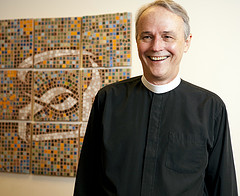
Who knew the Ivy League gem offered a wealth of free public religion events?

As a girl growing up in Point Pleasant Beach, I didn’t give much thought to Princeton University. It was the 1970s and I was, shall we say, distracted. If I thought about our state’s Ivy League jewel at all, I saw it as an inaccessable, dusty treasure chest full of academic stuffiness and snobbery.

If we’re lucky, we grow up and find out the world’s gems are much more accessable than we ever imagined. What a delight it was then, a few years ago, to learn that Princeton has a thriving faith community and offers a bounty of free public religion events.

It’s a pleasant 45 minute drive west on Route 33 and across Route 1 to the university from coastal Monmouth County and a great way to spend an afternoon or evening while enriching one’s understanding of the religious landscape. …

Read about some upcoming events here. Plus, where to park, eat, and shop in Princeton.

Lessons from Elite Leaders: Bearing Witness at Work through Generosity, Part 3 of 8 @TheHighCalling

People of faith are called to use their influence and power to work toward the common good. Laity Leadership Institute Senior Fellow D. Michael Lindsay says his new PLATINUM Study on elite leaders tells an important story about how leaders can work toward the common good through workplace generosity.

The story of David Grizzle, Chief Counsel for the Federal Aviation Administration (FAA), stood out to Lindsay from his interviews of some 500 leaders. Grizzle had a long career at Continental Airlines, retiring in 2008 as senior vice president of customer experience. (The High Calling interviewed Grizzle in 2006.)

In the late 1990s, Grizzle brokered a landmark marketing deal between Continental and Northwest Airlines that transformed the industry, according to Lindsay. Continental and Northwest sold seats on each other’s airplanes and shared reciprocal agreements in their frequent flyer programs that laid the groundwork for the mergers and consolidations that have since become standard in the airline industry. …

Read the whole thing at The High Calling.

Lessons from Elite Leaders: Mentors, Money, & Personal Devlopment, Part 2 of 8 @TheHighCalling

In part 2 of my series on lessons from elite leaders, I take on the thorny topic of leveraging relationships to one’s own advantage. Here’s a peek:

If you want to be an elite leader, you’ll need mentors, money, and personal development. Building upon research reported in his Pulitzer Prize nominated book, Faith in the Halls of Power: How Evangelicals Joined the American Elite, Laity Leadership Institute Senior Fellow and Rice University sociologist D. Michael Lindsay mined this startling new data about the factors that help elite leaders advance in their careers. In his new PLATINUM Study (PLATINUM stands for Public Leaders in America Today the Inquiry into their Networks, Upbringing, and Motivations), Lindsay reports that mentors, money, and personal development are vital to career growth. …

Find out how at The High Calling. Part 1 on limts, accountability, and marriage is here. Be sure to peruse the comments; there’s some good discussion going on.

Connoisseur for Christ: Roberta Green Ahmanson @Christianity Today

Roberta in her office

Roberta Ahmanson in her office, which is in one of three Ahmanson homes that I visited.


In its 2005 list of the 25 most influential U.S. evangelicals, Time magazine described former religion reporter Roberta Green Ahmanson and husband Howard simply as “The Financiers.” Indeed, that is what they are. But these are no ordinary philanthropists. Roberta, 61, and Howard, 60, are among a rare breed of donor who invests as much intellectual and emotional capital in the projects they support as their Fieldstead and Company philanthropy does vast sums of money. (One source who declined to be identified estimates Fieldstead’s annual giving in the low eight figures based on its projects and staff size.) While Howard’s name is at the fore of their notoriety, as heir to his father’s H. F. Ahmanson & Co. savings and loan fortune, Roberta’s passion and intellect have shaped a good deal of their giving in the
quarter century they’ve been married.

Consider Fieldstead’s $20 million investment into Roberta’s hometown of Perry, Iowa. It was Roberta’s vision that led to an elaborate restoration of the historic Hotel Pattee and the installation of an iconic downtown gateway by acclaimed sculptor Albert Paley. So too did Roberta’s vision secure Paley gates at the Orange County Rescue Mission’s Village of Hope in Tustin, California— and at the Ahmansons’ meticulously designed beachfront home in Corona del Mar. Orange County Register sources valued the home at $30–$35 million last January.

The Ahmansons’ critics focus on their support for conservative causes like Proposition 8 (their donations totaled approximately $1.4 million in 2007–2008), and for conservative thinkers like the late and much reviled Christian Reconstructionist Rousas John Rushdoony. The secular media especially have made and repeated these criticisms over the past decade.

For example, in a scathing 2004 Salon profile of Howard, “Avenging Angel of the Religious Right,” Max Blumenthal took pains to show that the Ahmansons’ ultimate goals are theocratic, a charge that has been widely disseminated. Roberta at once denies and defends the claim: “I never was, and I don’t know if Howard ever was either. I’m afraid to say this, but also, what would be so bad about it?”

Blumenthal wrote, “[Howard’s] money has made possible some of the most pivotal conservative movements in America’s recent history, including the 1994 gop takeover of the California Assembly, a ban on gay marriage and affirmative action in California, and the mounting nationwide campaign to prove Darwin wrong about evolution. . . . And besides contributing cash to George W. Bush’s 2000 presidential campaign, Ahmanson has played an important role in driving Bush’s domestic agenda by financing the career of Marvin Olasky, a conservative intellectual whose ideas inspired the creation of the new White House Office of Faith-Based and Community Initiatives.”

Meanwhile, Blumenthal described Roberta as a “warm refreshingly humorous . . . spokesperson and indefatigable guardian” of her husband. But he failed to either understand or to communicate the depth of her contribution to their work.

Howard, who has Tourette syndrome, rejects Blumenthal’s portrayal of his marriage. So do numerous sources who know the Ahmansons well and describe them as equals. “Sometimes [Roberta] has to confront me when I have Tourette-related issues,” said Howard, “but she is not really a ‘caretaker.’ ” Roberta added that the Salon profile was “full of lies” and won numerous corrections.

Furthermore, critics and supporters alike may be surprised to learn that Ahmanson is not opposed to domestic partnership rights for homosexuals. She said, “Marriage is something that has had a long definition in history. . . . The thing I’m most concerned about is that religious institutions maintain their freedom of association and their freedom of religious practice. The Catholic Church, for example, should not have to perform same-sex marriages.” After Proposition 8 was overturned, she said, “Everyone knew how the judge would rule. It’s headed for the Supreme Court. Always was.”

In 2005, The Guardian ran a sensational article titled, “Anti-Gay Millionaire Bankrolls Caravaggio Spectacular,” covering an exhibit sponsored by the Ahmansons at London’s National Gallery. The writer repeated many of Blumenthal’s charges and likewise failed to communicate Roberta’s primary role in the project, not to mention her deep commitment to the arts.

DISCOVERING REALITY

I became familiar with the Ahmanson name not through Time or Salon but at St. James Anglican Church in Newport Beach, where the couple was lauded for investing in the church’s legal dispute with the Episcopal Church. Howard and Roberta were members for a dozen years before joining Redeemer Presbyterian Church in Newport Beach, and although Roberta is currently between churches, she describes former St. James rector David Anderson, president and ceo of the American Anglican Council, as her pastor.

Meeting Roberta for the first time last winter, when she was in New York speaking at the International Arts Movement’s Encounter conference, I too found her to be a warm and generous conversationalist. Our discussion quickly turned from art and philanthropy, topics she covered in her conference talk, to mutual friends to the bipolar diagnosis that she and a member of my family share.

The interview led to a three-day stay at the Ahmanson guesthouse, where conservative luminaries like Anderson, Olasky, Thomas Oden, and Terry Mattingly had stayed before me. The well-appointed, art-filled home is located around the corner from the main residence and across the street from another that houses their private offices and Roberta’s extensive dish collection. On the weekend of my visit, Howard was driving Roberta’s red Range Rover to Hillsdale College in Michigan to collect their son David, who was completing his freshman year after a tutor-led primary education. Roberta stayed behind to host a lecture by Dallas Willard at their home. Afterward, she would meet her family in Michigan to begin a classic cross-country road trip before flying to Rome, where she would speak at a conference on Catholic philosopher Dietrich von Hildebrand’s philosophy of love. Next, they would return home and host a week-long celebration of the completion of their elaborate three-year home reconstruction, the subject of The Orange County Register’s interest.

To say Ahmanson’s passion for art permeates every space she inhabits is to underestimate her commitment. As we toured the main house, her running commentary on its extensive collection rivaled anything an art historian might offer. Although she was fighting a cold during frenzied preparations, she picked me up in Howard’s Toyota sedan to tour the Village of Hope, a traditional housing program whose Paley gates, sculpture, and stained glass showcase her artistic vision.

Ahmanson chairs the board of the five-year-old Museum of Biblical Art (mobia) in nyc and belongs to the Collectors Committee at the National Gallery of Art in Washington, D.C. She began arranging furniture and pictures when she was a young child and fell in love with painting in eighth grade, but love of art is not what drives her. Her life’s primary animating force was found in her strict Regular Baptist upbringing: her desire“to know if there was a God and if it mattered.”

She found the answer “painfully” at Calvin College, from which she graduated in 1972 before earning an M.A. in English at the University of Michigan in 1974. “When I was 21, I admitted that there was a God and that I believed Christianity was true, that it was the best description of reality. That’s how I think of it, and if there were a better description of reality, I hope, with C. S. Lewis, that I would embrace it. But it keeps proving itself to fit.

“Once you start on that path, you want to understand the world. It connects to my journalism, because what we believe shapes what we do. It shapes the art we create, the buildings we create, the institutions we create, the governments we create. All those things grow out of what we believe to be the nature of reality. So it’s the biggest question.”

Ahmanson taught (unsuccessfully, she says) in Canada before moving to California to pursue journalism. At Calvin, she had become aware of the biblical theme that we become what we worship. “We worship dead things, we become dead. We worship the living God, we become alive,” she says.
“And one of the attributes of that living God is beauty. Beauty leads us to him. We really cannot live without it.”

A mutual friend introduced her to Howard in 1984, when she was working at The Orange County Register. They married two years later. Conversations with people who minister to the poor taught her that beauty can inspire the downtrodden to improve their lives. Additionally, she says, “We live in an increasingly visual age, one in which art museums have become the new temples, art an alternative to religion. Art can serve God or be an idol. Given who God made me, it seemed that I had a responsibility to get involved in the work and the larger conversation.”

main house chapel

Stained glass window in the courtyard chapel of the Ahmanson’s oceanfront home.

This is not to say that the art she supports is saccharine or safe. Quite the contrary. The Caravaggio exhibit featured work from the 16th-century painter’s final years, after he had murdered an associate. The same newspaper that vilified its sponsors published an admiring review that said, “There is a frisson of the transgressive about Caravaggio’s art, a morbidity as much spiritual as it is—to modern eyes—sexual and social.”

Dawson Carr, the exhibit’s curator, researched online about the Ahmansons after they had approached the museum to fund Christian exhibits. The art historian was apprehensive about what he found. “I got all of the ins and outs and ups and downs and vitriol and the like, and I just thought to myself, Oh my goodness, what is this going to be like?” He discovered that the couple “may be doctrinally conservative, but in point of fact these are not ignorant, mean-spirited, nasty people the way they’re often portrayed.”

Carr also says their sponsorship of Christian art is vital and that they never tried to influence the content or presentation of the show. mobia director Ena Heller echoes Carr’s sentiments. “I have learned, sometimes the hard way, that when it comes to religion, people get very personal, very defensive, and slightly illogical, and I have never seen that with Roberta.”

ANCIENT CHRISTIAN VISION

Early in their marriage, the Ahmansons befriended Methodist theologian Tom Oden. Some 20 years ago, as they were sitting on their front porch overlooking the Pacific, Roberta asked Oden a question that would lead to one of their most significant projects: “What do you want to do with the
rest of your life?” He was taken aback, but had been thinking for several years about a major scholarly project on the ancient church fathers’ Bible commentary. He recalls, “Right quickly I said, ‘Well, this is the project that if I really could do it, I would feel I’d been most useful.’ ”

InterVarsity Press publisher Robert Fry- ling describes the resulting 29-volume Ancient Christian Commentary on Scripture series,co-funded by Fieldstead, as “the most significant publishing project in the history of InterVarsity Press.” He says it has been acclaimed by evangelical, mainline Protestant, Orthodox, and Catholic leaders, including two popes. “This extraordinary series would not have been possible without Howard and Roberta.” Meanwhile, the Ahmansons are funding another Oden project, the Center for Early African Christianity, whose mission is “to educate African leadership in the depth of African intellectual literary achievements, especially those from the Christian tradition of the first millennium.”

Roberta’s passion for journalism began when she was in high school and has continued throughout her life. She co- authored Blind Spot: When Journalists Don’t Get Religion, and Fieldstead funds two projects that relate to this interest and involve Roberta’s longtime friend Mattingly: the GetReligion blog of the Media Project and the Council for Christian Colleges and Universities’ Washington Journalism Center, which Mattingly directs.

Mattingly, for one, doesn’t think Roberta was fundamentally changed by marrying into great wealth. “The lady still reads like a tornado. She’s obsessed with the same kind of artistic and cultural and political and religious stuff. The same person that I knew as a reporter, chasing people around asking questions about all that, is frankly the same person that I know today.”

Roberta at Village of Hope in front of sculpture she commissioned

Roberta Ahmanson at The Village of Hope in Tustin, California, where she and Howard donated art and other ammenities.

When pressed, Ahmanson describes herself as a “Reformed Anglo-Catholic” and a philosophical realist. Two-thirds of the way through 2010, she had already read 74 books in the categories Mattingly mentioned, among them William Dalrymple’s From the Holy Mountain: A Journey among the Christians of the Middle East; Willard’s Knowing Christ Today: Why We Can Trust Spiritual Knowledge; volumes in the Ancient Christian Commentary on Scripture series; James Davison Hunter’s To Change the World: The Irony, Tragedy, and Possibility of Christianity in the Late Modern World; several books on the arts; several by Pope Benedict XVI; and the fiction of Frank Tallis, Jaqueline Winspear, and Henning Mankell.

Like Mattingly, Olasky knew Ahmanson before she married Howard. When they met, he was an associate journalism professor at the University of Texas at Austin working on an article for Eternity magazine. Fieldstead solicited Olasky’s help editing the Turning Point Christian Worldview Series, a 16-book collection that was co-published with Crossway Books. The Ahmansons went on to help finance (to various degrees) Olasky’s summer writing sabbaticals, international research trips, a James Madison Fellowship at Princeton University, and World Magazine, of which Olasky is editor in chief.

The second of the Turning Point books, on international poverty, emerged from a series of meetings that Fieldstead sponsored in Villars, Switzerland, and then at their California home. The meetings, Olasky says, also informed his thinking about domestic poverty and led to his influential book The Tragedy of American Compassion. Newt Gingrich commended the book in his 1995 inaugural address as Speaker of the House of Representatives, and former President George W. Bush, in the foreword to Olasky’s Compassionate Conservatism (2000), described him as “Compassionate Conservatism’s leading thinker.”

As Blumenthal noted, Howard and Roberta also have strong ties to intelligent design, which purports that life on earth is best explained by reference to a creator. “We are probably the single largest supporter of the intelligent design movement, and have been since the beginning,” said Roberta. Her perspective on theistic evolution is unflinching: She rejects it because it “legit-imates naturalism as the mode of understanding reality.” Even so, she is not a seven-day creationist, and Fieldstead funds projects at institutions that promote evolution (see “Where Does Their Money Go?” sidebar).

Ahmanson is equally un-flinching in her defense of Rushdoony, controversial in part for his belief that the Levitical laws should be applied in modern society. Roberta claims he wasn’t “the ogre” he was made out to be and explains his theodicy as a response to his family’s flight from the Armenian genocide in Turkey. “His whole life project was to try to figure out what could protect you. In the end, he came down to the only thing that is solid is God’s law. Well, you say the word law in the 20th or 21st century, and people break out in a rash.”

Peb Jackson, the principal of Jackson Consulting Group, has known the Ahmansons throughout their marriage. When I asked him about their connection with Rushdoony, he said he hadn’t thought about it in years, but, upon reflection, said, “I think they were perhaps a little bit zealous in reference to their powerful support for Rushdoony in that effort. It’s really a reflection of the passion that they bring to wanting to focus on the forces in culture and society and faith, and wanting to use their God-given resources to influence those forces.”

When asked if it bothers her that their philanthropy is often overshadowed by criticism of their activism, Ahmanson said, “It used to bother me. My husband, for one thing, became a Democrat [in 2009], and he’s much more complicated than this kind of cardboard figure that they try to create. Even The Guardian must have figured it out, because they didn’t do any scare kind of stories about ‘The Sacred Made Real’ exhibit we sponsored at the same museum [in 2010]. They just left it alone, and the show got nothing but rave reviews, including one in The Guardian.”

Fred Smith, founder of the Christian philanthropy group The Gathering, says the Ahmansons are generally ten years ahead of their peers in Christian philanthropy. He mentions their foundational support of the pro-life movement in the 1980s, as well as their art patronage and interest in the early church. Smith thinks people don’t realize how much Roberta has changed. When he first met her, he says, “She would get angry and just kind of stomp out of the room figuratively and say, ‘You guys are never going to get it.’ I think over the years, she’s learned to temper that a great deal.”

Smith attributes some of Roberta’s early frustration to the transition from religion reporter to wealthy patron. “In some ways, she responded by saying, ‘Now I have a bully pulpit,’ and then went through some of the painful experiences of finding out that you can burn some bridges with this new bully pulpit until you get comfortable with it.” He adds, “I think everybody assumes that wealth brings perfection and omniscience. Sometimes the wealthy foster that myth as much as anybody. She’s had to grow up and stumbled around some in that, but I think she’s growing up. She’s not against things as much as she’s now for things. I think that’s made a big difference.”

Roberta Ahmanson is a force of nature. She brings intelligence, passion, conviction, and energy to the projects she pursues, and yet, she is defined even here in terms of Howard; with characteristic mirth, she declares she is amused by this fact. “Well, I am his wife and it’s a very important part of my life,” she offers. But she is so much more.


Where Does Their Money Go?

Roberta Ahmanson identified her and her  husband’s most significant beneficiaries:

• The Ancient Christian Commentary on Scripture
• The Discovery Institute’s Center for Science and Culture
• The Center for Advanced Studies in Culture at the University of Virginia
• Orange County Rescue Mission’s Village of Hope
• Perry, Iowa (Roberta’s hometown)
• The Museum of Biblical Art
• Faculty development grants at Biola University
• The Center for Early African Christianity at Eastern University
• The Pacific Symphony’s Class Act Program
• The National Endowment for the Arts intern sponsorship in the chairman’s office
• The Dietrich von Hildebrand Legacy Project
• The Christian Community Development Association
• Food for the Hungry

Recent 990 tax forms for the Ahmanson Charitable Community Trust and Fieldstead and Company include donations to:

• Pepperdine University
• Survivors of the Shoah Visual History Foundation
• International Arts Movement
• Association for Community Education
• Breast Cancer Awareness Foundation
• World Food Prize Foundation
• Heartland Film Festival
• map International
• Trinity Christian Community (New Orleans)
• The Media Project


*This article first appeared in the January 2011 issue of Christianity Today.

The High Calling of Journalism: A Candid Interview with Philip Yancey @The High Calling

Philip Yancey is the author of 20 books that have sold more than 15 million copies in 35 languages. Thirteen of his books have won Gold Medallion awards from the Evangelical Christian Publishers Association (ECPA) and two, The Jesus I Never Knew and What’s So Amazing About Grace? were selected as ECPA Book of the Year. Yancey worked as a journalist for 20 years. He was editor and eventually publisher of Campus Life magazine. For many years, he wrote a monthly column for Christianity Today and still serves the magazine as Editor at Large. Yancey lives with his wife in Colorado, but travels internationally in search of compelling faith stories. The High Calling interviewed him about his vocational calling and his latest book, What Good Is God? Here’s a bit of the interview:

Christine SchellerWhat Good Is God? seems like a different book to me than your previous books.  I don’t recall you ever doing a collection of speeches with commentary before.

Philip Yancey:  I couldn’t find a model of a book that had combined journalism and related speeches in context.  So, it may be a different book, period.

Christine Scheller:  How did you come up with the idea?

Philip Yancey:  It came about after my wife Janet and I were involved in the Mumbai situation that I wrote about in the last chapter.  I was scheduled to speak downtown the night of the terrorist attacks in which 175 people died.  Our meeting was canceled, of course.  Instead, a smaller group of people spontaneously came together in a church and asked me to speak to them.  I looked out over that shocked and grieving audience—what could I say?

It was such a traumatic experience. When we left, I realized that I’ve been in all sorts of interesting situations.  It actually reflects what has happened to my career apart from my desires.  I feel most comfortable as a journalist taking notes, interviewing people and writing. I’ve done it for so long and have had so many books published that people started seeing me as a content person, as someone who could guide them. This was an identity crisis for me about ten years ago.  One way I resolved it was to accept overseas assignments, because I just don’t like the celebrity culture in the United States. Internationally, people are very grateful to have someone come and speak.  Because of the conditions in the places I visit, I generally don’t feel like I’m being pampered. So, it seemed like a healthier way to handle the success I’ve found in writing. …

Read the whole thing here.

Finding Comfort Where None Is To Be Found @TheHuffingtonPost

I was asked to write something about spiritual comfort after shocking sudden death for the HuffPost Religion channel, and only had a few hours to do it. Here’s what I came up with:

It took me all weekend to get used to hearing the name Gabrielle Giffords reported in the tragic context of the Tuscon shootings. Not only was the event horrific, but I also couldn’t shake the similarity of the congresswoman’s name to that of my late son Gabriel Gifford Scheller. The endless stream of news triggered a wave of memories from when police showed up at my door in the early morning hours of March 29, 2008 to report that Gabriel had killed himself. The horror of an event like that is so vast that unless you have lived through one like it, you can’t truly comprehend it. One moment, life is mundane, ordinary, perhaps even joyful. The next, it is torn to shreds so completely that you believe with every ounce of your being that it is over. At least I did.

And I was right, in a sense. Everything I thought I believed was called into question and everyone I thought I trusted was placed into one of two categories: safe or unsafe. Safe people didn’t say much and if they did, they most certainly did not speak in spiritual platitudes or pronounce judgment on the situation or on my son. Unsafe people did and do pretend to understand, minimize the horror or its impact, express some perverse need to identify with it, or otherwise just creep me out.

My husband had absolute peace that Gabriel was with God, but he really struggled with flashback images of how Gabe killed himself. I didn’t wrestle as much with our son’s final moments as I did with where he is now and why he did what he did. A friend who is a psychiatrist counseled me early on to give up the second battle because, he declared, “Suicide is inherently an irrational act; it will never make sense.” (Likewise, random acts of public violence.) A Lutheran pastor comforted me by saying that how we die doesn’t determine where we spend eternity.

Over the past couple days, I have heard the tragedy in Tuscon blamed on irresponsible political rhetoric and mental illness, neither of which provide satisfactory answers. In situations like these, we long for some kind of solace, for someone to tell us we and our loved ones are safe. In D. Michael Lindsay’s book Faith in the Halls of Power, former George W. Bush speechwriter Michael Gerson is quoted as saying, “When people are presented with entirely unfair and unreasonable suffering, the president of the United States has to assure them … that the universe has meaning, and that the universe is not an emptying, echoing void.” Gerson goes on to say that complaints about politicians’ use of religious rhetoric don’t often emerge in the context of public tragedy. Thus we waited for our president to speak.

We don’t want just anyone to tell us that everything will be okay both in this life and in the next; we want someone with authority to say it. My husband, a former pastor and longtime Bible teacher, was too paralyzed with grief and shock to attend to the practical details of our son’s funeral, but he was able to get up and spontaneously preach a mini-sermon that comforted many, including me. I couldn’t access my faith, but I was able to take comfort in his. Conversely, as he struggled with those terrible mental images, I shared with him something that had helped me when I kept mentally replaying the final moments of friends who had died in the terrorist attacks on Sept. 11, 2001. I realized one day as I was praying that they had only lived through the horror of Flight 93 crashing to the ground for an instant and then it was over. The same was true for Gabe’s final moments.

An old friend also sent me a note encouraging me to take solace in beauty wherever I could find it. As I took her advice, the beauty around me ministered to me and reminded me, as Gerson suggests, that order coexists with chaos. The universe is not an emptying, echoing void. A glorious California sunset would break through the kitchen window as tears flowed over the dishes I tried to do. The bougainvillea came into bloom despite my grief. My other son, who had been suffering from clinical depression for five years, finally received a correct diagnosis and the help he needed. We moved home to New Jersey and to the warm embrace of the family and friends we had missed so much when we lived out west.

There was good to be found, but none of it made up for, or brought meaning to the loss. It co-existed (co-exists) with it. Violence, whether it be self-inflicted or directed outward, teaches us that ours is an undeniably broken world. Yet even in this horrible moment when one young man walked into a crowd and shattered the lives of so many, another ran toward the bullets to provide triage to his wounded boss and to others around her. Three people conspired to stop the gunman as he struggled with his weapon. In a split second everything changed again. For him, for the people present, for their families, for his family, for the Congress, and for us. As we haggle and fight over what happened and about what needs to be done in light of it, may we not forget the sustaining beauty that exists in every moment we are privileged to live on this earth. Even the dark ones.

Check out what HuffPost readers are saying here.

Prosperity Gospel: Will Jesus Buy Me a Double Wide or What? @TheHuffingtonPost

I had a great time interviewing Karen Zacharias for this article. She’s not only a wonderful storyteller who writes about things that matter, she’s also feisty, generous, and smart. You should read her book; it’s engaging and thoughtful. I’m following it up with her memoir: After the Flag Has Been Folded: A Daughter Remembers the Father She Lost to War—and the Mother Who Held Her Family Together. Here we are, two incredulous faith-filled women, taking on the prosperity preachers:

In her new book, Will Jesus Buy Me A Double-Wide? (‘Cause I Need More Room For My Plasma TV), veteran journalist Karen Spears Zacharias takes on prosperity gospel hucksters. What began as a humorous look at a troubling phenomenon took a serious turn when the U.S. economy tanked in 2008, and another when Zacharias lost her job. Prosperity preaching wasn’t just something to report on; it was a personal attack on her faith.

I know what that’s like. After Janet Jackson scandalized U.S. audiences by exposing her breast at the 2004 Superbowl, I wrote an essay on the indecency of Christian television. In it, I critiqued a married televangelist couple’s shows. A producer from one of those shows invited me to be a guest for what she thought would be a “lively discussion.” I politely declined. The host e-mailed me directly. She took me to task, saying my article was misleading and that I was pompous. Never mind that she had claimed gold was literally raining down in her studio in one of the episodes I examined. She wrote, “The bottom line is that you have a small theological box that you live in and it wouldn’t matter what I said because until you open your mind and heart to the supernatural things of God, you will be quite content writing your cynical judgmental articles and watching your public television station,” which her network was suing to purchase against its wishes.

In her trumped up thinking, the fourth estate is spiritually bankrupt. I don’t see that any more than I saw the gold on my TV screen. Instead, I see prosperity theology as truncated, deceptive and dangerous, as do many Christians and as does Zacharias. In the introduction to her collection of stories about how people view the relationship between God and money, she writes, “It’s a terrible theology for the poor and downtrodden. When hard times hit, it must mean that God is put out with us. We’ve been unfaithful or otherwise not measured up.” Her scope is broader than any particular denomination, however. “We Americans,” she writes, “want to believe that God loves us best of all and that all of our nation’s riches are the result of our faithfulness to God. … Entitlement theology may very well be the bastard-child born from the mating of Calvinism’s strong work ethic with Capitalism’s get-all-the-goods-you-can mentality.” Ouch!

Zacharias is a braver woman than I am. She did a 700 Club interview about her book with Pat Robertson’s son Gordon. As the interview unfolded, Robertson said, “In reading your book, I notice that you don’t particularly like TV preachers and I was trying hard not to take it personal, but you’re really starting to skewer some of my friends in here.” To which Zacharias retorted, “Some of your friends in there deserve to be skewered.” A friendly debate about Joel Osteen ensued and Zacharias concluded, “When you go before the masses and tell them that their ‘best life now‘ is tied up into the things that they own, the size of their garage or anything materially oriented, I think you’re missing it.” In the book, she says, “If there’s a secret to living your best life now, it’s this: Stop imagining all the ways in which the universe can serve you and start figuring out how you can serve others.”

I talked to Zacharias as she was preparing to travel from her home in Oregon to Washington D.C. for board meetings of the Vietnam Veteran’s Memorial Fund and the Vietnam Women’s Memorial Foundation. She serves both organizations for good reason: her father was killed in Vietnam when she was just a girl. (She tells that story in her memoir, After the Flag Has Been Folded: A Daughter Remembers the Father She Lost to War — and the Mother Who Held Her Family Together.)

She said, “The thing I’m trying to address here is not just about money. It’s about saying to the 14-year-old girl whose father died in Vietnam that I didn’t measure up, that I wasn’t enough or that my mother wasn’t. [There is in prosperity theology] no taking into account that the Vietnam War had more to do with capitalism than it had to do with Christianity.”

She continued, “The problem with the whole formula of God’s faithfulness plus my obedience equals untold riches is that it’s a great formula as long as life’s going your way. …The moment it all comes crashing down, you don’t have a faith because that God doesn’t exist anymore.”

One of the many compelling stories Zacharias tells in Will Jesus Buy Me A Double-Wide? is about a friend of hers who she calls “the Redhead.” After the Redhead was diagnosed with cancer, her husband lost his job. She cleaned houses so they could afford to attend their child’s wedding in Australia. Zacharias grew up in a single-wide trailer and yet couldn’t imagine herself cleaning other people’s toilets, much less envision her elegant friend doing it. The Redhead told her that she prayed for her clients as she did her work. “It’s a kingdom choice to live with a grateful heart in the midst of all this,” she said. Zacharias reflects, “That’s not the power of positive thinking; it’s saying, ‘No matter what, I trust You.’ …That seems to me to be what faith is about.”

I’ve always thought that if I could have faith in light of other people’s suffering, then I best not second guess it in the face of my own. Zacharias and I have this in common. The television host and me, not so much; she closed her e-mail by saying she was content to let God judge between us and hold us accountable for our sins. I’m pretty sure that was a prayer for God to rain judgment down on me.

Check out what Huffington Post readers are saying here.


The Abortion Debate: Open Hearts, Open Minds and Tragedy as a Fair Minded Word @TheHuffingtonPost

Fordam University bioethicist Charles Camosy introduced Open Hearts, Open Minds and Fair Minded Words: A Conference on Life and Choice in the Abortion Debate at Princeton University on October 15, 2010 by saying that it wasn’t the conference any of its organizers wanted or envisioned. Instead many compromises were made between him and his colleagues Peter Singer (Princeton), Frances Kissling (University of Pennsylvania) and Jennifer Miller (Bioethics International) as they thought about how to find common ground amidst the debate.

In his introduction, Camosy, who is pro-life, outlined three goals: 1. better map disagreements; 2. find common ground across divides; 3. have open hearts and open minds. Kissling, who is pro-choice, compared her pre-event anxiety to preparing for a wedding that both families believe is a horrible mistake. (Perhaps such fears were eased as the conference unfolded because there were security guards at the doors on the first day but not the second.)

After the conference, Camosy described it as largely successful in meeting these goals despite pockets of incivility, while Evangelical participant David Gushee (MacAfee School of Theology, Mercer University) described it as an audacious attempt that largely failed to find common ground.

Gushee was on the first panel, “Bridging the Abortion Divide: Recurring Challenges, Emerging Opportunities,” with his Common Ground colleague Rachel Laser, Mary Jacksteit of the Public Conversations Project (which initially attempted to bridge the abortion divide in the 1990s) and both Kissling and Miller. While I learned a lot from each discussion, theirs was the only one I attended that didn’t devolve into a remix of worn-out debates. Perhaps this is because all five speakers were already committed to the goal of exploring shared values.

Laser (who is pro-choice) and Gushee (who is pro-life) became friends through their work on an abortion governing document that was submitted to President Obama’s transition team. They described themselves as comrades in arms who bonded as they fended off friendly fire from their respective sides.

In his opening remarks, Gushee described abortion as a tragedy. Kissling objected to this definition. She said the moral right of women to make decisions about reproduction is essential for them to be recognized as human beings and while she respects the “category of fetal life,” she doesn’t “have a sense of individual fetuses as possessing high value.” Even so, she’s troubled by what she sees as a coarsening of discourse over the issue.

Gushee’s use of the term tragedy initially struck me as emotionally loaded too. I did not choose abortion when I had an unplanned pregnancy, but several members of my social circle did in similar circumstances and only one of them seems to have experienced it as a tragedy. The rest have occasionally communicated feelings of guilt about their abortions, but not regret.

I have written for Christianity Today from a strongly pro-life perspective and yet I’m not sure I ever thought of abortion as tragedy either. Instead, I’ve thought of it and continue to think of it as morally wrong. When I think of tragedy now-a-days, I tend to think of my son Gabriel’s suicide. The issues are related in that he didn’t have the right to take his own life any more than I had the right to take it and yet they are different because he was mentally impaired by Depression when he did so. (Despite notions to the contrary, the American Foundation for Suicide Prevention says suicide is overwhelmingly a function of mental illness rather than free will.)

Because Gabriel’s death left his brother with no siblings in this world, I’ve become increasingly grateful for his cousins, several of whom were conceived outside of marriage and whose biological parents either never married or married and later divorced. That is a different kind of heartbreak, and yet all these young people are flourishing as are our bonds with one another despite the complications and pain common to all blended and broken families.

My gratitude for them has gotten me thinking about those other children who are missing from my social network because of abortion. I experience Gabriel’s death as tragic because I had the opportunity to know and love him, while I experience those children as mere absences because I never got the chance to know them. I’ve subjectified them as thoroughly as Kissling has.

This is an oft-cited problem with discussions about abortion that pit the life of the unborn child against the welfare of the mother. Women can speak for themselves while unborn children can’t and we are incapable of fully comprehending what we are missing, even if we can glimpse it from the joy other children bring us.

I talked to Gushee about his use of the word tragedy. He said it may not have been the most philosophically precise description, but he was trying to communicate that abortion reflects a deep brokenness in the human condition. This sounds exactly right.

When I think about how tragic my son’s death is, I’m reminded that I would much rather live with the anguish it causes me than envision a life in which I never knew him. Abortion is a tragedy in and of itself, regardless of whether or not we as individuals or we as a society feel that it is so.

1 Corinthians 13:12 says we see things imperfectly in our finite understanding, but one day we will see with perfect clarity. Only then will our perception of abortion match reality.

Check out reader reaction to this reflection at The Huffington Post.

The Politics of Hunger @UrbanFaith

Ambivalent about exercising your patriotic duty on Tuesday? I was too, until I interviewed the winner of the World Food Prize and learned why this election is so important to hungry Americans. Here’s the intro:

Hunger is a devastating problem in third-world countries, but according to Bread for the World president David Beckmann, one-quarter of all African Americans live in poverty right here in the U.S. That’s why he believes vanquishing poverty should be at the top of our “Christian” political agendas — and why he’s urging people to vote on Tuesday.

David Beckmann is president of Bread for the World and the recent winner of the 2010 World Food Prize. In addition to being an anti-hunger activist, he is a Lutheran minister and an economist who formerly worked at the World Bank. His latest book is Exodus from Hunger: We Are Called to Change the Politics of Hunger. UrbanFaith columnist Christine Scheller interviewed Rev. Beckmann about his work, hunger in the African American community, and why we should be aware of the federal policies that influence issues of poverty in America. …

And a compelling exchange from our conversation:

I tend to think that living in the United States, hunger is more invisible. How has it changed you working for the World Bank and Bread for the World?

What’s most striking is that the world as a whole has made remarkable progress against hunger, poverty and disease. I believe in God and I see that hundreds of millions of people have escaped from poverty in places like Ethiopia, Bangladesh, Brazil and Britain. That’s why, for me, it makes sense that this is God moving in our history. And then I come back to the U.S.A. where we haven’t made any progress against hunger and poverty since about 1973 and it informs, I think, the U.S. situation. If Brazil and Bangladesh can reduce poverty, it’s clear that we could do it in the U.S. We just haven’t tried for a while. But we did try as a nation. In the ’60s and the early ’70s, we had economic growth and we had a concerted effort under both Johnson and Nixon to reduce hunger and poverty and we cut poverty in half. So it’s doable here too. … I think the fact that we work on world poverty and domestic poverty together makes it all much clearer that our problem in this country is lack of commitment.

Read the whole thing here, and don’t forget to vote.

This interview was reprinted with permission at The Huffington Post on November 2, 2010.

Flashes of Light in the Darkest Depths: The Faith and Life of Blind Photographer Pete Eckert @TheHuffingtonPost

Pete Eckert is a unique artist featured in the documentary Dark Light: The Art of Blind Photographers. I reviewed the film earlier this year and talked to Eckert afterward about his spiritual and artistic journey. Here’s our conversation, edited for space:

Christine A. Scheller: As you know, I was exposed to your work through the documentary Dark Light, which is about blind photographers. Do you have any vision at all?

Pete Eckert: No. I have some light perception, but I also have phantom things that go on like crackling lightning and spirals. Somebody comes up and makes a loud noise; I get a big burst of white light come across my vision.

Christine A. Scheller: Do doctors have an explanation for that or is it just something going on in your brain responding to the noise?

Pete Eckert: The last 25 years or so, I’ve been actively rewiring the optic cortex. And so, it doesn’t surprise me when a sound will generate a visual effect. Somebody comes up and I don’t hear them and they grab hold of my shoulder, or if there’s a loud noise, I get this burst of light. That’s, I think, direct evidence that there’s a cross-over between sound, touch and vision.

Christine A. Scheller: What condition caused you to lose your sight?

Pete Eckert: I have Retinitis Pigmentosa (RT). My life is divided very neatly into two sides. I started to go blind when I was 27 or so. I had 210 degrees of vision. I dropped down to 90 degrees within just a couple of months. But I had 10 years of some central vision. I was legally blind, but I was a foreman of a construction crew at that time. I could shoot at the top of National Rifle Association pistol competitions. I made a lot of use of my central vision.

Christine A. Scheller: Was that a terrifying experience to go through?

Pete Eckert: It’s very emotional. RP is very cruel. You adapt and then some more vision gets taken. You adapt again and some more vision gets taken. Depending on how long it takes for you to drop down into complete blindness, you’re always suffering a loss. It’s as if you are watching yourself die.

Christine A. Scheller: What sustained you through that continual sense of loss?

Pete Eckert: That’s hard to say. I refused to accept blindness. I always pushed out into the world. When I got my first guide dog, we had some mishaps. I almost got run over by a train. A number of cars almost hit us. It was very difficult to adapt. Finally, at one point, I just decided my independence and freedom [are things] I’m willing to die for.

Christine A. Scheller: Did your Christian faith help you deal with the losses?

Pete Eckert: Perhaps, perhaps. I’m not really sure. I could see that something was taken, but something was given. You could call that faith. … I base my life on the Ten Commandments. But then, also on the tenets of Tae Kwon Do: Courtesy, integrity, perseverance, self control, and indomitable spirit. The tenets that I just rang off there, they’re just reflections of the Ten Commandments. A lot of them, if you thought about it, they fit together. A lot of Christians, they forget to be courteous. And then, when you run into trouble, you don’t give up–you know the indomitable spirit.

Christine Scheller: You were a visual artist before you went blind. At what point did you begin doing photography?

Pete Eckert: After I was totally blind.

Christine Scheller: How did that come about?

Pete Eckert: I was looking through a drawer and I came across my mother-in-law’s old camera. … I like mechanical things. I was fooling with it and my wife came home. I had her explain what all the settings were. There was an infrared setting on it. …I have a corny sense of humor. A blind guy doing photos in a non-visible wavelength, that just cracked me up!

Christine A. Scheller: Your process and your photos are so meticulous and ordered that it’s obvious you have a particular vision in mind. Tell me about that.

Pete Eckert: Vision is a slow process. Babies, when they are learning to see, don’t fully comprehend what their eyes are bringing to them. Sighted people, if they’re sick or preoccupied, are not getting all the data from what they’re seeing. So getting vision from sound is like low resolution detail. As I sit in the room I’m in right now, I can hear the clock going off. The sound’s bouncing off the walls; I can tell exactly where my dog is; hear the arms on the couch. Sound paints an image. It does give you the details of your surroundings.

Christine A. Scheller: Did you research sound or you just figured this all out from your own experience?

Pete Eckert: From my own experience. Now there are fancy studies on how the brain works and how blind people can do this and that. It’s pretty much documented. I was just going by the fear of blindness on my own. Once I realized and I was so quickly able to adapt, I figured, “I know I’m going to go blind; I don’t want to go blind; how can I provide a mind’s eye image?”
When I walk upstairs now, I don’t count the stairs; I listen. When I get to the landing at the top, I hear the opening. I used to teach martial arts. Learning to spar at full speed is a very good test of how fast can you change the sound into an image, because if you don’t do it fast enough, you’re going to get tagged.

Christine A. Scheller: How do you know if your work turns out the way you’d like it to?

Pete Eckert: Think of the process broken into two sides: The event and the product. As I build the image–it’s in my mind’s eye–so I know when to stop. I know what I’ve done by sound and touch. I know where I was and where everything is. I develop the film. I take the picture. I do the contact sheets. Then I get some feedback. It could have a technical problem, say, I left the lens cap on and there’s nothing there and if I brought it to the lab and said, “I want this to be two feet by two feet.” I’d be throwing money away. So, this is economics. I listen to a description and match it up with my memory–and so, did I get what I intended to get?

Christine A. Scheller: So you’re matching that feedback to the image you have in your mind and that you want to project.

Pete Eckert: Right. I’m looking for confirmation. I let the people talk–it’s a gift that they’re giving me. Feedback is a gift. Communication is a gift. And so, I let them speak as much as they want. Some people go like, “Oh, this is really scary. I wouldn’t want this in my house.” Even a negative response I think of as a gift…. I’ve got a whole bunch of work that never has been printed. People either like [my work] or they really don’t.

Christine A. Scheller: The images I saw are really fascinating. One is called “Stations” and the other is “Cathedral.” Were they made while church services were going on?

Pete Eckert: “Stations” was not. There were a few people in the church, but they weren’t in the photo. “Cathedral” was done during Christmas Mass. There was a whole lot of work that went into that. I did a film test to figure out how much light was needed. Everything that I could touch, as far as my hands would go, I touched. I memorized the layout of the church. I know the sequence of a Mass. I know when what happens. …

The parishioners weren’t too pleased that I was setting up to shoot and I knew they wouldn’t be. I wore my best clothes–coat and tie. I washed the dog. (I had a beautiful black German shepherd then.) I also had the knowledge that Father Anthony was a friend of mine and he supports what I do.

A few parishioners came, and they said, “You can’t do this.” And I said, “Yeah, I did it last year,” which was true. And they went away. Then they came back and said, “You can’t use a flash in here.” I said, “No problem, I never use a flash.” They went away. And then, they said, “Do you have permission to do this?” And I said, “Yes, from above.”

If you think about it, the Franciscan Church–its mission is to help the poor and disenfranchised. A blind person who has learned a method to see, who is more disenfranchised than that? Who should they support? They went to [Father Anthony] and I think he just said, “Leave Pete alone.” When Communion came up, Father Anthony came [off] the altar. He came to my wife and I, served us Communion, and then went back up and served the rest [of the] probably 800 people there.

Christine A. Scheller: That sends a message of affirmation.

Pete Eckert: Exactly. He was teaching the parish.

Christine A. Scheller: What were you trying to communicate?

Pete Eckert: The Spirit in a church. I had tried to find a way to show the Holy Spirit. It’s very elusive. And so, this isn’t a direct attempt for the Holy Spirit, but it’s a direct attempt to show spiritual feeling in the church.

Christine A. Scheller: And the “Stations” image–what were you going for there?2010-10-09-STATIONS.jpg

Pete Eckert: This is a little bit more controversial. If you look at the guy’s feet, he’s wearing duck boots. The Catholic Church is having a lot of problems right now. There is a lot of controversy. The duck boots are for walking through the muck and mire of controversy. Remember I have a corny sense of humor!

Christine A. Scheller: Yeah. Now, I have to look at that again, because you really do! Are you Catholic?

Pete Eckert: I don’t know.

Christine A. Scheller: Were you raised Catholic?

Pete Eckert: Yes.

Christine A. Scheller: What are you working on right now?

Pete Eckert: I’m working on a series. It’s multiple exposures. What I’m doing is I’m showing the sighted world with people ghosting out and cars whizzing around, and then, in my studio, I’m dropping in these kind of wild figures…. I’m trying to show how it feels to be a blind person in the sighted world.

If you think about it, as I’m around people, I can hear them. I can place them. But, since I can’t see them, they could be spirits. They could be an apparition. … And so, some of the misinformation or misinterpreted information–I let that go into my photos. Even when I was sighted, if I was preoccupied or sad, I wasn’t getting the same data from my vision as I was if I was happy and very attentive.

One time I was at a crosswalk and the light changed and the guy standing behind me started yelling, “Go, go, go!” I wouldn’t move and he started to step out around me and stepped as if he was going to step into the street. I reached forward and grabbed his shoulder and yanked him back. A car whizzed in front of him, and he went, “Oh.” And, he didn’t thank me for saving his life or anything.

Christine A. Scheller: Well, I want to thank you for inviting me into your world and the fascinating world of blind photography. You have much to teach those of us whose sight is limited by our vision.

Check out reaction to this interview at The Huffington Post.

Ordained Into Wet Cement: What Does ‘Anglican’ Mean? Not @TheRevealer after all

Way back in August, when Becky Garrison wrote a little article “Ordained Into the Abstract: What Does Anglican Mean?” for The Revealer, which describes itself as “a daily review of religion and media,” I tweeted that I disagreed with her point of view and her description of evangelicals in the piece. An editor at the review direct messaged me asking if I would consider writing a response, which I did. Amidst the busy September religion news cycle, my response was left to grow stale.

Then this weekend, while I was tweeting away at the Religion Newswriters Association annual conference in Denver, I received an email from the editor asking me to revise my response. She said she could intuit from the piece what my political positions are on homosexuality and women’s ordination and she challenged me to come out with them and speak up for injustice where I find it. I replied that people choose their churches for complex reasons and that it would be wrong to assume anything about my positions based on where I go to church, because I’ve never entirely agreed with the values of a church I’ve attended and that remains true now. I also said that as a journalist, I feel no responsibility to be on the record about all any of my personal convictions.

As it happens, on the way home from Denver, I read an article about Anglican-Episcopal splintering over homosexuality in a lofty religion journal. The writer did a good job giving voice to both sides of the issue, but I could easily discern from the sources he quoted in his sidebar and who he gave the last word to in the main article that his sympathies lie with liberal Episcopalians on this issue. It also happens that Facebook recently suggested this writer as a “friend” for me. From his profile picture with another man and the comments that accompanied it, I just as easily discerned that he is gay. I wondered as I was flying through the night if the neutral tone masking his personal stake in the issue isn’t more of a problem than terminology or my own unwillingness to state a bias that I do not possess about an issue in which I have much less personal stake. It all seems so odd to me.

In the end I decided that the revisions the editor requested would be too time consuming, given that I will not be paid for the work. So here is my very stale response to Becky Garrison’s contention that it is wrong to call breakaway priests and churches Anglican.

In her Revealer article, “Ordained Into the Abstract: What does ‘Anglican’ Mean?” my friend and fellow Episcopalian, Becky Garrison, says the term Anglican has been distorted by conservative evangelicals and traditionalists who have left the Episcopal church over the issues of homosexual ordination and the blessing of same sex unions. She views the alternate bodies they’ve created as imposters and wishes media outlets would stop bestowing the purebred label on these rogue priests and provinces.

I do not pretend to know what’s in the minds of others, but I do know that the Episcopal Church’s decisions regarding homosexuality are viewed as symptoms of the denomination’s departure from orthodoxy rather than its cause by many conservatives. Becky knows this. It diminishes discourse, in my opinion, to misconstrue the motives of those with whom one disagrees.

We’re all guilty at times of careless generalizations, but when Becky links to an interview by fellow Episcopalian David Neff in Christianity Today as a kind of circumstantial evidence of media complicity in this crime, I must cry foul on her crying foul. What her assessment sounds like  is less a critical analysis than an ardent fan blaming a biased umpire for deciding a call in the other team’s favor.

I myself was confirmed an Anglican at St. James Church in Newport Beach, CA, when it was affiliated with the Diocese of Luwero, Uganda, after it left the Episcopal Church. When my membership was transferred to an Episcopal church last year, the diocese didn’t question the validity of my confirmation or ask me to be re-confirmed now that St. James has aligned itself with an upstart North American Anglican organization. It’s a good thing too, because I would have refused. However much our presiding bishop disagrees with traditionalists, he still apparently views us all as Anglicans. Why the Rev. Doctor Maggi Dawn (who Becky cites) should hold more sway in regard to who is and who isn’t an Anglican than him or Ugandan Archbishop Henry Luke Orombe under whom I was confirmed, I cannot imagine.

If Becky wants to appeal to an individual at all, perhaps it ought to be Archbishop of Canterbury Rowan Williams, who, in the wake of the Episcopal Church’s consecration of its second gay bishop said her election “raises very serious questions not just for the Episcopal church and its place in the Anglican Communion, but for the Communion as a whole.”Additionally, the Anglican Church issued a statement to the Episcopal News Service saying the consecration “shows that the TEC [the Episcopal Church] has now explicitly decided to walk apart from most of the rest of the Communion.”

Now, I respect the fact that Becky is a cradle Episcopalian while I am a church hopping mixed-breed evangelical, but I honestly don’t get her appeal to Anglican history either. Ours is a branch of Christianity that was founded in dissent and our democratic forbears were given special consideration, not to mention a unique name, because it was impossible for them to swear fealty to the English crown. We North American Anglicans are, for better and worse, acting in accord with our heritage, both political and ecclesial. In attempting to widen her argument to include Newsweek’s use of the term Presbyterian to describe Redeemer Presbyterian pastor Tim Keller, Becky demonstrates nothing so much as that denominational splintering is writ large in Protestant DNA.

Had my friend appealed to the 1930 Lambeth Conference statement as Anglicans Online did instead of maligning evangelicals and appealing to Lambeth generally, I might have given her argument more sway, though I still would have disagreed. Here’s how Anglicans Online describes its decision to label The Anglican Mission in the Americas (AMiA) as “Not in the Communion”:

“When a person or parish leaves a national church, for whatever reasons—doctrinal, personal, spiritual, theological—it does just that: it leaves. The leaving is tantamount to saying: ‘This entity has become something I can no longer be a part of’. That decision prima facie breaks communion.

In these days of easy transport and effortless technology, of course it is possible to virtually affiliate with another part of the Anglican Communion that seems to be more in line with one’s own thinking. But unless one physically moves oneself or one’s parish to that geographically-defined national church, one cannot claim to be in communion through some sort of virtual relationship.

Perhaps the definition of a national church or province will need to be altered, to take into effect the increasing globalisation of the communion through the Internet and what that means to the understanding of ‘diocese’ or ‘episcope’. As yet, that redefinition has not taken place.”

But can redefinition be far off?

A more interesting subject for this type of critique would be The Huffington Post Religion channel headline: “Interview with Toni Tortirilla, Female Catholic Priest.” The accompanying Religion News Service (RNS) article clearly states that Tortirilla was ordained in the Roman Catholic Womenpriests movement. It proceeds to say that “within a year of her 2007 ordination, the Vatican said women who attempted to be ordained—and those who tried to ordain them—were automatically excommunicated.” The Pope can do that sort of thing, so it seems to me that The Huffington Post is being intentionally provocative in describing Tortirilla as a Catholic priest. In comparison, describing internationally recognized Anglicans by their preferred name isn’t controversial.

While Becky advocates careful use of terms, she herself is careless. In her conclusion, for example, she writes, “This battle over the blessing of same sex unions and ordination of gay clergy needs to be placed in the larger context of the culture wars being waged by fundamentalist Christians against the rising forces of ‘secular humanism.’ In the eyes of these righteous warriors, their chief enemies are feminists, gay activists and others who advance what they perceive to be the ‘secular humanist’ agenda.” Suddenly she is no longer talking about evangelicals involved in an intra-denominational dispute. Now their actions are a function of fundamentalists fighting secular humanism. As an evangelical Anglican, I must protest.


On Quitting the Circus & Coming Home to the Jersey Shore @HuffingtonPost

A while back I was invited to blog for The Huffington Post Religion channel. I had a nice conversation with an editor who I’d met in 2008 at a professional event. I sent a couple emails in reply and heard nothing back. I submitted the post below last week and heard nothing back. I called and left a message for the PR guy who emailed me when the channel went live and heard nothing back. So I’m posting my introductory The Huffington Post post here. Perhaps someone at The Huffington Post will discover it and get in touch, either to tell me that they want it and/or me or that they don’t. Either way, this lighthearted, but very serious post reflects my current spiritual convictions and my current state of mind, which is contentedly and resolutely conflict averse. So,  if you’re reading, just pretend you are at the swarming open-source site being introduced to me for the very first time. Here’s what I’d have to say:

I was sitting on the front porch of the aluminum-sided duplex I rent from my mama and daddy, talking to my chickens and looking through the rusty old chain link fence, past a neighbor’s immovable pile of junk and the port-o-potty that’s taken root in the yard of a newly manufactured home like it’s a perverse old local pine, at a kid in a hunter green pick-up truck squealing out of the neighborhood and I thought to myself, “This is why people call this town Bricktucky.” It’s an insult that I’ve only recently been introduced to, though I’ve lived here at the Jersey Shore nearly all my life.

Never mind that it’s a short two mile jog from my neighborhood to some of the most expensive beach front real estate in New Jersey and nine miles southeast to the party town where American television is creating the same kind of distorted image of the Jersey Shore and Italian Americans that Neil Postman said it does of everything that matters. There’s a Moose Lodge between me and the summering glitterati and the most prominent Italian American influence that I observe here besides the dominant culinary one is the Roman Catholic Church.

It startled me, for example, after a six year sojourn in Orange County, California, to come home and find the local Gannett affiliate reporting on Ash Wednesday services as if they were a matter for serious consideration. In the land of the mega-church, the impartation of ashes was an opportunity to be identified with him who was despised and rejected, or at least with him who was a religious sideshow oddity.

Speaking of the circus, there is the carnival that is summer at the Jersey Shore and then there is a bucolic day-in, day-out life that nourishes those who live it. The same could be said of American Christianity. The abundant life resides in a parallel universe from the carnival performances of pseudo-celebrities and culture warriors left and right. Sometimes the universes intersect. Often they collide.

I didn’t always know this. I had my favorite Christian authors and radio preachers. I heard a particularly insightful one speak at a conference once. He was getting close to retirement and sprinkled his talk with appeals to buy his books so that he could enjoy his golden years. Another one, whose radio broadcasts nourished my budding faith in the early 1980s, was, twenty-five years later, the only mega-church pastor in an affiliation of them to publicly stand by my husband and me after we publicly confronted his spiritual mentor’s corruption.

You can be assured of one thing only when it comes to successful preachers and authors: they are compelling communicators. They’ve no doubt worked hard to get that book or sermon written while you’ve been lounging at the pool (or, in my case, the coop), but I’ve met and/or interviewed enough authors and speakers to assure you that prominence and godliness don’t go together like Guidos and Guidettes. Your grandma is more likely to be an accurate reflection of the risen Christ than anyone who’s sought and endured the limelight, including me.

You need to know this if you want to live the abundant life our savior promises rather than aspiring to the fun house mirror distortion. Becky Garrison gets this and writes about it in her new book, Jesus Died for This? A Satirist’s Search for the Risen Christ. Garrison is the daughter of an eccentric Episcopalian priest. Although her father preached civil rights in the south when that was a dangerous thing to do, he also reportedly dropped acid with Timothy Leary. She writes, “Dad overloaded his sermons with countercultural slogans that were full of tolerance but light on theology. Without the power of the risen Christ, Dad’s civil rights activism that drew him to the priesthood was reduced to Sesame Street sing-alongs.” About her progressive peers, she says, “When peaceful progressives downplay the life-transforming power of the resurrection, they reduce the words of ‘social justice’ Jesus to just another prophetic voice calling people to repent.” And about herself, she reflects, “I can very easily get caught up in critiquing emergent exercises, progressive power plays, and other ungodly games that I forget to follow the living Christ.”

Garrison’s hyperbolic take on American Christianity reminds me of John Hurwitz’s and Hayden Schlossberg’s take on South Jersey in Harold and Kumar Go to White Castle. You remember when the main characters get lost in the Pine Barrens and battle it out with deer and peculiar country bumpkins? When I wasn’t cringing at their crudity, I was laughing myself silly at the duo’s depiction of my sacred soil, because it was so obviously rooted in a wry love of home. (Hurwitz and Schlossberg are natives of semi-rural Randolph, New Jersey). Likewise, Garrison’s skewering of the religious carnival is rooted in her love for the real thing and the bitter experience of seeing the spotlight shine so brightly on the center ring.

So, just remember, next time you’re reading that new spiritual memoir (or any post of mine): if the message doesn’t turn you back to your own life and its local sources of nourishment, turn your back on it.

Now I gotta’ go pickle those beets I picked yesterday with my mama. She taught me most of what I know about loving God and living the Christian life. That’s why I quit the circus and came home to her.

Thanks for reading.

Update 8/19/2010: The Huffington Post published an earlier version of the post. Thanks HuffPo!