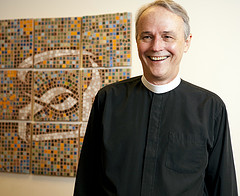
Compromise Keeps Neptune Graduation at Great Auditorium @ManasquanPatch

Neptune High School Graduation Compromise, Great Auditorium, Ocean Grove, NJ

ACLU complaint over holding ceremony at religious venue has been resolved.

Neptune High School seniors will continue decades of tradition tonight when they hold their graduation ceremony at the Great Auditorium in Ocean Grove.

The American Civil Liberties Union of New Jersey had threatened to sue the school district if changes weren’t made to the ceremony after a grandmother complained about the location and religious references in the ceremony last year. …

“The Board of Education and the administration is pleased that there has been a resolution,” said Neptune Township Superintendent of Schools David A. Mooij this morning.

“The intent of the district was always to keep the tradition alive. …It’s a building that cannot be duplicated anywhere, let alone within the geographical and municipal boundaries of Neptune. …” he said.

Katie Wang, communications director for the ACLU of New Jersey, declined to comment on the record Thursday other than to say the media had blown the issue out of proportion, but Wang emailed Patch a news release. …

“The national press on this has gotten way out of control,” said Ocean Grove Camp Meeting Association Chief Administrative Officer Scott Hoffman Thursday.

It had been reported, for example, that students would be forced to enter the auditorium from the rear so as to avoid passing the prominent white cross that adorns the front of the building, but there are no front entrance doors and students have always processed from the rear, said Hoffman.

“That’s nothing new,” he said, conceding that “minor adjustments” had been made, including allowing the school district to display banners “in a place they think is appropriate.”

“I’m sure their objective there will be to make it hard to see” [two lighted signs at the front of the auditorium], said Hoffman. The historic signs say “Holiness to the Lord” and “So Be Ye Holy.” …

For the whole story and more photos, go to Manasquan Patch.

Will Graham on Preaching, Public Statements, & His Famous Family @ManasquanPatch @TheHuffingtonPost

William (Will) Franklin Graham IV is the grandson of Billy Graham and the son of Franklin Graham. Graham is an associate evangelist at Billy Graham Evangelistic Association and assistant director of The Billy Graham Training Center at The Cove. He just returned from the Philippines, where he preached to 97,000 people in four days. Graham is a graduate of Liberty University and holds an MDiv. from Southeastern Baptist Theological Seminary. He and his wife, Kendra, live near Asheville, North Carolina with their three children.

Last time we talked, I asked you if you thought the press was unfair to your father, Franklin Graham, because his public statements generate more coverage than the humanitarian work he does with Samaritan’s PurseNow, he’s drawn criticism for making statements to Christiane Amanpour of ABC News that seem to imply that he doesn’t really believe President Obama is a Christian and that he does believe there is merit to the claim that President Obama was not born in the United States. I have two questions about this issue. First, do you believe President Obama is an American citizen and a Christian? 

It seems from all standpoints that we can tell, yes. I have no reason not to think it. Do I know him as a Christian? I’ve never spoken to the president about his personal walk. I’ve never met him. …My father and I, we’ve never discussed the president’s [faith]. My father’s had more intimate conversations with the president than I have, so I can’t speak to that. He claims to be a Christian, I do know that. …

His job is the toughest job in the world. I don’t think anybody really knows the pressures the president goes through. I know for certain, my grandfather, my father, and my family, we all pray for our president, just in the sense of  “God, give him wisdom.” He’s got to make decisions that you and I will never know about in human history. We know that that burden falls on his shoulders and his alone. God’s put him in that place to make those decisions. We just pray that God will direct him on the decisions to make. Not to make our decisions, but to make what God wants to do and those are tough.

When it comes to his birth certificate—if he was born American—it looks like he’s produced documents that say without a question anymore, it’s laid to rest. I think even [Donald] Trump waved his white flag.

That brings me to my second question. Many BGEA staffers have told me over the past few months that you are more like your grandfather than your father. When it comes to making political statements, whose footsteps do you intend to follow? …

To find out the answer to that question and others, go to Manasquan Patch. To find out what HuffPost readers think, go here.

High School Social Studies Classes Confront Islamophobia @LaceyPatch

I’ll be dealing with some of the issues raised in this lecture in my next NJ Shore Patch column. I didn’t have the opportunity to do so in this article.

Lacey Township High School is attempting to break cultural boundaries as guest lecturer Engy Abdelkader, a Muslim American, spoke to students about Islamophobia.

Social Studies teachers Julie Ferenc and Joe Humenick hosted Abdelkader in an effort to increase tolerance and reduce bullying, Humenick said. Although previous classes have learned about intolerance and a holocaust survivor is scheduled to speak before the school year ends, Abdelkader is the first person invited to speak on the topic this year, he said.

Abdelkader is a Monmouth County attorney of Egyptian descent. She was born, raised, and educated in the United States. Her goal for the event was to reduce conflicts, misunderstanding, teasing, and bullying, and to build trust and supportive relationships so that a more effective learning environment is created for all students, she said.

Abdelkader opened the discussion by asking students what stereotypes they have heard about Muslims and/or Arab Americans.  …

To learn more and to see how Lacey residents are responding, go to Lacey Patch.

How I Learned to Love a Show about Mormon Polygamy @Her.meneutics

Despite its troubling views on marriage and family, HBO’s Big Love always felt like an allegory for real people I know.

Years before TLC launched its polygamous reality show Sister Wives, Tom Hanks and company produced HBO’s award-winning drama series Big Love, about a family of polygamists who emerged out of a creepy Mormon splinter group.

I’ve watched all five seasons of Big Love, including Sunday night’s series finale. Creators Mark V. Olsen and Will Scheffer told the Los Angeles Times this week that the series emerged from their marriage, with the goal of communicating the idea that marriages can endure change. What appealed to me about the show was how it parsed the challenges of breaking free from a closed religious community while grappling with the community’s best ideals and penetrating reach. …

Read the whole review here.

Race to Economic Recovery Goes to the Tortoise @LaceyPatch

State of the Chamber 2011 keynote speaker forecasts solid job growth by summer

After a new slate of Southern Ocean County Chamber of Commerce officers was installed and elected officials from local municipalities spoke, Joel Naroff, president and founder of Naroff Economic Advisors, delivered a cautiously optimistic business forecast at the 2011 State of the Chamber Meeting in Manahawkin on Feb. 24.

Naroff, who had addressed the group at the height of the economic downturn two years ago, said there’s been significant change since then.

“The problem we have with this recovery is that it is really slow, but it is also the recovery we were always going to get,” Naroff said.

If you think of a recovery as a race, what we wanted was the hare and we got the tortoise. But the tortoise is steadily making its way towards the finish line,” Naroff said. …

Read the Christie administration advisor’s forecast and news about proposed solar and wind farms in Southern Ocean County here.

Deceit & Hidden Cameras in the Abortion Debate @TheHuffingtonPost

As a Christian, a pro-lifer, and a journalist, I’m ambivalent about the Planned Parenthood hidden camera sting that was perpetrated here in central New Jersey and reported sporadically by news outlets this week. The California based anti-abortion activist group Live Action sent two actors into a clinic posing as sex traffickers and recorded an employee doling out unethical, dangerous, and illegal advice that would keep the duo in business.

As a Christian I’m uncomfortable with both the failure of the office worker to report the couple to authorities and the entrapment of her by the activists. When is it appropriate to lie? The biblical stories of the midwives who refused to kill male infants as commanded by Egypt’s pharaoh and Rahab’s deception that saved Jewish spies in Jericho both seem to affirm lying when it’s done to save lives, but I question whether or not any lives will be saved as a result of this action.

As a pro-lifer, I doubt this kind of activism ultimately advances the goal of reducing abortion. On one hand, undeniable truth is exposed. On the other, the bad will it inspires is a serious blow to the common ground efforts that I believe hold the best hope of actually bringing down the abortion rate in the United States. Also, as pro-lifer Rachael Laramore writes at Slate,

“Planned Parenthood should be responsible for the actions of its employees. It should at least be held to the same standards that the left wants crisis-pregnancy centers held to–no false advertising, no erroneous medical information. But it’s extremely unlikely that there are multitudes of men walking into Planned Parenthood trying to get cheap abortions for their sex workers. And the young women who count on the group’s cheap birth control will be the ones who are harmed if Planned Parenthood loses its federal funding.”

As a journalist, I’m ambivalent about the use of hidden cameras and deception. At the journalism resource Poynter.org, several articles address the ethical problems inherent in using deception to reveal truth. When it comes to using hidden cameras, an article by Bob Steele offers the following factors to consider:

The Importance Threshold

“Since we are in the business of pursuing truth, there is more than a hint of hypocrisy when we use some form of deceit to pursue the truth. We can only justify that inconsistency and the use of deception when we truly serve a greater principle, such as pursuing a highly important and otherwise elusive truth. Therein lies the first standard for deciding when it is appropriate to use hidden cameras. To justify deception we must be pursuing exceptionally important information. It must be of vital public interest, such as preventing profound harm to individuals or revealing great system failure.”

Tools of Last Resort

“This covert method of newsgathering amplifies any accusations we make. We must insure that the tone and emphasis of hidden camera video meet standards for factual accuracy and contextual authenticity.”

Trinagulate & Test Assumptions

“We must devote enough resources, time and attention to gather the right facts and make sure our facts are right. We must supplement the surreptitious video with insightful observations, seeing and retaining important details of a scene that might not be captured by the camera.”

Know and Respect the Law

“We must pay close attention to the legal land mines in hidden camera reporting. Stations must develop sound strategies that recognize matters of defamation and privacy, including false light and intrusion torts. We can be vigorous in our reporting if we are clear on the law regarding fraud, trespass and surreptitious recording of audio. The law appropriately protects citizens. We should honor the law while also responsibly serving the public.”

Live Action’s amateur investigative work meets the Importance Threshold in my opinion, but I’m not sure it meets the other three criteria. A quick search of the bios on its website reveals that no one on the leadership team has journalistic training. Their success causes me to not only question the veracity and ethics of the work, it makes me lament the fact that more professionals aren’t doing excellent, unbiased reporting like this from ProPublica’s Marian Wang.

In the New Jersey case, the first outcome is that one woman lost her job. While she seems incredibly callous in the video, I assume that hers is a tragically misguided attempt to minimize the consequences of sex trafficking on underage girls who are beyond her reach, or as one commenter at GetReligion suggests, perhaps to get them into the clinic away from the pimps so that they can be helped.

Hidden camera video doesn’t reveal what is in a person’s mind and I don’t believe this is a singular story. The woman identified in the video as Amy Woodruff is culpable for her actions, but she has also become a convenient scapegoat. It’s understandable that pro-life activists wouldn’t be interested in what it means for Woodruff’s family for her to lose a job they believe is immoral, but as a Christian I am concerned about the harm that was done to them in the name of the cause.

*Update: Three additional videos have been released from clinics in Virginia.

Update 2/7: This article has now been published at The Huffington Post.

The Politics of Hunger @UrbanFaith

Ambivalent about exercising your patriotic duty on Tuesday? I was too, until I interviewed the winner of the World Food Prize and learned why this election is so important to hungry Americans. Here’s the intro:

Hunger is a devastating problem in third-world countries, but according to Bread for the World president David Beckmann, one-quarter of all African Americans live in poverty right here in the U.S. That’s why he believes vanquishing poverty should be at the top of our “Christian” political agendas — and why he’s urging people to vote on Tuesday.

David Beckmann is president of Bread for the World and the recent winner of the 2010 World Food Prize. In addition to being an anti-hunger activist, he is a Lutheran minister and an economist who formerly worked at the World Bank. His latest book is Exodus from Hunger: We Are Called to Change the Politics of Hunger. UrbanFaith columnist Christine Scheller interviewed Rev. Beckmann about his work, hunger in the African American community, and why we should be aware of the federal policies that influence issues of poverty in America. …

And a compelling exchange from our conversation:

I tend to think that living in the United States, hunger is more invisible. How has it changed you working for the World Bank and Bread for the World?

What’s most striking is that the world as a whole has made remarkable progress against hunger, poverty and disease. I believe in God and I see that hundreds of millions of people have escaped from poverty in places like Ethiopia, Bangladesh, Brazil and Britain. That’s why, for me, it makes sense that this is God moving in our history. And then I come back to the U.S.A. where we haven’t made any progress against hunger and poverty since about 1973 and it informs, I think, the U.S. situation. If Brazil and Bangladesh can reduce poverty, it’s clear that we could do it in the U.S. We just haven’t tried for a while. But we did try as a nation. In the ’60s and the early ’70s, we had economic growth and we had a concerted effort under both Johnson and Nixon to reduce hunger and poverty and we cut poverty in half. So it’s doable here too. … I think the fact that we work on world poverty and domestic poverty together makes it all much clearer that our problem in this country is lack of commitment.

Read the whole thing here, and don’t forget to vote.

This interview was reprinted with permission at The Huffington Post on November 2, 2010.

On the Bridge: A Conversation Between a Pro-Lifer and an Embryonic Stem Cell Researcher @TheHuffingtonPost

hESCs@CHOC

When I investigated human embryonic stem cell (hESC) research for Christianity Today in 2005, the debate about the ethics of the science was heated and tense. I was a pro-lifer who’s child had an incurable disease. What I wanted to know was: what would I do if hESCs could cure my child’s Neurofibromatosis? As part of that investigation, I spent ten days attending a National Institutes of Health (NIH) training course for post-doctoral scientists at Children’s Hospital of Orange County (CHOC) in Southern California. Every other attendee was there to learn how to create and grow stem cell lines from five day old human embryos (blastocysts). Because it was an NIH funded course, no new embryos were destroyed to grow the lines the researchers manipulated.

I was the invited guest of Phil Schwartz, who is both director of the Human Neural Stem Cell Resource at CHOC and a Christian opposed to embryo destruction. Schwartz ran the course with Jeanne Loring, director of the Center for Regenerative Medicine at The Scripps Research Institute in San Diego, California. Loring is a cell biologist who has been working with hESCs since 1997. Before that, she worked with another Christian, Francis Collins, on mapping the human genome. She describes herself as a “cultural Catholic,” but practices no religion and has never had any doubts about the ethics of her hESC work.

In 2008, Schwartz invited me to attend the course again and I did. The political tenor had changed considerably with the advent of induced pluripotent stem cells (iPSCs), which are derived from adult somatic cells and thus are not controversial.

Writing on the Center for Genetics and Society’s blog, Project Director on Biotechnology Accountability Jesse Reynolds predicted,

“With the end of stem cell research as a political vehicle, its advocates are likely to temper expectations. They’ll not just move out the goalposts on the timeline towards treatments, but the touted uses of stem cells will shift from potential cellular therapies to models of human diseases in Petri dishes and better drug testing methods. These new purposes will win fewer votes than ‘your own personal biological repair kit,’ but they are also much more realistic.”

And yet, here we are again, with advocates lamenting a lawsuit that brought a temporary injunction against NIH funding of hESC research. (The injunction was quickly reversed.) So, I called Jeanne Loring and asked her thoughts on the lawsuit and the current state of the field. Here’s that interview, edited for space:

SCHELLER: What do you think of the legal situation?

LORING: For scientists, the embryonic stem cells have been the basis for all of the research, including the induced pluripotent stem cell research. Also, they’ve had a lot of influence over adult stem cell research, although I don’t think those guys would admit it. … There’s a gradual growing excitement … because of what you can do with them. So we have people with all sorts of different skills that are all focusing on hESCs or iPSCs or stem cells in general. What the legislation does is it puts a halt to an awful lot of research that’s ongoing right now. Maybe in another ten years, it wouldn’t have such an impact because people would have already done all these things and it would all be in the hands of companies, but right now it’s in a really frantic research phase. We’re discovering things all the time. It’s the worst possible time to have money taken away.

SCHELLER: Who brought case?

LORING: A researcher who used to be at [Harvard] MIT. Harvard [MIT] denied him tenure and he went on a hunger strike. That’s what he was famous for. I knew I’d heard of him before.

SCHELLER: Was he opposed to the research on ethical grounds?

LORING: There are two people: a woman from Louisiana, I believe, opposing the research on ethical grounds and this guy. In legal terms, in order to get an injunction, you have to show financial harm. He said he was being financially damaged because hESC research was unfairly competing with adult stem cell research at NIH. It’s outrageous. It’s foolish. It’s silly. Because research funded by the NIH is funded on merit and there’s no one pot for all stem cell research that gets divided up differently. There’s a big pot for all sorts of research and depending on the stage of the science and the urgency of the need, the research dollars go in a lot of different directions. Adult stem cell research gets far more funding than embryonic stem cell research and it continues to, mostly because it’s already well established.

SCHELLER: Do you think the spinal cord hESC therapy human trials that have been approved by the FDA [the first of their kind] at the Reeve-Irvine research Center in Southern California will work?LORING: I don’t know. Scientifically, I think there’s a possibility. As a scientist, what I really want are for those cells to not harm anybody because it’s a Phase One trial and the object of a Phase One trial is to show that it doesn’t do any harm, and that will be a huge step forward if they can show that.

SCHELLER: In 2008, we heard from Geron Corporation funded Oxford scientist Paul Fairchild that the immune challenge with hESCs wouldn’t be overcome. Has that changed?

LORING: No. They are going to have an immune problem, but they’re going to treat it like an organ transplant. They’re going to use the minimum amount of immune suppression that they can get away with. … This is not a fix for immune rejection. I just got a grant to develop of way to trick the immune system into thinking transplanted cells are theirs. There are several projects going on along those lines. The cells themselves are not going to move into another body and not cause a reaction, which is actually good because if your immune system is not aware of something and that cell became cancerous, you couldn’t do anything about it.

SCHELLER: California Institute for Regenerative Medicine (CIRM) co-founder Robert Klein is the father of a diabetic child. I’ve never understood the trade off of insulin dependency for immune suppression that diabetic patients would potentially make if hESC therapies become available. Do you grapple with that at all?

LORING
: Sure. Ranking diseases is always difficult. A lot of what diseases are going to be treated with cell therapy really depends on a balance between how serious they are and how deadly they are and how easily they can be treated with cells. So, diabetes seems to be, relatively among all diseases, probably easier than most to treat, but it’s not life-threatening. So you have to get a really good therapy, but definitely require immune suppression before you would actually use it.

SCHELLER
: So there’s a benefit/risk analysis?

LORING: Yeah, that’s right. So there is progress to be made. All this immune system stuff is sort of catching fire now, so people are not going to just stand by and let the immune system reject everything. They’re going to try to modify the immune system, not with immune suppression, but in a way that will last. Now people are also encapsulating cells so that the immune system can’t get at them.

SCHELLER: They’re still able to function when they’re encapsulated?

LORING: Yeah, in diabetes they certainly are because all they have to do is react to glucose in the blood and make insulin.

SCHELLER: Last time I talked to you, you sounded more excited about iPSCs than hESCs.

LORING: I am more excited for a lot of reasons about iPSCs because you can make them from any individual. As far as the way they act in the culture dish, they’re exactly the same as embryonic stem cells. You have the same problems and the same advantages.

SCHELLER: Is it much harder to get them to turn into other cell types than it is with hESCs?

LORING
: No. It’s very easy to get them to turn into other cell types. They’re essentially equivalent. If you look at 100 iPSCs and 100 hESCs, you’ll find there are outliers in both groups–cells that are difficult or act funny. But on the average, among those 200 cell lines, you really couldn’t tell them apart.

SCHELLER: 2009 was the last NIH funded course you directed with Phil Schwartz. Is there no longer a need to train scientists?

LORING: My lab is still running courses. We’re doing it semi-independently and also for CIRM. They are more popular than ever. We modified them so we are actually offering them every couple of months because there are so many people in line waiting to take them.

SCHELLER: So it’s not the case then, as it was in 2005, that you have more cell lines than scientists to do the research?

LORING
: No, it’s not like that at all. People really want to get involved in this field. We still teach embryonic stem cell culture methods because that is still the fundamental technology that underlies all of this work.

SCHELLER: Do you need new hESC lines?

LORING: No, I don’t need to make hESCs. This is a dilemma. You make hESC lines from five-day old blastocystes that have been donated by people in in-vitro fertilization (IVF) clinics. I’ve been getting repeated frantic emails from people who want to donate their embryos. I don’t really have any need for them, but I’m feeling like I should start a bank. The alternative is throwing them away. Nobody’s going to adopt the embryos, so they’re paying to have them stay frozen and they want to see some good come of them. I want to start a bank. It’s just that I don’t have funding for it. I’m cooperating with an IVF physician who’s temporarily taking the embryos in. We definitely don’t need to make embryonic stem cell lines. There are probably 400 around now. All you have to do is call somebody and ask them for them.

SCHELLER: At the 2008 course, an IVF physician called his field “Cowboy Science” because of the lack of regulation. It seems to me that this lack of regulation may be a bigger ethical problem than hESC research because it creates the excess embryos.

LORING: I have no objection to increasing regulation of IVF. It’s like any medical practice. It shouldn’t be hurt by oversight.

SCHELLER: We also heard about the potential for exploitation of egg donors in 2008.

LORING: The egg donation issue in 2008 was very hot. That’s died out considerably with the advent of iPSCs because people were looking for alternative sources for pluripotent cells and now there is an alternative source.

SCHELLER: As you know, I first investigated this topic because my first pregnancy was unplanned and I didn’t believe I had the right to end it. My child was then born with Neurofibromatosis. So I had an ethical dilemma to think about when hESC research first emerged.

LORING: Yeah, I understand. I obviously don’t feel it in my heart, but I understand.

SCHELLER: How would you describe your ethical convictions about hESC research?

LORING: I find it completely ethical. I have absolutely no problems with it. It isn’t abortion, so my opinion about abortion is irrelevant. The fact that these embryos would be thrown away and not used for research, I think it would be unethical not to use them.

SCHELLER: You’ve never had any doubts?

LORING: I’ve never had a doubt.

SCHELLER: How long have you been doing this research?

LORING: I started in 1997 in northern California. I started my own company to make hESCs. I didn’t know then that there were so many embryos being thrown away every day. So it made me nervous to have embryos in the lab and I made sure that I got good cell lines out of them. It would still do that to me now. They are really precious, but if you can’t do anything else with them. I was interviewed by a reporter for a Christian newspaper maybe a year ago, I actually wanted to talk to this guy because I wanted to suggest that the churches should put up embryo banks because there’s no adoption for embryos. It would be like starting an orphanage. If they want to keep the embryos from being used for research or being thrown away, then they should set up a bank, a freezer somewhere and just keep them.

SCHELLER: And then do what with them?

LORING: Whatever they want.

SCHELLER: In other words, they should take responsibility for their convictions?

LORING: Exactly. Nobody took me up on it. I’m happy to say that again though.

SCHELLER: People say similar things to pro-life Christians about abortion.

LORING: This would be really simple, though, simple and cheap because you don’t have to raise them. All you have to do is keep them frozen. And then you can figure out what should happen to them after that. That’s not my problem.

SCHELLER: Do you get any flack from your Catholic relatives about your work?

LORING: No. As you know, many Catholics also think birth control is okay and a lot think IVF is fine. So it all follows from that. My relatives are pretty intelligent people, so I don’t get any trouble from them. There might be an outlier somewhere, but not a close relative.

SCHELLER: Thanks for talking to me Jeanne. I always appreciate the fact that you shed light rather than heat on this issue.

LORING: If somebody wants controversy, they’re going to have to go somewhere else.

Check out the reaction to this interview at The Huffington Post.

Eating Problems for Breakfast: An Interview with Kay Cole James @TheHighCalling

Kay Cole James is an impressive woman who shared her considerable wisdom with me on behalf of The High Calling. She talked about what makes a good employee, how she gained the confidence to run the federal workforce, what she thinks of her successor, how she handles that damning Wikipedia article, and more.  Here’s the intro:

Kay Cole James was Director of the U.S. Office of Personnel Management when the 9/11/2001 terrorist attacks occurred. In the wake of those attacks, she oversaw the reorganization of agencies and endured misplaced criticism for allegedly hiring alumni from Regent University, where she had been Dean. James is now culling from these and other personal and professional experiences to shape a new generation of leaders through her work at the nonprofit Gloucester Institute. James talked to TheHighCalling.org about what it takes to be a success, both at work and at home. …

Go here to read the interview. While you’re there, why not check out the other High Calling offerings? It’s a great site, and no one paid me to say that!

“Poverty is on the Agenda” at UrbanFaith.com

My first article for Urban Faith is up. It’s a report on the Sojourners/World Vision Mobilization to End Poverty event I attended in Washington D.C. last month. My reporting for Urban Faith focuses primarily on the experiences of other attendees at the event. I was also asked to write a blog post for Sojo.net about my own experience at MEP. After agreeing to do so and then attending the event, I realized I had made a mistake because I couldn’t really do honest journalism for the event host. When an outlet reports on its own event, it is called public relations. I decided to submit an honest account of my experience and let the chips fall where they may. Sojo.net elected not to publish this account. I take the editors at their word that the problem was with the writing and not with my critique. It’s pretty dull, I guess, and perhaps tangential, but I present it here nonetheless. Make of it what you will.

What to make of an anti-poverty event that could easily cost participants $500-$1000 or more, depending on how far they traveled, where they slept and what they ate? I ask the question not as a criticism, but because it influenced my one day experience of the Mobilization to End Poverty gathering, and my early exit from it.

The recommended hotel cost $245 a night, an amount higher than any I have ever paid for a hotel, even when my husband earned a six-figure income. I might have stayed at a hostel for $50 if I had acted early, but instead I camped alone for $16 a night at Greenbelt National Park in nearby Maryland. A late model German station wagon served as my “tent.” For dinner I prepared Trader Joe’s noodles with a cup of hot water that I grubbed at McDonald’s. I covered my interior windows with $9 worth of “made in China” tablecloths I had purchased at a nearby dollar store. They quickly filled my abode with the suffocating smell of formaldehyde. (How toxic must those factories be?) As evening wore on, I tried to read the 100th anniversary edition of Walter Rauschenbusch’s Christianity and the Social Crisis, but felt vulnerable, alone and foolish for setting up camp in what passes for a DC suburb.

What little sleep I got was periodically interrupted by the sound of sirens in the distance. Looking put together and professional after such a night is a challenge I don’t care to repeat. It’s a challenge I’m not sure I could endure with grace on a daily basis. By the time I arrived at the convention center, I felt unkempt. Inferior. Apart from attendees I imagined could afford to comfortably lobby and talk about poverty—even though I’ve spent the past six months working hard to gain access to tax-payer funded mental health services for an uninsured and currently uninsurable family member. I rejoice in care of questionable quality because it is something and it’s cheap.

From this vantage point I assessed day one of the Mobilization to End Poverty.

The speakers were inspiring—more consistently inspiring than most on the poverty circuit, according to a couple Sisters of Charity from Leavenworth, Kansas. Biblical mandates flowed freely, and startled when they too closely resembled mandates anointing a different political agenda that had been roundly and rightly criticized from these quarters.

Activists were enthused. A couple expectant Presbyterian fathers from Bradenton, Florida, were there looking for inspiration. They had flown into town, but were staying with friends in the suburbs. One is a church youth group leader; the other a board member of his local chapter of Habitat for Humanity. At the close of day one, both had gained renewed enthusiam for themselves and their ministries. The investment was clearly worth it to them.

 A Lutheran attendee from Pennsylvania said he was excited to be there talking about something other than abortion and gay marriage. Yes, but why must we denounce? The rigor of the abortion debate was appropriate to its time and is evolving in ways appropriate to our time. The gay marriage debate is one worth having. We should applaud it, and add to it, not shirk from it. Ambivalence on this issue dare not speak its name and that’s not good. What does it require of me to oppose hunger or affirm health care reform?  Certainly nothing as gauche as meddling in other people’s sex lives. Unless of course one deigns to get their hands dirty with real people—people like my grandfather, who produced six children and then abandoned them.

It’s easier to meddle in people’s money, especially with an economic crisis and an unpopular war that create convenient platforms upon which to build our case. On Monday afternoon, no less than former CEO and current World Vision president Richard Stearns compared the 2009 economic collapse to the 1989 fall of communism, saying unrestrained capitalism had been found “bankrupt” and “inadequate” in the same way unrestrained communism had twenty years ago. He spoke truth to the choir.

So let me meddle. In addition to denouncing corporate greed, how about, as longtime urban minister Rudy Carrasco suggested to me, we lobby business for its support in the same way we lobby elected officials? Doing it already? Fine. Then don’t dismiss the interests of business.

Instead of comparing and contrasting one pro-life cause with another, as Monday night’s preacher did, how about we make Obama accountable for his promises to support responsible fatherhood, adoption and abortion reduction?

In my husband’s work as case worker and pastor to homeless men at Double R Ranch in Warner Springs, CA, one of his responsibilities was to help men re-enter the lives of their children. Often this meant getting them to see beyond themselves and their own histories of failure to the welfare of others. The process began with caring for the ranch’s 40+ horses and other animals. It also included requiring them to contribute a portion of their minuscule incomes to the support of their children and facing the women who were busy cleaning up their messes.

Last year, I emailed my elected representatives to ask them to vote for the Paul Wellstone-Pete Domenici Mental Health Parity and Addiction Equity Act of 2008, a bill that requires insurers that offer mental health coverage to do so equitably. A bill that President Obama sponsored as a senator and that President Bush signed into law. It’s a pro-life issue I heartily supported as the mother of a child who died by suicide and whose birth was ensured by the advocacy of notorious pro-lifers like the late Jerry Falwell.

I realized this week that I cannot afford face time with my legislators in Washington right now, but I can make a difference. First by caring for my own family members and others within my sphere of influence, second by contributing tax revenue to fund sources of support upon which my loved ones currently depend, third by advocating for a wide variety of pro-life causes and, finally, by challenging my peers.

So let me close with this reflection: It’s great to rally the troops and celebrate our victories, as long as we don’t become the thing we despise. Don’t become the thing you despised Sojourners. You have friends of all political and theological persuasions.

Update: Sojourners included my UrbanFaith article in their media accounts of MEP.

The Short Term Future of Stem Cell Funding

 California Stem Cell Report appropriately opines

As California’s public universities are turning away students and state cash is being cut for projects ranging from research labs to affordable housing, the California stem cell agency is on track to give away $66 million later this month.

The awards will come following CIRM‘s handout of more than $19 million last month.

No one – except for those congenitally opposed to hESC work — is contending that all these millions are going to unworthy scientists or to dubious research. But the CIRM giveaways stand in marked contrast to what is happening to the rest of the state in the light of its $40 billion budget crisis.

If CIRM were, say, part of the state Department of Health, chances are good that it would not be able to spend taxpayer money so freely.

The disparity raises major public policy issues about the use of ballot initiatives to promote and protect various causes. Should the elderly and poor see their much-needed assistance and medical care cut while cash flows unimpeded, in this case, to researchers, some of whom are already exceedingly well funded?

A ballot initiative, Prop. 71, is just what created the $3 billion stem cell effort in 2004 – not carefully crafted legislation hammered out over months with all parties having their say in public. The measure was drafted in secret by CIRM Chairman Robert Klein (with the help of a couple of others he rarely acknowledges) and placed on the ballot with a signature-gathering effort that probably cost $1 to $2 million. (That is the most common way of placing an initiative on the ballot in California – hiring firms that specialize in such efforts and paying them on a per signature basis.)

It’s an especially timely thought given that President Obama made this oblique statement in his Inaugural Address:

We will restore science to its rightful place, and wield technology’s wonders to raise health care’s quality and lower its cost.

 … leaving both Ted Olsen and me wondering if he’s about to upend Bush on federal funding for Human Embryonic Stem Cell research  … when there ain’t no money for nothin’.  But then, there’s still Dickey-Wicker to contend with.

Thinking about Religion, Belief & Politics @ Princeton

The inaugural Danforth Lecture at Princeton University was a lucky little feast for the brain Thursday afternoon. CUNY anthropologist Talal Asad gave a breathtaking talk on “Thinking About Religion, Belief and Politics.” I hadn’t expected Charles Taylor to be the subject of Asad’s elegant dissection, but there it was: A Secular Age fileted and served on ice. 

This eminent scholar/author said Taylor’s seminal work deals with personal crisis of belief that are insufficient to the global crisis of our time. He argued that beliefs formed through external acts of devotion and training are not inherently coercive, but can lead to authentic faith and the formation of a moral personality. Asad appeared to be making a case for non-Judeo-Christian, or, at least non-Protestant, religious influence in the public square. He spent precious little time talking directly about politics, but instead drew an entertaining connection between the development of public ventilation systems and narcissistic notions of belief.

Asad objected to an audience member’s suggestion that he dismiss religion outright as a dangerous force that wants to control other people’s bodies. He said the secular/religious debate is tired and suggested that market forces can be at least as coercive as religion. He cited coercion of women’s bodies as an insightful example. 

Although the lecturer expressed faith in liberal democratic values, he has comparatively little faith that states can effectively implement those values. He concluded by confessing doubt that mankind will see the next century. With such apocolyptic vision, one wonders where he gets off saying personal faith is insufficient to the times. Perhaps he thinks no other kind will hold sway in coming decades.

Ah well. My momentary USC advisor Diane Winston tipped me off to Princeton Religion Department public offerings. I had been lamenting the loss of such local events at USC and UCI, but found this first lecture a more than adequate substitute. Thanks to Ed Gilbreath, I’ve also been reading the blog of two Princeton professors lately. Check it out; it’s called The Kitchen Table.

The Princeton University Art Museum is likewise a lovely place to spend an afternoon. The museum is free and contains a good deal of compelling Christian art and iconography. There are also a couple witty architectural exhibits right now and a nice collection of ancient art, including Roman floor and wall mosaics. Strolling the campus, parts of which date back to 1756, is itself an exercise in art appreciation.

My husband’s handicapped tag came in handy on this trip. A quick phone call to the PU parking office and we were waved in to park on campus. Between the museum and the lecture, I dragged him to the Whole Earth Natural Grocery, which has been selling bulk health foods on Nassau Street since the 1970s. The last time I was there, it was a warm, earthy place. A low VOC renovation has left the store feeling sterile, cold and utterly suburban. Still, I stocked up on brown rice, Kombu seaweed (which is supposed to reduce the gassiness of beans when a couple 1-inch chunks are thrown in the pot) and other vegan staples. 

On the drive to Princeton, I was struck once again by the subtle beauty of my state. We passed quaint farms, small towns and mile after mile of hearty pine. A gas station on Rte. 33 was simultaneously selling Chicken Parmesan sandwiches and gas for under $2-a-gallon. Can’t beat that.

At dinner on the same road in Hightstown (half way between home and Princeton), a high school classmate of my husband’s was working as a waitress. Dinner was lousy. We should have eaten down the road at Jack Baker’s Lobster Shanty instead. Baker’s original Lobster Shanty is a landmark in my home town of Point Pleasant Beach. I went to high school with his children, one of whom is a longtime friend.

We were at a delightful party together last night. There was plenty of good wine, lots of laughter and a passionate debate amongst old friends the likes of which I imagine taking place in Republican living rooms from coast to heretical coast. The topic? What does it mean to be a Conservative? What went wrong in ’08? And since when did disagreement mean one’s conservative and/or spiritual credentials are suspect?

Have I mentioned lately how glad I am to be home?

I have a job interview Tuesday. Send up a prayer for me if you’re so inclined. I’ve been told to prepare for a two-hour introduction.