Pressing Past the Heartbreak @UrbanFaith.com & @HuffingtonPost.com

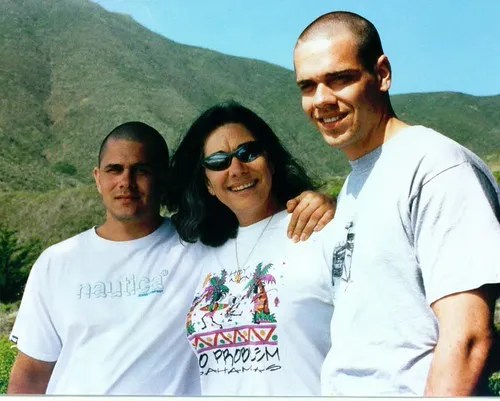
Dustin, Lynn Ann & Daniel Bogard

The photo above is of Lynn Ann Bogard and her two sons, Dustin (left) and Daniél (right). She and her husband Craig were kind enough to talk to me about how they are able to continue on in urban youth ministry after their sons’ deaths. The story begins like this:

Craig and Lynn Ann Bogard grew up in a small, predominantly white community in New Mexico but sensed a call to minister to African American youth in central New Jersey after a short-term mission trip to the area in the early 1970s. Thirty-five years later, despite living through periods of relying solely on God for their next meal, the Bogards are still at it. They have faced the kinds of challenges that only a deep and abiding faith could pull them through — fundraising struggles, misunderstandings about their motives by both blacks and whites, and, most recently, the untimely deaths of their two beloved sons, Daniél, 28, in 2004 and Dustin, 25, in 2007.

I’ve been aware of the Bogards’ Aslan Youth Ministries for many years, but only just met Craig Bogard last month. As I listened to this slight, serious man recount Aslan’s history, what I really wanted to know was: How do you keep ministering to other people’s children when your own were taken from you?

You’ll find the answer to that question and a whole lot more here, and here, at The Huffington Post where the article was reprinted with permission from Urban Faith.

The Case for Male Circumcision @Her.meneutics

I really had no idea how passionate people could be about this topic until I tweeted my intent to respond to a BloggingHeads.tv discussion of it. Below is the intro to my allegedly man-hating take. Above is a photo of my two precious boys.

What mother hasn’t, in the halcyon days after the birth of a son, felt her ferocious she-wolf instincts kick in when it comes time for her boy to be circumcised? Having perhaps suffered violence to her genitals during the birth, the physical ache to all that is vulnerable in her world can seem unbearable. And then it is done, and life goes on.

Anti-circumcision activists would have us believe that life does not in fact go on, that boys grow into men whose sexual pleasure (and that of the women they love) is compromised by this act of “genital mutilation.” While increasing numbers are swayed by both argument and sentiment, I’m stupefied by the controversy.

Male sexual pleasure is not my highest priority, having rarely witnessed a lack thereof. Nor is my own, if in fact I’m speaking out of my ignorance of the delight foreskin can deliver. What I am concerned about is sky-rocketing rates of sexually transmitted diseases, and the gender inequality evident in these rates. …

Read the rest here. For a taste of the emotion this topic inspires, be sure to read the comments, and my response to them.

Update 9/14/09: I posted this definitive comment in response to the 90+ comments on my post, and will have nothing further to say on this topic for the time being.

I really appreciate all the insightful, civil comments on this post. I’m not going to respond to them or to the hostile ones, as I’ve said my piece and others have filled in the blanks.

What I would like to explain is that as a journalist, I look for an angle on a topic that has not been covered sufficiently elsewhere. In my research for this post, I noticed that the writers I was reading seemed to miss the comparison to women’s embodied experience, so I chose to highlight that comparison.

I always consider what I write a contribution to public conversation, not a definitive statement on any given topic. Thus, I am gratified that what I’ve written has spurred people to think about something they might not have otherwise considered. If readers disagree with me, fine. Let the conversation continue and lead to change where it might be necessary.

In regard to this particular issue, I confess a subtle bias that I did not reveal in the post. I trust the Bible as my primary source of authority and have a bias towards its commands and injunctions. For example, I suspect that a kosher diet is probably healthiest, even though I don’t keep kosher. When God told women to stay outside the camp during menstruation, I think of that as a mercy. In the case of circumcision, I tend to think that if God ordained it, there is something inherently beneficial in the act itself.

When Abraham was commanded to be circumcised, he was a grown man, and must have been as horrified as many of you. Family members who did not hear from God must have been even more horrified. (LL Barkat made this point to me privately.) Still, circumcision became the sign of faith. Even if there were no medical benefits that science would later suggest, there are other values demonstrated in the act: pleasure is not our highest end; we are to acknowledge God’s sovereignty over our most vulnerable, intimate issues and trust him with our whole selves; logic is not to be our final authority, etc.

Don’t misunderstand. As I’ve already stated, the apostles declared circumcision of the heart the true sign of faith, as was consistent with Jesus’ reforms. Our Lord affirmed the Law though, and so I respect it, even when I don’t entirely understand it or live it out or think we are subject to it. I simply have a bias towards it.

I confess that there is a superstitious element to my reasoning. I also confess that scientism is probably the bigger problem with all kinds of medical procedures. If postmodernism has done nothing else, it has given us back a willingness to own our instincts.

Which brings me back to our faithful reader, Christian Lawyer, who I chose to engage because she consistently makes good points.

This I agree with: “If you want to teach our young people that they are powerless in the face of the “culture,” have at it, but don’t be surprised when these same young people succumb to the buffeting winds of suggestion, peer pressure, and defeatism rather than learning to stand strong and take responsibility for themselves and the circumstances of their lives.

The paternalism of the far right complementarians, just like the maternalism of the the far left feminists, is disempowering to women and instead breeds weakness.”

However, I never said I was powerless. I said I was influenced. Because of public conversations like the ones we have here at Her.meneutics, the excesses of both feminism and FAR RIGHT complementarianism may weaken. I hope to advance those goals.

With this, I disagree:

“Advocating cutting off men’s foreskins to protect women, rather than advocating education and contraception for women so they can protect themselves, is just another creepy example of the disempowerment of women under the guise of ‘protection.'”

Not either/or, but both/and. I am grateful that my mother took me to a gynecologist for contraception when she knew I was having sex and had no intention of stopping. However, this doctor (like the one who performed my tubal ligation) doled out treatment without asking a single penetrating question. I think this was a combination of both sexism and scientism.

Finally, I am no longer going to respond to anyone who does not own their comments with their full name and/or a link to their website or blog. I own my public comments both here and elsewhere. When I comment on other blogs, I usually do so under my initials, CAS, and leave the link to my blog when that feature is offered. In this way, internet searches of my name lead only to my work, but I am still held accountable for what I write online.

Thanks again for your interest. I look forward to what my colleagues have to say on this topic.

Cross-post from NF Endurance Team blog: Why Gabe Will Always Be My NF Hero

It’s a rare photo in which Gabe appears depressed. He was known for his boisterous, charismatic personality. But, from the time he left home for college, he struggled with depression. This photo was taken at my husband’s graduation from a pastoral training program in June 2004. Gabe would have just finished his freshman year at Wheaton College in Illinois.

I write about his depression because, as Endurance Team members, we are focused on overcoming and suicide seems like the antithesis of that. One thing I’d really like to accomplish through my involvement with the team is to help others overcome faulty ideas about depression and suicide. Ideas that I myself once held.

Not long before Gabriel died, I joined the CTF group on Facebook. A young woman posted a comment on the group wall about studies linking NF to psychiatric difficulties. I didn’t think much about it until after Gabe died. Then I began doing research and found one of the studies she may have been referring to. Here it is from PubMed:

Neurofibromatosis type 1 (NF1) is often associated with psychiatric disorders, which are more frequent in NF1 than in general population (33% of patients). Dysthymia is the most frequent diagnosis (21% of patients). There is also a high prevalence of depressive mood (7%), anxiety (1-6%), and personality (3%) disorders. The risk of suicide is four times greater than in the general population. Bipolar mood disorders or schizophrenia appear to be rare. The impaired quality of life associated with NF1 may play an important role in the development of psychiatric disorders. Quality of life assessments may help to identify a population at high risk.

Dysthymia can be defined as depression; despondency or a tendency to be despondent. It certainly describes Gabe at increasingly frequent intervals in the last year of his life. In another study, researchers found no link between the severity of familiar NF symptoms and the severity of psychiatric ones, indicating that something neurological might be going on rather than simple despair over the condition itself.

Since 2002, I have written for a magazine called Christianity Today. One of my articles was about Gabe and a couple others mentioned him. Because I had encountered a good deal of both ignorance and empathy after his suicide, I wrote about his death for the magazine. You can read that article here. It traces a bit of family history, does some education and poses the possibility that Gabe was suffering from bipolar disorder, which a couple of mental health professionals suggested after reading his suicide notes and journal entries. I’m ambivalent about this post-mortem analysis though, because the impulsivity that correlates with his attention deficit disorder combined with his undiagnosed dysthymia could be mistaken for bipolar.

Long before I had a thought about any of this, I wrote about Gabe’s NF in Christianity Today. That article was an investigation into human embryonic stem cell (hESC) research. Through it, I met my friend and NF Endurance Team partner David Brick. David is an hESC researcher at Children’s Hospital of Orange County, CA. When we were training for the Long Beach Half Marathon last year, David did some reading of his own on NF. He found something about the involvement of mast cells in NF. Mast cells are also indicated in asthma and allergies. This got me wondering if Gabe’s severe asthma might also have been a function of his NF. Instead of suffering from three separate diseases—NF, asthma and depression—was he really only suffering symptoms of one nasty disorder? I’d like to know the answer to this question.

The point of my writing about this here is both to alert CTF to these possibilities and to say that Gabe was for all of his life a true NF Hero. He overcame challenges that many of us will never face. The father from whom he inherited neurofibromatosis never acknowledged him and chose not to be a part of his life. He dealt with race issues as well, and was frequently sick and isolated with asthma. NF was always in the background as a concern. And yet, Gabe was incredibly accomplished. You can read about his many accomplishments here.

In one of his suicide notes, he wrote that as much as he kept trying to “pull himself up into the world of real people,” he felt dead inside. That feeling is not failure or a lack of courage; it’s a symptom of clinical depression. A symptom that he did not recognize had a treatment. A symptom he hid well in his lifelong habit of being an overcomer. A symptom I did not understand.

For the sake of others suffering such symptoms, I want to challenge the NF Endurance Team and its members to recognize that our message shouldn’t exclude those suffering from mental illness. Death by suicide is a preventable tragedy, not a lack of character. While we want to be careful not to romanticize or idealize those who die by suicide, we also want to remember that the vast majority of people who take their own lives die from mental illness that is no fault of their own.

So, here’s to my NF Hero, Gabriel Gifford Scheller!

Update: The NYC Half Marathon is just 10 days away and I’ve only raised $350 of my $1000 goal. If you’d like to help me answer the question posed in this post, you can support my efforts here, or you can send a check to: The Children’s Tumor Foundation 95 Pine Street, 16th Floor, New York, N.Y. 10005.

Education in Color @UrbanFaith.com & Sojo.net


I have an article up at UrbanFaith.com and Sojo.net that I believe is as important as anything I’ve written. Here’s a clip:

I’ve often thought that if my husband had been black, we would have raised our sons in my hometown. It was small and idyllic. Both boys would have received a stellar academic foundation and Gabe would have had a role model at home to help him deal with identity issues. As it was, my husband and I were clueless about basics like what to do about his “ashy skin” or where to get him a decent hair cut. Living in a diverse community solved a lot of everyday problems and allowed us to develop socially and biblically responsible attitudes about race that we might not have otherwise developed. Still, there were costs. …

Read the whole thing here, especially if you’re a white parent raising children of a different race.

“Poverty is on the Agenda” at UrbanFaith.com

My first article for Urban Faith is up. It’s a report on the Sojourners/World Vision Mobilization to End Poverty event I attended in Washington D.C. last month. My reporting for Urban Faith focuses primarily on the experiences of other attendees at the event. I was also asked to write a blog post for Sojo.net about my own experience at MEP. After agreeing to do so and then attending the event, I realized I had made a mistake because I couldn’t really do honest journalism for the event host. When an outlet reports on its own event, it is called public relations. I decided to submit an honest account of my experience and let the chips fall where they may. Sojo.net elected not to publish this account. I take the editors at their word that the problem was with the writing and not with my critique. It’s pretty dull, I guess, and perhaps tangential, but I present it here nonetheless. Make of it what you will.

What to make of an anti-poverty event that could easily cost participants $500-$1000 or more, depending on how far they traveled, where they slept and what they ate? I ask the question not as a criticism, but because it influenced my one day experience of the Mobilization to End Poverty gathering, and my early exit from it.

The recommended hotel cost $245 a night, an amount higher than any I have ever paid for a hotel, even when my husband earned a six-figure income. I might have stayed at a hostel for $50 if I had acted early, but instead I camped alone for $16 a night at Greenbelt National Park in nearby Maryland. A late model German station wagon served as my “tent.” For dinner I prepared Trader Joe’s noodles with a cup of hot water that I grubbed at McDonald’s. I covered my interior windows with $9 worth of “made in China” tablecloths I had purchased at a nearby dollar store. They quickly filled my abode with the suffocating smell of formaldehyde. (How toxic must those factories be?) As evening wore on, I tried to read the 100th anniversary edition of Walter Rauschenbusch’s Christianity and the Social Crisis, but felt vulnerable, alone and foolish for setting up camp in what passes for a DC suburb.

What little sleep I got was periodically interrupted by the sound of sirens in the distance. Looking put together and professional after such a night is a challenge I don’t care to repeat. It’s a challenge I’m not sure I could endure with grace on a daily basis. By the time I arrived at the convention center, I felt unkempt. Inferior. Apart from attendees I imagined could afford to comfortably lobby and talk about poverty—even though I’ve spent the past six months working hard to gain access to tax-payer funded mental health services for an uninsured and currently uninsurable family member. I rejoice in care of questionable quality because it is something and it’s cheap.

From this vantage point I assessed day one of the Mobilization to End Poverty.

The speakers were inspiring—more consistently inspiring than most on the poverty circuit, according to a couple Sisters of Charity from Leavenworth, Kansas. Biblical mandates flowed freely, and startled when they too closely resembled mandates anointing a different political agenda that had been roundly and rightly criticized from these quarters.

Activists were enthused. A couple expectant Presbyterian fathers from Bradenton, Florida, were there looking for inspiration. They had flown into town, but were staying with friends in the suburbs. One is a church youth group leader; the other a board member of his local chapter of Habitat for Humanity. At the close of day one, both had gained renewed enthusiam for themselves and their ministries. The investment was clearly worth it to them.

 A Lutheran attendee from Pennsylvania said he was excited to be there talking about something other than abortion and gay marriage. Yes, but why must we denounce? The rigor of the abortion debate was appropriate to its time and is evolving in ways appropriate to our time. The gay marriage debate is one worth having. We should applaud it, and add to it, not shirk from it. Ambivalence on this issue dare not speak its name and that’s not good. What does it require of me to oppose hunger or affirm health care reform?  Certainly nothing as gauche as meddling in other people’s sex lives. Unless of course one deigns to get their hands dirty with real people—people like my grandfather, who produced six children and then abandoned them.

It’s easier to meddle in people’s money, especially with an economic crisis and an unpopular war that create convenient platforms upon which to build our case. On Monday afternoon, no less than former CEO and current World Vision president Richard Stearns compared the 2009 economic collapse to the 1989 fall of communism, saying unrestrained capitalism had been found “bankrupt” and “inadequate” in the same way unrestrained communism had twenty years ago. He spoke truth to the choir.

So let me meddle. In addition to denouncing corporate greed, how about, as longtime urban minister Rudy Carrasco suggested to me, we lobby business for its support in the same way we lobby elected officials? Doing it already? Fine. Then don’t dismiss the interests of business.

Instead of comparing and contrasting one pro-life cause with another, as Monday night’s preacher did, how about we make Obama accountable for his promises to support responsible fatherhood, adoption and abortion reduction?

In my husband’s work as case worker and pastor to homeless men at Double R Ranch in Warner Springs, CA, one of his responsibilities was to help men re-enter the lives of their children. Often this meant getting them to see beyond themselves and their own histories of failure to the welfare of others. The process began with caring for the ranch’s 40+ horses and other animals. It also included requiring them to contribute a portion of their minuscule incomes to the support of their children and facing the women who were busy cleaning up their messes.

Last year, I emailed my elected representatives to ask them to vote for the Paul Wellstone-Pete Domenici Mental Health Parity and Addiction Equity Act of 2008, a bill that requires insurers that offer mental health coverage to do so equitably. A bill that President Obama sponsored as a senator and that President Bush signed into law. It’s a pro-life issue I heartily supported as the mother of a child who died by suicide and whose birth was ensured by the advocacy of notorious pro-lifers like the late Jerry Falwell.

I realized this week that I cannot afford face time with my legislators in Washington right now, but I can make a difference. First by caring for my own family members and others within my sphere of influence, second by contributing tax revenue to fund sources of support upon which my loved ones currently depend, third by advocating for a wide variety of pro-life causes and, finally, by challenging my peers.

So let me close with this reflection: It’s great to rally the troops and celebrate our victories, as long as we don’t become the thing we despise. Don’t become the thing you despised Sojourners. You have friends of all political and theological persuasions.

Update: Sojourners included my UrbanFaith article in their media accounts of MEP.

Thinking about Religion, Belief & Politics @ Princeton

The inaugural Danforth Lecture at Princeton University was a lucky little feast for the brain Thursday afternoon. CUNY anthropologist Talal Asad gave a breathtaking talk on “Thinking About Religion, Belief and Politics.” I hadn’t expected Charles Taylor to be the subject of Asad’s elegant dissection, but there it was: A Secular Age fileted and served on ice. 

This eminent scholar/author said Taylor’s seminal work deals with personal crisis of belief that are insufficient to the global crisis of our time. He argued that beliefs formed through external acts of devotion and training are not inherently coercive, but can lead to authentic faith and the formation of a moral personality. Asad appeared to be making a case for non-Judeo-Christian, or, at least non-Protestant, religious influence in the public square. He spent precious little time talking directly about politics, but instead drew an entertaining connection between the development of public ventilation systems and narcissistic notions of belief.

Asad objected to an audience member’s suggestion that he dismiss religion outright as a dangerous force that wants to control other people’s bodies. He said the secular/religious debate is tired and suggested that market forces can be at least as coercive as religion. He cited coercion of women’s bodies as an insightful example. 

Although the lecturer expressed faith in liberal democratic values, he has comparatively little faith that states can effectively implement those values. He concluded by confessing doubt that mankind will see the next century. With such apocolyptic vision, one wonders where he gets off saying personal faith is insufficient to the times. Perhaps he thinks no other kind will hold sway in coming decades.

Ah well. My momentary USC advisor Diane Winston tipped me off to Princeton Religion Department public offerings. I had been lamenting the loss of such local events at USC and UCI, but found this first lecture a more than adequate substitute. Thanks to Ed Gilbreath, I’ve also been reading the blog of two Princeton professors lately. Check it out; it’s called The Kitchen Table.

The Princeton University Art Museum is likewise a lovely place to spend an afternoon. The museum is free and contains a good deal of compelling Christian art and iconography. There are also a couple witty architectural exhibits right now and a nice collection of ancient art, including Roman floor and wall mosaics. Strolling the campus, parts of which date back to 1756, is itself an exercise in art appreciation.

My husband’s handicapped tag came in handy on this trip. A quick phone call to the PU parking office and we were waved in to park on campus. Between the museum and the lecture, I dragged him to the Whole Earth Natural Grocery, which has been selling bulk health foods on Nassau Street since the 1970s. The last time I was there, it was a warm, earthy place. A low VOC renovation has left the store feeling sterile, cold and utterly suburban. Still, I stocked up on brown rice, Kombu seaweed (which is supposed to reduce the gassiness of beans when a couple 1-inch chunks are thrown in the pot) and other vegan staples. 

On the drive to Princeton, I was struck once again by the subtle beauty of my state. We passed quaint farms, small towns and mile after mile of hearty pine. A gas station on Rte. 33 was simultaneously selling Chicken Parmesan sandwiches and gas for under $2-a-gallon. Can’t beat that.

At dinner on the same road in Hightstown (half way between home and Princeton), a high school classmate of my husband’s was working as a waitress. Dinner was lousy. We should have eaten down the road at Jack Baker’s Lobster Shanty instead. Baker’s original Lobster Shanty is a landmark in my home town of Point Pleasant Beach. I went to high school with his children, one of whom is a longtime friend.

We were at a delightful party together last night. There was plenty of good wine, lots of laughter and a passionate debate amongst old friends the likes of which I imagine taking place in Republican living rooms from coast to heretical coast. The topic? What does it mean to be a Conservative? What went wrong in ’08? And since when did disagreement mean one’s conservative and/or spiritual credentials are suspect?

Have I mentioned lately how glad I am to be home?

I have a job interview Tuesday. Send up a prayer for me if you’re so inclined. I’ve been told to prepare for a two-hour introduction.

Gralla ’08

From Jewish medical ethics to the mikveh: 14 journalists complete ’08 Gralla Fellows Program at Brandeis


WALTHAM, Mass. – Fourteen journalists from eight states and Canada participated in the 2008 Gralla Fellows Program for Religion Journalists at Brandeis University.
The Gralla Fellows Program, the premier advanced journalism seminar in the nation on the American Jewish community, is designed to enhance journalists’ knowledge of Judaism, American Jewish life and trends relevant to religion reporting. The program was held July 13-18 on the Brandeis campus. Fellows, including religion reporters from media outlets including The Washington Post, Houston Chronicle, Beliefnet.com and Arkansas Democrat-Gazette, were selected from a competitive pool of candidates in print, broadcast and digital media.


During this year’s program fellows had the opportunity to meet with leading scholars, communal leaders, and reporters to explore topics ranging from politics and the coming election, to American Jews and Islam, to how the economy impacts religion. In addition to the seminars and workshops, fellows visited the Mayyim Hayyim Living Waters Community Mikveh and Education Center in Newton, Mass., two synagogues in the Boston area, and other Jewish sites to become better acquainted with Judaism and to learn more about issues in Jewish life they can report about.
Jonathan D. Sarna, the Joseph H. and Belle R. Braun Professor of American Jewish History in the Department of Near Eastern and Judaic Studies, and the director of Hornstein: The Jewish Professional Leadership Program @ Brandeis, directs the Gralla Program along with associate director Ellen Smith.
Founded in 1998, the Gralla Program is open to journalists in the early and middle stages of their careers.  In odd-numbered years the program focuses on journalists in the Jewish press.  In even-numbered years, the program is offered to religion journalists.
The program is made possible by a grant from Milton Gralla, co-founder of Gralla Publications and creator and editor of outstanding trade publications for more than 30 years.  Fellows receive funding for tuition, room and board, and a travel stipend.
Since 1998, the Gralla Program has trained more than 200 fellows.


The 2008 Gralla Fellows include:
 
Kay Campbell, faith and values editor, The Huntsville Times, Huntsville, Ala.
Deena Guzder, freelance journalist, New York City, N.Y.
Barbara Karkabi, religion writer, Houston Chronicle, Houston, Texas
Alana Elias Kornfeld, assistant editor and Judaism editor, Beliefnet.com, New York City, N.Y.
Frank Lockwood, religion editor, Arkansas Democrat-Gazette, Little Rock, Ark.
Christine Morente, faith editor/staff writer, San Mateo County Times, San Mateo, Calif.
Max Pearlstein, Brandeis University, Waltham, Mass.
Mirko Petricevic, religion reporter, Waterloo Region Record, Kitchener, Ontario, Canada
Jacqueline Salmon, religion reporter, Washington Post, Fairfax, Va.
Christine Scheller, freelance journalist, Irvine, Calif.
Lois Solomon, religion reporter, South Florida Sun-Sentinel, Boca Raton, Fla.
Tamar Snyder, staff writer, The Jewish Week, New York City, N.Y.
Sharon Udasin, staff writer, The Jewish Week, New York City, N.Y.
Steven Vegh, religion staff writer, The Virginian-Pilot, Norfolk, Va.


Max Pearlstein ’01

University and Media Relations Specialist
Office of Communications
Brandeis University
781-736-4206
Fax: 781-736-4209

 Images from Gralla ’08


A History    


 [


photos ©cas 2008, all rights reserved.] 
The Birth of an Activist by Gabriel G. Scheller

In this piece of work from Gabriel’s senior year of high school, he outlines his racial awakening and subsequent passion for racial justice and reconciliation. 

***

The Birth of an Activist by Gabriel G. Scheller

Over the years I have probably read more books than the average teenager. This can partly be attributed to my four years of home schooling with a literature-based curriculum and partly an early introduction to novels by my mother. I have also seen many movies and television shows, more than is probably healthy. Because of these two factors, I was hard-pressed to think of one book or movie that has had any significant influence on my life. The movies I chose are Remember the Titans and Glory; the book is Uncle Tom’s Cabin.

I have been blessed to live as a bi-racial child in an entirely Caucasian family. I never knew my Tanzanian birth father. About a month after my first birthday, my mom married my father and he adopted me when I was five. I have never felt uncomfortable around my white family. Everyone on both my natural mother’s side and my adoptive father’s side treats me with love and respect.

My parents tried as hard as they could to make sure I never tasted the bitterness of racism or bigotry. They even moved the whole family from Point Pleasant Beach, NJ, which had hardly any diversity to Long Branch, NJ, which had everything from Hispanics to Asians. In turn, I never had to deal with discrimination because of the color of my skin. I was never denied access to any public place because I was black. I could always drink out of the same water fountain as anyone else. This was a blessing in almost every way, except that by not suffering myself, I was not as sympathetic towards the people who had suffered as I could have been. The Civil War and the Civil Rights Movement seemed so far away that I never appreciated what had been sacrificed.

It was not until eighth grade that I began to realize the things I had been taking for granted. My mom, my brother and I read Uncle Tom’s Cabin. Harriet Beecher Stowe’s writing style was breathtaking and powerful. She made me feel the ice cold water of a woman trying to escape through a frozen river and every lash inflicted on Tom by Simon Legree. As we read, I had to breathe sighs of relief throughout the book and thank God that he did not create me to live in that time.

Later on I saw the movie and it was very disappointing, as most book-based movies are. I was the only one in AP History class who had read the book and I had everyone excited to watch it. “Wait ’til you see how bad Legree is. You’re gonna’ hate him so much.” Unfortunately the film makers could not fully visualize just how evil Simon was. They did not make his voice drip with hate or send tingles up my spine every time he entered a scene. The movie made him out to be simply an angry drunk, more pitiful than malevolent. The effect was exactly the opposite of the one I had had as a reader. Instead of hating Legree, I almost felt sorry for him.

This new found empathy with the suffering of my predecessors invigorated me. I wanted to do everything for Civil Rights! I wanted to fight the good fight! But there was not even a little inequality I could find in my town, considering the fact that minorities were the majority.

It was not until sophomore year that I saw the two movies that have had the greatest effect on me. I recall seeing posters advertising Remember the Titans and scrutinizing it harshly. How could a Disney movie about football be worth seeing? After it came out, the buzz of the critics was positive, but anyone can find a critic who likes a bad movie. I didn’t take it that seriously until I heard the kids in school raving about it. It was inspirational! It made grown men cry! I finally watched it in my US History II class when it came out on video. I was astonished by Denzel Washington’s stellar performance. This movie didn’t sugar coat anything. It showed the bigotry and skewed logic of disrespecting someone just because of their skin color.

I wanted to do something. I thought for a long time and finally decided I wanted to make a movie, a story of racism that takes place in the present. I wanted to show that it still lives, to show that even though the movers and shakers of the Civil Rights Movement made astronomical advances, we still have a ways to go. I also wanted it to be set in the North. Unfortunately other than setting, I really had nothing to go on. I thought for days, but nothing came to mind and I gradually forgot about my plans.

That spring the class watched Glory. Once again I watched as African Americans were hated for no logical reason. I watched them fight and die for the freedom that I still take for granted. I wanted others to feel the same way I did, watching these movies and reading that book. I was reminded of my screenplay. This time I was determined to come up with a plot. I tried for almost two weeks. Everything I came up with was either pitiful or reminiscent of some other movie. Three weeks had gone by and I had given up. I went to sleep depressed and discouraged. It must have been 2:30 in the morning when I woke up. I saw it all in my head: plot, camera angles, what the actors needed to look like. Everything was there. I hopped out of bed and took out a piece of paper from my desk drawer. I had to get it all down. I couldn’t forget. I crawled back into bed after almost forty-five minutes of furious scribbling and fell asleep with a smile spread across my face.

After much refining and lots of thought, my screenplay evolved into a book. I figured that it would be a lot easier for a first time author to have his book published than it would be to have a screenplay made into the major movie I wanted it to be. Plus, I had no idea how to write a screenplay. It just made more sense to write it as a book, hope it would be popular and then have it made into a movie.

The novella is coming along very slowly. I have been writing it for almost a year. Due to writer’s block and my tendency toward procrastination, I have spent much less time on it than I would have liked. In the move out here to California, some of my important notes were lost, which set me back further. I plan on bouncing back and reaching my goal before I have to leave for college, where I will probably be so sick of writing things that I’d rather have my fingers broken than do it voluntarily.

These three media pieces have influenced me for the better. I have more respect for myself and appreciation for my ethnicity. I don’t let people make ignorant comments about my being mixed the way I used to—even if it’s only in fun. I have decided to stop pretending that it doesn’t hurt. One day I hope and pray that I will have done something to make at least one person feel the same way.

[© GGS 2002, all rights reserved.]

Grieving a Suicide


Wheaton College professor John Walford gave a passionate testimony about his brushes with suicide at a recent Wheaton chapel service. There have been three recent alumni suicides in the past year, and the university is rightly concerned about a trend that reflects an alarming three-fold increase in youth suicide. 

While I commend both the university in its desire to address the issue with a strong exhortation and Dr. Walford for his transparency, the message fell short in that it lacks the expert advice that might have provided students with consolation, deeper understanding and tangible help.

Today I’d like to commend to you InterVarsity Press editor and Christianity Today columnist Al Hsu’s excellent book, Grieving a Suicide. I met Al in February at the National Pastors’ Convention and noticed this book on a display table. After Gabe’s death and before we left for the services in New Jersey, I asked him to send me a copy. It was waiting for me when we returned to California. I’m reading it for the second time and ordered 10 more copies for family and friends. (I received the shipment yesterday and will distribute the books forthwith.)

Al’s book is dedicated to his father, Terry Tsai-Yuan Hsu, an accomplished electrical engineer who took his own life after a debilitating stroke. Al brings to the topic both a survivor’s understanding and good scholarship.

The book is divided into three parts:

  • When Suicide Strikes—Shock, Turmoil, Lament, Relinquishment and Remembrance
  • The Lingering Questions—Why Did this Happen? Is Suicide the Unforgivable Sin? Where is God When it Hurts?
  • Life after Suicide—The Spirituality of Grief, The Healing Community, The Lessons of Suicide.


In Part I, we learn that “the grief that suicide survivors experience is described by psychologists as ‘complicated grief.’ … Those of us who experience complicated bereavement are actually grappling with two realities, grief and trauma. Grief is normal; trauma is not. The combination of circumstances is like a vicious one-two punch. We are grieving the death of a loved one, and we are reeling from the trauma of suicide. The first is difficult enough; the second may seem unbearable.”

Al categorizes the resultant turmoil as follows:

  1. Shock, disbelief and numbness–“‘The immediate response to suicide is total disbelief,’ writes a suicide survivor. ‘The act is so incomprehensible that we enter into a state where we feel unreal and disconnected.'”
  2. Distraction—“Friends of survivors may need an extra measure of patience … traumatic grief has caused an inability to focus.”
  3. Sorrow and Despair—“Survivors often fall into a state of melancholy and depression … In some ways we may unconsciously identify with the hopelessness that precipitated our loved one’s death.”
  4. Rejection and Abandonment—“Suicide feels like a total dismissal, the cruelest possible way a person could tell us that they are leaving us behind … So we feel abandoned. Our sense of self-worth is crippled. All our doubts and insecurities are magnified a hundred-fold.”
  5. Failure—“Feelings of failure may surface any time a survivor had a caretaking role … Our feelings of regret and guilt may seem overwhelming, but they eventually subside as we realize the death was not our fault.”
  6. Shame—“Beyond the combination of normal grief and traumatic grief, survivors of suicide suffer an additional insult to injury—the societal stigma that surrounds suicide.”
  7. Anger, Rage and Hatred—“We may hate our loved one for doing this to our loved one. We grieve the suicide and rage against him simultaneously.”
  8. Paralysis—“A simple phone call had triggered an anxiety-filled reaction.”
  9. Sleeplessness—“We lie awake, with our thoughts flying in all directions.”
  10. Relief–“About half of suicides are at least somewhat expected due to ongoing depression or patterns of self-destructive behavior. In our sadness, we are shocked to discover that we are glad it’s all over.”
  11. Self-destructive thoughts and feelings—“One danger of being a suicide survivor is the possibility of falling into suicidal despair.”

In the chapter from Part II on remembrance, Al offers this helpful advice:

“Because of the corrosive, personality-altering nature of suicidal depression, ‘by the time suicide occurs, those who kill themselves may resemble only slightly children or spouses once greatly loved and enjoyed for their company.’ The days, weeks and years following a suicide may be a time of gradually recovering the memories of our loved one, of discovering true and lasting remembrances of their life.”

The chapter I have most marked up is the Why chapter. From our first conversation at 5:00 in the morning after Gabe died, Aaron Kheriaty gently but firmly instructed us that the suicide will never make sense. And yet we try …

Al writes, “We must make a distinction between causes and triggers. Suicide might be triggered by divorce or the loss of a job, but those may not be the actual causes … Suicidal desires run much deeper, and if one event does not trigger the suicide, another might.”

Nonetheless there are some defining characteristics:

  1. Medical and biological factors—“Studies show that about two-thirds of suicides had suffered from clinical depression or had a history of chronic mental illness.”
  2. Psychological factors—“Psychiatrist Karl Menninger suggested that suicides have three interrelated and unconscious dimensions: a wish to kill (the self), due to some degree of self-hatred; a wish to die, arising out of a sense of hopelessness; and a wish to be killed, coming from a sense of guilt. …  The agony of depression is so great that the suicide musters the resolve to do away with the pain, at the expense of his or her own life.”
  3. Sociological factors—“In the last quarter-century, society has tilted toward the individual rather than the communal … The glue that holds communities and families together is disappearing … [Suicide] rates among the young, more socially alienated generations have tripled … The more socially isolated we become, the higher our risk.”

Al mentions other factors like suicide as philosophical protest, the higher tendency toward depression/suicide in those with artistic temperaments, suicide because of grief (eg. 9/11 survivors) and suicide as atonement.

He says we may be asking the why question when what we really want to know is How could they do this to me?  For him, it is helpful to realize that his father “did what he did to end his pain, not to cause pain for me.” 

Each life and death is both common and unique. Dr. Walford’s experience with the temptation toward suicide sounds familiar and yet very different from Gabe’s. He communicated it in his chapel message through the lens of spiritual battle. That is one lens. The context of Gabriel’s death reads to me like a perfect storm of contributing factors. I see his suicide through a compound lens.

Walford chose a route to suicide that allowed him the opportunity to come to his senses. Gabe did not. Is one man more spiritual than the other because of method or outcome? I think not.

In Part III of Grieving a Suicide, Al talks about life after suicide. In the chapter on the healing community, he gives good advice on the language we use to describe suicide. Instead of saying someone “committed suicide” as if the victim were a criminal, we can say they died by suicide or they took their own life.

The final chapter offers five lessons we can learn from suicide:

  1. Suicide reminds us that we live in a fallen world.
  2. Suicide teaches us that life is uncertain.
  3. Suicide reminds us of our mortality.
  4. Suicide shows us the interconnectedness of humanity. Al was surprised to discover how well regarded his father was by his peers and what a profound impact his good gifts had on them. He and his family were comforted by the outpouring of support they received. We’ve had these experiences as well.
  5. Suicide demonstrates the necessity of hope. Amen and amen.

Our family has been mercifully spared much insensitivity and ignorance in the wake of this tragedy. I can’t imagine going through this without the wise counsel of those who’ve walked the road before. Grieving a Suicide is a book I don’t ever want to recommend again because doing so would mean someone else enduring this type of senseless tragedy. And yet, a suicide occurs every 17 minutes in the United States.

If you are a pastor or lay minister, prepare yourself with knowledge before you try to minister to the grieving and confused. This book will help you do that; it includes a helpful appendix of suicide prevention/survival resources. If you are a survivor, it will be a balm to your soul.

Thanks Al!

[photo ©cas 2007: sunrise at Mustard Seed Ranch, Warner Springs, CA]

Racing for Research


The scene above is a favorite one when I’m out walking. It will become much more familiar as I train for the Long Beach Marathon. I begin today with a moderate Run/Walk Plan. The race takes place on October 12, 2008. My goal is to raise $1000 for Neurofibromatosis (NF) research. More info and updates to come.

But first  …

Did you know that NF is more common than Cystic Fibrosis, inherited Muscular Dystrophy, Huntington’s Disease and Tay Sach’s combined? More than 100,000 Americans have NF, which is either inherited or the result of a genetic mutation. 

The gene that causes NF was identified in 1990 by Francis Collins’ team (before he was director of the National Human Genome Research Institute). Collins’ book The Language of God is being discussed in considerable depth on Scot McKnight’s Jesus Creed blog. To date, there are five six posts archived under the Theology category.

[photo ©cas 2008, Irvine, CA]

Winding Down

I’m on day 10 or so of conference lectures. Today it’s Stem Cell Culture Secrets and Patent Issues (which combine into quite the quagmire in the hESC field). Yesterday I only attended one talk, that of Gary Robbins, the Science Dude at the Orange County Register. Gary’s blog about local science news gets a lot of traffic. I picked up some good tips.

This week he is running two polls. One is about whether or not it will demean a trained elephant to temporarily encapsulate it in a giant bubble as part of a stunt at the Discovery Science Center (371 respondents said no; 353 said yes as of 6:42 am this morning). The other is called “Is Science Sinful?” It asks about a senior Catholic cleric’s declaration that certain types of scientific research (including genetic manipulation of human embryos) are sinful. This poll only got 68 responses: 43 disagreed with the cleric, 7 agreed and 18 said the question was too vague.

If these polls are to be taken seriously—and I’m not sure they are—more Orange County Register readers care about the temporary fate of a trained elephant than care about a prominent theologian’s opinion about what it means to be human.

Gary and I have emailed back and forth a couple times in regard to his coverage of local hESC news. It was good to meet him in person. He’s appropriately kinetic, and gave a current events talk about the impact of the Internet on the news business. He also handed each of us a dime to demonstrate how hESC scientists ought to talk to the press about their work. He said that when he talks to people about hESCs, he uses a dime to demonstrate that the 8-celled blastocysts destroyed in the research are the size of President Roosevelt’s eye on the coin. His was a lecture about educating a busy public about science rather than one about how hESC scientists can avoid being misquoted or manipulated by unscrupulous or untrained reporters.

After the lecture, I attended a party at the hotel where the students are staying. We sat together in a dark room on the 18th floor and watched the fireworks over Disney Land. I was asked my opinion of The Secret and will be researching that today for a lovely, accomplished scientist from another part of the world. She doesn’t want to buy into The Secret’s message if it is inconsistent with Christian faith.

I also heard last night that Hans Keirstead is being shadowed by an HBO film crew and that he’s toned down his rhetoric, which, if true, is good for everybody.

Tomorrow, the NIH course wraps with an all-day symposium on stem cell treatment for pediatric diseases. Then I’m off to Santa Cruz to meet a faithful blogging friend in person. While I’m there, I’m going to worship at Vintage Faith Church where my new friend Dan Kimball pastors. After that, I’ll be spoiling my family for a bit and getting down to some serious writing work.

Update: I was thinking more about Gary’s polls. There are other possibilities for the divergent interest. First, Gary said his readers respond more to local science news than national or international news. Second, perhaps readers rightly discern that the temporary fate of a trained elephant is trivial enough for a 2-second opinion poll, whereas contemplating what it means to be human requires a bit more thought.

Update 2 (3/15/08): The Bubble/Elephant stunt at the Discovery Science Center has been canceled after an outpouring of public protest.