Serving God in the Family “Business”: A Candid Interview with William Franklin Graham IV @TheHighCalling

At The High Calling, we don’t often address the unique vocational, relational, and spiritual challenges of working for a Christian non-profit organization. So we couldn’t pass up the opportunity to interview William Franklin Graham IV, the grandson of evangelist Billy Graham and the son of Billy Graham Evangelistic Association (BGEA) President and CEO Franklin Graham. Now an associate evangelist with BGEA and Assistant Director of the Billy Graham Training Center at The Cove in Asheville, North Carolina, Will has a lifetime’s worth of exposure to these challenges. Here’s the first question:

The High Calling: People often idealize working for a Christian organization. Are we wrong to expect a Wll Graham at Ocean Grove Auditorium, May 2011Christian workplace to be different?

Will Graham: When we hire people, one of the things that we really try to listen for is if whether or not they feel called to ministry with our organization. We’ve gotten a lot of resumes from qualified people, but if they’re not called, ultimately, they’re not going to fit. They may be wonderful Christian people, but they’re not who we’re looking for.

BGEA has some of the best employees; we really do. But at the same time, we’re all human, and we all have bad days. When there is an issue, we’ll sit down and pray about it. Employees will get together and pray about it. Sometimes it still doesn’t work out. We may have to move people to a different department because their gifts aren’t being used – maybe we put them in a bad spot that doesn’t meet their strengths. On the other hand, we have some great administrators who have helped us in this area. My dad is a wonderful administrator. My granddaddy hired George Wilson, who really kind of shaped the Billy Graham organization administration-wise when it first was founded.

As a staff, every morning we start off in devotions, looking into God’s Word together, praying together for the needs of the ministry. We pray for one another. BGEA is a wonderful place to work, and I’m blessed to be a part of it. It’s tough working for family, but we do it because we love each other. …

Read the whole interview at The High Calling.

Cross-Country Bike Ride to End in Toms River Brings Light to Brain Injury @NJShorePatch

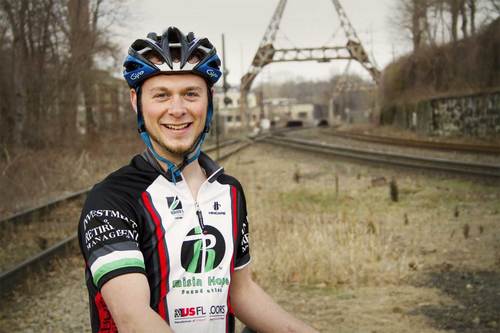
Doug Markgraf’s cross country fundraising and awareness bike ride will end in Toms River August 21.

The finish line is in sight for Doug Markgraf, a traumatic brain injury (TBI) survivor who is due arrive in Toms River August 21 after cycling across the country alone to raise money and awareness for TBI. Markgraf chose the location to highlight the work of Health South Rehabilitation Hospital of Toms River.

“Ocean County is very lucky to have an acute rehabilitation hospital,” said Denice Gaffney, director of Marketing Operations at Health South. “Not everyone has that level of care available to them locally.”

“We’re hoping to connect Doug with our brain injury survivors and our therapy team,” she said.

Markgraf, of Philadelphia, has been meeting with TBI survivors throughout the trip and was five miles outside Smyrna, Ohio when Patch talked to him Thursday afternoon.

“It’s blown me away that people who need that extra boost are getting it by me riding and meeting them,” said Markgraf.

Read the whole inspirational story at Toms River Patch.

Only a Number Takes Top Prize at Jersey Shore Film Festival @NJ Shore Patch

Steven Besserman shares his ailing mother’s Holocaust memories in award winning documentary.

“A17855: This became my only identity. This was Auschwitz,” Aranka Besserman says in the film tribute to her memories Resa, Steve, & Eleanor Besserman at Only a Number Screening, Deal, NJof the Holocaust that her son Steven Besserman directed.

Only a Number premiered at the Garden State Film Festival in March and won the Best Feature Documentary prize in a field of about 100 documentaries at the Jersey Shore Film Festival last week.

“This is where my mother lost her mother. This is where she lost all human dignity. This is where she became only a number,” Steven says as he narrates her story from the fairytale-like places where it unfolded.

Hers is an unlikely story of finding lasting love amidst unspeakable evil. …

Read the whole thing at Manasquan Patch.

Faith at Work, Part 7: Putting It All Together @TheHighCalling

glory 4

Figuring out how to integrate our faith with our work is a primary interest for the High Calling community. In our series about the work of Laity Leadership Institute Senior Fellow David W. Miller, we learned about four ways people do this and about a Hebrew concept that Miller says undergirds the Faith at Work movement.

Investigating the Sunday/Monday Gap

In the first article, we learned that Miller was flourishing in his career as a senior executive and partner at a London bank, and felt called to that career. But he seldom, if ever, heard clergy talk about how to integrate faith and work, even as he intuitively viewed work as part of God’s created order. If work mattered to God, why weren’t clergy talking about it?

To his surprise, Miller gradually discerned a new calling to attend Princeton Theological Seminary, where he earned an MDiv. and then a PhD. in Social Ethics, focusing almost exclusively on the question of integrating faith and work. This question continues to be central to his teaching and research at Princeton University, and to his consulting work with CEOs and businesses.

“I suppose people are drawn to study things either because they’re really good at it or because they’re not really good at it. I was drawn to this subject of integrating faith and work because of my own professional experience of asking how to overcome the Sunday/Monday gap,” said Miller.

A Theological Foundation

In the second article, we learned that the Hebrew concept of avodah provides a theological foundation for Miller’s work. …

Read the whole rest at The High Calling.

Hugs & Hospitality at Wright Memorial Church @BarnegatPatch

Congregation that meets in former opera house welcomes visitors with music and warmth.

“Life is desperate; we need all the hugs we can get,” said Rev. Bob Lewis after Sunday morning worship at Wright Memorial Presbyterian Church, Barnegat, NJWright Memorial Presbyterian Church.

He was standing at the foot of the church’s front steps greeting people after the service. There were hugs for the men and kisses on the cheek for the women. He inquired warmly about each person’s concerns and sent them on their way.

This kind of affection permeated the morning.

At 9 a.m., people gathered for coffee and conversation, Lewis said.

“Sometimes it’s religious. Sometimes it’s just funny and jokes,” he said.

At 10 a.m., Lewis began strumming his guitar and singing modern worship songs while congregants arrived and chatted. Music has always been important to the congregation, in keeping with its history as a former opera house that was foreclosed upon and purchased by the Presbytery of Monmouth in 1877, a church brochure said. …

Read the rest at Barnegat Patch.

Faith at Work, Part 3: Uncompromising Ethics @TheHighCalling

glory 4

Jimmy Dunne is, by his own admission, a man who sees the world in black and white. In a time when shades of gray are increasingly admired, this is not always a popular perspective. But Dunne’s singular vision became a bright light for others to follow after his workplace was decimated by terrorist attacks on the World Trade Center. Dunne is Senior Managing Principal for Sandler O’Neill, an investment banking firm that  suffered the loss of one-third of its 171 member workforce on 9/11/01.

At a 2010 Princeton University event, “Faith & Work Ethics in the Executive Suite,” Dunne spoke at length with Laity Leadership Institute Senior Fellow David W. Miller about his decision making process in the first harrowing days after he learned that his partners, friends, and coworkers had been killed. Nine-and-a-half years after suffering those losses, Dunne was still emotional about them.

He had survived the first terrorist attack on the World Trade Center in 1993, but was on the golf course the morning of September 11, 2001, when he learned of the second attacks. Thinking about the needs of spouses and children left behind, he quickly decided that these grieving families would receive salaries, medical benefits, and bonuses owed to their missing loved ones. …

Read the rest of this inspiring story at The High Calling.

Globetrotting toward a Spiritual Center and a Sense of Shared Humanity @NJShorePatch

 Dean Fengya’s accidental adventure evolved into a business with a spiritual core.

Dean Fengya, owner of Globetrotters, Pt. Pleasant Beach, NJIf you’ve driven the stretch of Route 88 where Point Pleasant Beach meets Bay Head, you’ve probably noticed Dean Fengya’s colorful collection of ceramic pots at Globetrotter, the import store he’s been running for 17 years.

What you may not have noticed is the religious statuary that grounds the carefully arranged field of blue, green, and beige. Fengya doesn’t import it for its religious significance, but that hasn’t stopped customers from turning some of the artifacts into shrines.

“My criteria is beauty. I see something that’s beautiful or I meet people that I know can make something that’s beautiful, perhaps with a little bit of my guidance and direction… and we work together,” said Fengya.

The pursuit of beauty has led Fengya to over 100 countries and he has integrated goods from close to 30 nations into Globetrotter and a second location that is set to open on Route 35 in July, he said.

Take those brightly colored ceramic pots that surround the flagship store, for example.  …

To read all about this delightful man and to see more photos of his beautiful wares, go to Manasquan Patch.

What Does the Missional Church Look Like? @TheHighCalling

The story of ORB.

Christian Andrews was in his sixth year of studies at Princeton Theological Seminary when he walked away from those studies to help a small proof of the garden stategroup of Christians reach out to youth in his home town of Red Bank, New Jersey.

“This group over time began to sense that God had called them together to do ministry with high school students. They sensed that in the joy they received from doing it, in the effectiveness of their work, and in the way it brought them to life,” said Andrews.

“They wanted someone to live in this town and facilitate their doing the work they felt called to—not someone to come and do ministry for them, but to equip them to do ministry,” he explained.

Andrews began to live in Red Bank “with eyes that were formed by this idea that what God had done in Christ was done for all people and that the difference between me and another person might just be that they haven’t come to know it yet and I’ve been given to know it and that I should live in such a way that maybe God would use me to help them see,” he said….

Read the whole thing at The High Calling. You’ll be inspired or challenged or both.

Christian Music, Divorce, & Triathlons: An Interview with Big Tent Revival’s Spence Smith @TheHuffingtonPost

When I talked to Spence Smith, a founding member of the five-time Grammy-nominated band Big Tent Revival, he had just come back from a run, which was appropriate given that Smith is a triathlete who took up the sport after a divorce left him feeling like a failure.

These days, if Smith picks up his drum sticks, it’s usually to play with one of the bands he collaborates with as an artist relations professional with the international aide agency Compassion International. He’s also a social media and marketing consultant.

On a trip to Ecuador earlier this year, Smith asked a Compassion coworker to marry him. She said yes.

Scheller: How do you maintain your faith and spiritual life both in the Christian music industry and traveling so much?

Smith: I grew up in the Church of Christ, which is notorious for no instruments in worship. … So when our band formed, I was not listening to Christian music. I did not know there was a Christian music industry. I just knew that there was this guy named Michael W. Smith and this girl named Amy Grant out there. …

When we started the band, we started because we really loved music and we really loved Jesus. That was about it. Walking out of the Church of Christ and into that environment was pretty eye-opening because I literally had grown up thinking — because that’s what we were taught — that we were the only ones going to heaven.

When you get outside of that and realize there’s tons of people in the world that love Jesus just as much, if not more, it really questioned my faith. What I realized after a few years of being in the band was that I wasn’t in this band because this band needed me or that God needed me to be in this band to help lead people into relationship with Christ. I really felt like I was in this band because it’s where God needed me to be to keep me in check and help me to grow.

So it was a growing experience for your faith rather than a destroying one?

Right. But because of that, you start walking through all these different denominations, playing for everything from Southern Baptists to the most Charismatic church out there. So you see everything in between. None of us spoke in tongues, so we played shows where promoters spoke in tongues and if they found out we didn’t speak in tongues, it’s like they were trying to get us saved again and that just wasn’t us. …

We ended up seeking out different people to walk alongside of us as road pastors or advisors or mentors. A guy that we had for a really long time who still does this for a bunch of mainstream artists is a guy named Michael Guido, and he was pivotal in our growth and in how we handled things relationally within the band. …

People always thought that we had tons of groupies and girls hanging around our band. For whatever reason, we just weren’t that band. … We took steps to make sure we were being accountable to each other and to the people we were working with. And so, I think that set us up for some pretty big success when it came to relationship and family and how we lived out our lives.

I will say this: there are lots of things that I experienced in Christian music that makes me very leery of Christians in general. Me, being a Christian, I walk very gingerly into situations where I know it’s going to be a heated discussion or a controversial issue, because most of the time I think they’re uncalled for.

What do you mean by that?

It could be anything. It could be walking into a church that you’re going to play at and all of a sudden you find out that the pastor is pretty egotistical. You basically want to kind of separate yourself from having to play to the whims of the senior pastor. If you walk into a situation where the senior pastor or the youth pastor is the big man on campus, and all of a sudden you’re 10 times bigger in popularity than he is, then it becomes an interesting situation.

We stayed away from issues that people fought about denominationally. For instance, our lead singer was very adamant about presenting the Gospel at as many shows as possible and giving people the opportunity to come to Christ at the show, and we were fine with that. That’s just part of who Big Tent was. In the process, we would go hang out during the day in this town, and we would ask questions like, “What’s it like for the church here in town?” Nine times out of 10, people would say, “We’re having a real problem getting the churches to come together to help this town out. These denominations just will not work together.”

Our lead singer would get up and he would present the Gospel and all these people would come forward and pray to receive Christ and it was all good. … Then he’d go through the whole line of denominations and he’d say, “We talked to people in this town and you guys have a real problem about churches coming together. Why does it take a show coming to town to get you guys all in the same room?” He would just encourage them to get in a room together more and to do things together. We really wanted to try to bring people together.

Coming out of working in Big Tent and working for Compassion has been an even more incredible experience because I got all that experience dealing with different denominations and people, and now I work for an organization that is very adamant about staying non-political and non-denominational. … When you walk up into the office in Colorado Springs or hang out with any of the staff, the denominational lines aren’t there at all. It’s that way politically too. … We have one goal and that is to help release children from poverty in Jesus name no matter where we go to church.

Tell me about Big Tent Revival. Did the band break up or go on hiatus?

We basically started forming in 1990. By the time we got on the road and started playing shows, it was around 1993. Our first record came out in 1994 and then we came off the road at the end of 2000. When we officially came off the road, we told people we broke up. There was all this record company politics of saying, “No, tell people you’re taking a break.” We said, “Wait, man, we gotta go get jobs. We can’t just tell people we’re taking a break. No one’s going to believe us.” We worked that all out and, about a month after we got off the road, I got this job with Compassion.

Since then, we get together and play shows every once in a while. … We left as friends and we’ve become better friends since. I think for us it’s just a matter of wanting to play together because we miss hanging out with each other.

How did you come to work for Compassion International?

Big Tent represented Compassion International and I really fell in love with the organization the first time I went on a trip. … I told the guy who was our artist guy, “If anything ever happens to this band, I’m coming to work for Compassion.” I didn’t realize that years later that would actually happen. …

When I got the job, it was a big risk for them because they’d never hired a musician. It’s been one of the greatest experiences of my life. … My job specifically is to work with artists and creative people. Part of my passion is to bring people into a bigger worldview than just what they’re dealing with locally.

Your other passion, I know, is triathlons. When did you start doing that and why?

I was coming out of a divorce about six years ago and I really needed to get my head together. I felt like a complete failure. I had failed in one of the greatest gifts we are given in life and I (we) just couldn’t make it work the way it was supposed to. The YMCA had this sign on the board that said “Running Group: Tuesdays and Thursdays 9:00, Brentwood Y.” I thought, “I work from home. I can do that.” I went the first time, I walked in this room and there’s like 20 ladies standing in this room. … I was the only guy that ran with them and they just totally took me under their wing. … It was cool and I did it for a year and I loved it.

I noticed at that time that I wanted to get stronger as a runner. I used to be a swimmer and I heard about this swimming group that was in town and I went to check them out and lo and behold, they were a swimming group that trained for triathlons. … I started swimming with them. … I did one triathlon at the end of the summer, and I fell in love with the sport. The next summer, I trained for triathlons for the whole summer. I did eight triathlons that next summer, sprint distance and Olympic distance. At the end of that summer, because of all the community and friends that I’ve made through that process, a bunch of us decided to do Ironman Louiseville for 2009. … I’ve been doing it ever since.

How do running and triathlons nourish the rest of your life?

There are good days and there are bad days when you run. There are some days when your legs are sluggish. I think life is like that. There are some days you wake up and you feel like you can tackle the world and things are going to be good, and there are some days when you get up and you’re like, I don’t even want to get out of bed. I can’t do this. But you have to make a choice. Part of this comes from going through my divorce. I chose to say, “I’m not going to be one of those guys who’s going to wallow in this and let this get the best of me. So, I’m going to choose to get up and make the best of it.” …

What I learned through training for Ironman is that there are a lot of Type A personalities that do triathlons. They’re very competitive. They’re very high energy. But doing something that’s an endurance sport separates those who are driven from those who are determined. Driven people usually quit. What happens is they drive, drive, drive and they go for it; and then they decide when they hit a roadblock, they’re not going to do that anymore because the path isn’t that easy, so they go a different direction.

Determined people will see the end result and when they hit a roadblock, they go, “All right, here’s a road block. How do I get around it? Does that mean I have to back up a few steps, take a break? If I get injured, do I have to call it off for a little bit? But I still have this goal ahead of me and even on the days that completely suck, I’ve still got to recognize that these are sucky days and I’m OK with that. There’s going to be a better day coming. So, let’s just get through.”

That helped me get through Ironman. It’s helped me get through difficult times in my life. It helps me walk with my relationship with the Lord in a way that’s much more honest and real than it ever has been because I have days where I have to recognize that my relationship with Christ is truly a relationship and he is perfect. I in no way can expect to be perfect. So I treat my relationship like I would with anyone else that I dearly love. And that is, some days I’m going to have bad days and some days I’m going to have good days. That if a friend is truly a friend, they’re going to be there for you no matter what.

Because you’ve talked about your divorce, I want to get some context for it. Was being on the road so much a contributing factor?

I was off the road by the time we divorced. I was traveling still, about half as much. No, it was definitely a relational thing.

How did you navigate that within the Christian world that you move and work in?

It was difficult, to say the least. Part of it was because she and I together in town were kind of high profile in the circles that we move in. She does publicity and we both work in the Christian music industry. So we definitely had to deal with a lot more than probably the average person would have to deal with in a divorce when it comes to stuff like that.

What I basically did was I just laid low. I set some ground rules in my personal life and I just made sure to not cross those lines so that I could be very accountable and know that I walked through things the best way that I could. There’s nothing easy about divorce. When we went our separate ways, even though it was rocky, when it comes to the friends and people that we deal with, we didn’t lose that. In fact, I think it kind of enhanced some friendships.

We only see each other two or three times a year at an event, but I would say over the past year, we’ve had some pretty good reconciliation on the level of friendship and respect. When it comes to dealing with each other in work-related matters, we’re both right on top of it. It’s been a real blessing for me and I’m really proud of her. She’s remarried and she’s doing a lot of cool things in her life, so it’s just been good.

I think the interesting thing is that it’s taken something like that to bring me into really discovering the person that I am now. I think walking into this next marriage, had I not gone through the divorce and learned what I’ve learned about myself, I don’t think I could walk into this marriage as well as I feel like I’m going to.

Congratulations to you both!

This interview has also been published at The Huffington Post.

High School Social Studies Classes Confront Islamophobia @LaceyPatch

I’ll be dealing with some of the issues raised in this lecture in my next NJ Shore Patch column. I didn’t have the opportunity to do so in this article.

Lacey Township High School is attempting to break cultural boundaries as guest lecturer Engy Abdelkader, a Muslim American, spoke to students about Islamophobia.

Social Studies teachers Julie Ferenc and Joe Humenick hosted Abdelkader in an effort to increase tolerance and reduce bullying, Humenick said. Although previous classes have learned about intolerance and a holocaust survivor is scheduled to speak before the school year ends, Abdelkader is the first person invited to speak on the topic this year, he said.

Abdelkader is a Monmouth County attorney of Egyptian descent. She was born, raised, and educated in the United States. Her goal for the event was to reduce conflicts, misunderstanding, teasing, and bullying, and to build trust and supportive relationships so that a more effective learning environment is created for all students, she said.

Abdelkader opened the discussion by asking students what stereotypes they have heard about Muslims and/or Arab Americans.  …

To learn more and to see how Lacey residents are responding, go to Lacey Patch.

Brookville Community Church Celebrates Easter @BarnegatPatch

Tiny but devoted congregation meets monthly in historic one-room church.

Easter 2011 at Brookville Community Church, Barnegat, NJEaster service at Brookville Community Church in Barnegat began at 11:30 a.m. At 11:20, Dave and Tammy were sitting in their car chatting with Bill, who was leaning into their window. My husband and I pulled up and said hi.

Tammy and Dave have been attending the one-room church for almost two years. They live in Beachwood, but park their motor home at Brookville Campground down the street, said Tammy.

“We saw this little church. We’re very fond of it. We love it. It’s just beautiful, ” she said.

The little building reminds her of an old Victorian chapel, she said. She’s equally fond of Brookville’s pastor, Eileen Murphy.

“She’s a wonderful speaker,” said Tammy.

At 11:25, I pushed open the church door and Bill turned on the light. He lives in the neighborhood and had the keys to the church. Dave began searching for a brochure that would tell me about Brookville’s history. He gave up a few minutes later when three women arrived.

One woman sat in a chair at the front of the sanctuary facing the congregation – eight of us altogether. She asked if anyone had joys to share.  …

Read the rest at Barnegat Patch.

What Makes Those Roller Girls Skate? @NJShorePatch

Jersey Shore Roller Girls season opener gives this longtime fan a glimpse into what propels so many of us to love roller derby.

Jersey Shore Roller Girls 2011 Season OpenerIt was a standing room only crowd for the Jersey Shore Roller Girls season opener at Convention Hall in Asbury Park Saturday night.

The Anchor Assassins scored a decisive win (163-134) over Murder Beach Militia. It was redemption after losing to the team by five points in the 2010 championship bout. …

The bout was fun, but what I really wanted to know was what motivated these women to pursue the flat track version of a sport I vicariously competed in when I was watching bank track bouts on Saturday afternoons back in the 1970s. …

Find out what keeps them and us hooked at NJ Shore Patch.