Cross-Country Bike Ride to End in Toms River Brings Light to Brain Injury @NJShorePatch

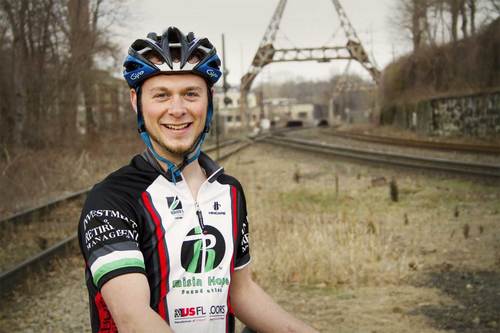
Doug Markgraf’s cross country fundraising and awareness bike ride will end in Toms River August 21.

The finish line is in sight for Doug Markgraf, a traumatic brain injury (TBI) survivor who is due arrive in Toms River August 21 after cycling across the country alone to raise money and awareness for TBI. Markgraf chose the location to highlight the work of Health South Rehabilitation Hospital of Toms River.
“Ocean County is very lucky to have an acute rehabilitation hospital,” said Denice Gaffney, director of Marketing Operations at Health South. “Not everyone has that level of care available to them locally.”

“We’re hoping to connect Doug with our brain injury survivors and our therapy team,” she said.

Markgraf, of Philadelphia, has been meeting with TBI survivors throughout the trip and was five miles outside Smyrna, Ohio when Patch talked to him Thursday afternoon.

“It’s blown me away that people who need that extra boost are getting it by me riding and meeting them,” said Markgraf.

Read the whole inspirational story at Toms River Patch.

Clarence Clemons Asks: Who Do I think I am? @Manasquan-BelmarPatch

Documentary on E Street Band’s ‘Big Man’ premieres at Garden State Film Festival.

Clarence Clemens Garden State Film Festival 016Clarence Clemons had dispersed a crowd on the Great Wall of China so a filmmaker could record him playing his saxophone when a member of the crowd demanded, “Who do you think you are?”

The accusation can be heard off camera in theWho Do I Think I Am? documentary that emerged from the encounter and that Clemons premiered at the Garden State Film Festival in Asbury Park Saturday night.

Clemons narrates the story himself.

It was 2005 and he had gone to China in search of rest and alternative medicine after a grueling tour took a toll on his body. Instead his accuser’s question became both the title and subject of his film and a catalyst for a spiritual quest. …

To find out where his quest leads, go to Manasquan-Belmar Patch.

One Church Said Yes to Perinatal Wellness @NJShorePatch

Rachel McKibben’s experience with Postpartum Psychosis inspired her to accept help on behalf of others.

Regional Perinatal Consortium of Monmouth and Ocean Counties (RPCMOC) health educator Amy Goldberg mailed 600 fliers to local religious organizations offering her program on pregnancy related emotional wellness.

One person responded.

That person was Rachel McKibben, director of youth and family ministries at Trinity Episcopal Church in Red Bank. For McKibben, the flier didn’t just represent another ministry opportunity; it was a highly personal invitation to do something about an issue that has shaped her own life.

McKibben is one of a tiny percentage of women who have experienced Postpartum Psychosis.  Although she had no history of mental illness and no symptoms after her first pregnancy, she did have some risk factors for Postpartum Depression (PPD)….

To find out how Rachel dealt with this terrifying experience, and what the signs, symptoms, and solutions are for PPD, go here, or here, or here, or one of the other Jersey Shore Patch.com sites.

Training Elite Athletes with a Jersey Shore Ethos @NJShorePatch

How performance coach Todd Durkin uses hometown lessons to lead elite athletes to victory:

The first time I met superstar performance coach Todd Durkin he was on his bike, slinging a newspaper across my family’s front lawn. Then his sister and I married a couple of Bricktown brothers and we became family. Last week, for the second time in two years, one of Durkin’s clients led a team to victory in the Superbowl.

In an interview with Yahoo! Sports this week, Green Bay Packers quarterback Aaron Rodgers talked about what a tough and effective trainer Durkin is. In the forward to Durkin’s new book,The Impact! Body Plan, last year’s winning quarterback Drew Brees credits the trainer with helping him grasp the elusive trophy. While Durkin expresses gratitude to these and other professional athletes for helping to make him a success, it’s his family and legendary Brick Dragons football coach Warren Wolf who get top billing in the acknowledgements. …

Read the whole thing here. …

Deceit & Hidden Cameras in the Abortion Debate @TheHuffingtonPost

As a Christian, a pro-lifer, and a journalist, I’m ambivalent about the Planned Parenthood hidden camera sting that was perpetrated here in central New Jersey and reported sporadically by news outlets this week. The California based anti-abortion activist group Live Action sent two actors into a clinic posing as sex traffickers and recorded an employee doling out unethical, dangerous, and illegal advice that would keep the duo in business.

As a Christian I’m uncomfortable with both the failure of the office worker to report the couple to authorities and the entrapment of her by the activists. When is it appropriate to lie? The biblical stories of the midwives who refused to kill male infants as commanded by Egypt’s pharaoh and Rahab’s deception that saved Jewish spies in Jericho both seem to affirm lying when it’s done to save lives, but I question whether or not any lives will be saved as a result of this action.

As a pro-lifer, I doubt this kind of activism ultimately advances the goal of reducing abortion. On one hand, undeniable truth is exposed. On the other, the bad will it inspires is a serious blow to the common ground efforts that I believe hold the best hope of actually bringing down the abortion rate in the United States. Also, as pro-lifer Rachael Laramore writes at Slate,

“Planned Parenthood should be responsible for the actions of its employees. It should at least be held to the same standards that the left wants crisis-pregnancy centers held to–no false advertising, no erroneous medical information. But it’s extremely unlikely that there are multitudes of men walking into Planned Parenthood trying to get cheap abortions for their sex workers. And the young women who count on the group’s cheap birth control will be the ones who are harmed if Planned Parenthood loses its federal funding.”

As a journalist, I’m ambivalent about the use of hidden cameras and deception. At the journalism resource Poynter.org, several articles address the ethical problems inherent in using deception to reveal truth. When it comes to using hidden cameras, an article by Bob Steele offers the following factors to consider:

The Importance Threshold

“Since we are in the business of pursuing truth, there is more than a hint of hypocrisy when we use some form of deceit to pursue the truth. We can only justify that inconsistency and the use of deception when we truly serve a greater principle, such as pursuing a highly important and otherwise elusive truth. Therein lies the first standard for deciding when it is appropriate to use hidden cameras. To justify deception we must be pursuing exceptionally important information. It must be of vital public interest, such as preventing profound harm to individuals or revealing great system failure.”

Tools of Last Resort

“This covert method of newsgathering amplifies any accusations we make. We must insure that the tone and emphasis of hidden camera video meet standards for factual accuracy and contextual authenticity.”

Trinagulate & Test Assumptions

“We must devote enough resources, time and attention to gather the right facts and make sure our facts are right. We must supplement the surreptitious video with insightful observations, seeing and retaining important details of a scene that might not be captured by the camera.”

Know and Respect the Law

“We must pay close attention to the legal land mines in hidden camera reporting. Stations must develop sound strategies that recognize matters of defamation and privacy, including false light and intrusion torts. We can be vigorous in our reporting if we are clear on the law regarding fraud, trespass and surreptitious recording of audio. The law appropriately protects citizens. We should honor the law while also responsibly serving the public.”

Live Action’s amateur investigative work meets the Importance Threshold in my opinion, but I’m not sure it meets the other three criteria. A quick search of the bios on its website reveals that no one on the leadership team has journalistic training. Their success causes me to not only question the veracity and ethics of the work, it makes me lament the fact that more professionals aren’t doing excellent, unbiased reporting like this from ProPublica’s Marian Wang.

In the New Jersey case, the first outcome is that one woman lost her job. While she seems incredibly callous in the video, I assume that hers is a tragically misguided attempt to minimize the consequences of sex trafficking on underage girls who are beyond her reach, or as one commenter at GetReligion suggests, perhaps to get them into the clinic away from the pimps so that they can be helped.

Hidden camera video doesn’t reveal what is in a person’s mind and I don’t believe this is a singular story. The woman identified in the video as Amy Woodruff is culpable for her actions, but she has also become a convenient scapegoat. It’s understandable that pro-life activists wouldn’t be interested in what it means for Woodruff’s family for her to lose a job they believe is immoral, but as a Christian I am concerned about the harm that was done to them in the name of the cause.

*Update: Three additional videos have been released from clinics in Virginia.

Update 2/7: This article has now been published at The Huffington Post.

The Case for Male Circumcision @Her.meneutics

I really had no idea how passionate people could be about this topic until I tweeted my intent to respond to a BloggingHeads.tv discussion of it. Below is the intro to my allegedly man-hating take. Above is a photo of my two precious boys.

What mother hasn’t, in the halcyon days after the birth of a son, felt her ferocious she-wolf instincts kick in when it comes time for her boy to be circumcised? Having perhaps suffered violence to her genitals during the birth, the physical ache to all that is vulnerable in her world can seem unbearable. And then it is done, and life goes on.

Anti-circumcision activists would have us believe that life does not in fact go on, that boys grow into men whose sexual pleasure (and that of the women they love) is compromised by this act of “genital mutilation.” While increasing numbers are swayed by both argument and sentiment, I’m stupefied by the controversy.

Male sexual pleasure is not my highest priority, having rarely witnessed a lack thereof. Nor is my own, if in fact I’m speaking out of my ignorance of the delight foreskin can deliver. What I am concerned about is sky-rocketing rates of sexually transmitted diseases, and the gender inequality evident in these rates. …

Read the rest here. For a taste of the emotion this topic inspires, be sure to read the comments, and my response to them.

Update 9/14/09: I posted this definitive comment in response to the 90+ comments on my post, and will have nothing further to say on this topic for the time being.

I really appreciate all the insightful, civil comments on this post. I’m not going to respond to them or to the hostile ones, as I’ve said my piece and others have filled in the blanks.

What I would like to explain is that as a journalist, I look for an angle on a topic that has not been covered sufficiently elsewhere. In my research for this post, I noticed that the writers I was reading seemed to miss the comparison to women’s embodied experience, so I chose to highlight that comparison.

I always consider what I write a contribution to public conversation, not a definitive statement on any given topic. Thus, I am gratified that what I’ve written has spurred people to think about something they might not have otherwise considered. If readers disagree with me, fine. Let the conversation continue and lead to change where it might be necessary.

In regard to this particular issue, I confess a subtle bias that I did not reveal in the post. I trust the Bible as my primary source of authority and have a bias towards its commands and injunctions. For example, I suspect that a kosher diet is probably healthiest, even though I don’t keep kosher. When God told women to stay outside the camp during menstruation, I think of that as a mercy. In the case of circumcision, I tend to think that if God ordained it, there is something inherently beneficial in the act itself.

When Abraham was commanded to be circumcised, he was a grown man, and must have been as horrified as many of you. Family members who did not hear from God must have been even more horrified. (LL Barkat made this point to me privately.) Still, circumcision became the sign of faith. Even if there were no medical benefits that science would later suggest, there are other values demonstrated in the act: pleasure is not our highest end; we are to acknowledge God’s sovereignty over our most vulnerable, intimate issues and trust him with our whole selves; logic is not to be our final authority, etc.

Don’t misunderstand. As I’ve already stated, the apostles declared circumcision of the heart the true sign of faith, as was consistent with Jesus’ reforms. Our Lord affirmed the Law though, and so I respect it, even when I don’t entirely understand it or live it out or think we are subject to it. I simply have a bias towards it.

I confess that there is a superstitious element to my reasoning. I also confess that scientism is probably the bigger problem with all kinds of medical procedures. If postmodernism has done nothing else, it has given us back a willingness to own our instincts.

Which brings me back to our faithful reader, Christian Lawyer, who I chose to engage because she consistently makes good points.

This I agree with: “If you want to teach our young people that they are powerless in the face of the “culture,” have at it, but don’t be surprised when these same young people succumb to the buffeting winds of suggestion, peer pressure, and defeatism rather than learning to stand strong and take responsibility for themselves and the circumstances of their lives.

The paternalism of the far right complementarians, just like the maternalism of the the far left feminists, is disempowering to women and instead breeds weakness.”

However, I never said I was powerless. I said I was influenced. Because of public conversations like the ones we have here at Her.meneutics, the excesses of both feminism and FAR RIGHT complementarianism may weaken. I hope to advance those goals.

With this, I disagree:

“Advocating cutting off men’s foreskins to protect women, rather than advocating education and contraception for women so they can protect themselves, is just another creepy example of the disempowerment of women under the guise of ‘protection.'”

Not either/or, but both/and. I am grateful that my mother took me to a gynecologist for contraception when she knew I was having sex and had no intention of stopping. However, this doctor (like the one who performed my tubal ligation) doled out treatment without asking a single penetrating question. I think this was a combination of both sexism and scientism.

Finally, I am no longer going to respond to anyone who does not own their comments with their full name and/or a link to their website or blog. I own my public comments both here and elsewhere. When I comment on other blogs, I usually do so under my initials, CAS, and leave the link to my blog when that feature is offered. In this way, internet searches of my name lead only to my work, but I am still held accountable for what I write online.

Thanks again for your interest. I look forward to what my colleagues have to say on this topic.

Cross-post from NF Endurance Team blog: Why Gabe Will Always Be My NF Hero

It’s a rare photo in which Gabe appears depressed. He was known for his boisterous, charismatic personality. But, from the time he left home for college, he struggled with depression. This photo was taken at my husband’s graduation from a pastoral training program in June 2004. Gabe would have just finished his freshman year at Wheaton College in Illinois.

I write about his depression because, as Endurance Team members, we are focused on overcoming and suicide seems like the antithesis of that. One thing I’d really like to accomplish through my involvement with the team is to help others overcome faulty ideas about depression and suicide. Ideas that I myself once held.

Not long before Gabriel died, I joined the CTF group on Facebook. A young woman posted a comment on the group wall about studies linking NF to psychiatric difficulties. I didn’t think much about it until after Gabe died. Then I began doing research and found one of the studies she may have been referring to. Here it is from PubMed:

Neurofibromatosis type 1 (NF1) is often associated with psychiatric disorders, which are more frequent in NF1 than in general population (33% of patients). Dysthymia is the most frequent diagnosis (21% of patients). There is also a high prevalence of depressive mood (7%), anxiety (1-6%), and personality (3%) disorders. The risk of suicide is four times greater than in the general population. Bipolar mood disorders or schizophrenia appear to be rare. The impaired quality of life associated with NF1 may play an important role in the development of psychiatric disorders. Quality of life assessments may help to identify a population at high risk.

Dysthymia can be defined as depression; despondency or a tendency to be despondent. It certainly describes Gabe at increasingly frequent intervals in the last year of his life. In another study, researchers found no link between the severity of familiar NF symptoms and the severity of psychiatric ones, indicating that something neurological might be going on rather than simple despair over the condition itself.

Since 2002, I have written for a magazine called Christianity Today. One of my articles was about Gabe and a couple others mentioned him. Because I had encountered a good deal of both ignorance and empathy after his suicide, I wrote about his death for the magazine. You can read that article here. It traces a bit of family history, does some education and poses the possibility that Gabe was suffering from bipolar disorder, which a couple of mental health professionals suggested after reading his suicide notes and journal entries. I’m ambivalent about this post-mortem analysis though, because the impulsivity that correlates with his attention deficit disorder combined with his undiagnosed dysthymia could be mistaken for bipolar.

Long before I had a thought about any of this, I wrote about Gabe’s NF in Christianity Today. That article was an investigation into human embryonic stem cell (hESC) research. Through it, I met my friend and NF Endurance Team partner David Brick. David is an hESC researcher at Children’s Hospital of Orange County, CA. When we were training for the Long Beach Half Marathon last year, David did some reading of his own on NF. He found something about the involvement of mast cells in NF. Mast cells are also indicated in asthma and allergies. This got me wondering if Gabe’s severe asthma might also have been a function of his NF. Instead of suffering from three separate diseases—NF, asthma and depression—was he really only suffering symptoms of one nasty disorder? I’d like to know the answer to this question.

The point of my writing about this here is both to alert CTF to these possibilities and to say that Gabe was for all of his life a true NF Hero. He overcame challenges that many of us will never face. The father from whom he inherited neurofibromatosis never acknowledged him and chose not to be a part of his life. He dealt with race issues as well, and was frequently sick and isolated with asthma. NF was always in the background as a concern. And yet, Gabe was incredibly accomplished. You can read about his many accomplishments here.

In one of his suicide notes, he wrote that as much as he kept trying to “pull himself up into the world of real people,” he felt dead inside. That feeling is not failure or a lack of courage; it’s a symptom of clinical depression. A symptom that he did not recognize had a treatment. A symptom he hid well in his lifelong habit of being an overcomer. A symptom I did not understand.

For the sake of others suffering such symptoms, I want to challenge the NF Endurance Team and its members to recognize that our message shouldn’t exclude those suffering from mental illness. Death by suicide is a preventable tragedy, not a lack of character. While we want to be careful not to romanticize or idealize those who die by suicide, we also want to remember that the vast majority of people who take their own lives die from mental illness that is no fault of their own.

So, here’s to my NF Hero, Gabriel Gifford Scheller!

Update: The NYC Half Marathon is just 10 days away and I’ve only raised $350 of my $1000 goal. If you’d like to help me answer the question posed in this post, you can support my efforts here, or you can send a check to: The Children’s Tumor Foundation 95 Pine Street, 16th Floor, New York, N.Y. 10005.

Speak the word only and my soul shall be healed.


I spend a good deal of time defending evangelicals, both in the real world and in the virtual one. I’ve begun to realize, however, that I’m often defending aspects of evangelicalism that I don’t care for myself. For example, in a discussion that followed my Her.meneutics post on “Hooking Up,” I defended followers of Bill Gothard against some rabid criticism, even though I deplore the sort of legalism Gothard represents. And last year, at Brandeis University, as one of two evangelicals amidst a dozen or more religion journalists doing a fellowship on Judaism, I repeatedly defended evangelicals against negative stereotypes that I myself have pondered in print.

I bring this up because, now that I’m home, I don’t fit easily in some of my old evangelical circles. Not that I ever did, but it’s been a while since I’ve been immersed in certain of our popular religious practices. I find myself shocked at things I once gave ne’er a thought to. I had hoped, for instance, that attending a Bible study led by a dear friend and wonderful teacher would bring me comfort. Unfortunately, I don’t care for the Bible study material we are using. It wants to turn the Bible into a self-help manual and its characters into heroes, and I don’t. I’m also tired of studying the Bible to extrapolate every last ounce of possible meaning out of it. It follows then that I don’t want to rip it into shreds and remake it in my own image. I mostly just want to read it for the comfort and correction I find in it.  So, there’s that and then the study group is composed of women from both sides of two church splits I lived through. There’s nothing awkward in this, except that I get a clear picture of where I’ve been and see pretty clearly that I no longer belong there.  I love and appreciate those places, but rarely find comfort in their forms of worship, whereas I always find comfort in the Anglican liturgy. Always. Never once in my three years as an Anglican has it failed to do its work on me. I live for Sunday worship because Sunday worship imbues me with the power and peace I need to live. (Worship is about God, but it gives back.)

I mention this because it relates to the topic at hand. That topic is pain. Deep, abiding psychic, spiritual, emotional pain that sometimes lasts for days on end.

Last night I was in that kind of pain, and so I picked up Nancy Guthrie’s book, Hearing Jesus Speak into Your Sorrow. I’m skeptical, not of Nancy mind you, but of my evangelical tribe’s tendency toward weak tea. I began reading nonetheless.

In chapter 3, she deals with those who would suggest that our children ( hers, and mine by inference) who died would have been healed if only we (or they) had had more faith. Nancy chose the story of Jesus healing the leper in Mark 1: 40-42 as her text for dealing with this issue. She came across the passage in the months after her daughter Hope died and says it hurt her feelings to think that Jesus was not willing to heal her child. I know exactly what she means. On the morning Gabe died, I said something to God that I don’t recall ever saying to Him before. I lay in my bed, and said, “God, if I were honest, I’d tell you I don’t think you love me anymore. How could you let my children …” A little while later, I said something harsh to Gabe about him wearing a dirty, smelly shirt to work again, and then went for a long prayer walk so that I could get my thoughts back in line with the truth of God’s word and affirm my trust in His love for me and my children. Before the day was done, my son was dead.

Nancy’s implicit trust in God led her to dig deeper into the Scripture to find out what Jesus was really communicating through his miracles (particularly the healing miracles). She came to the conclusion that if Jesus’s healing ministry had been mostly about healing physical sickness, it would have been more pervasive and central to his focus. Also, physical healing is by nature temporary and God didn’t come to earth for a temporary fix. In John 20: 30-31, we learn that the purpose of Jesus’s miracles is that we might believe, and believing, “have life by the power of his name.” Jesus’s priority was our deliverance from the ultimate source of our suffering and that is the sin that separates us from God. About the fall, Nancy writes:

Into the purity of the world God created, sin brought a poison that penetrated everything. And into the relationship we enjoyed with God, sin built a barrier. We went from being at peace with God to feeling threatened by him. Guilt and fear took over where innocence and openness had once ruled.

Ever been there? I have, at least once in the past 24 hours. And yet, she reminds us,

There is a day coming when death and disease will be healed for good. That is our sure hope in the midst of sorrow.

The passage that penetrated my pain last night is this one:

When Jesus said, “I am willing. Be healed!” to the leper, he was saying that he wants to cleanse us from the pervasive sin that will prove eternally fatal without his healing touch.

And now I realize that Jesus turns toward me when I call out to him for healing. Now I can hear him lovingly responding to me, saying, “I am willing. Be healed.” He is at work in my life, bringing healing to the wounded places where sin has left its ugly mark. He certainly isn’t finished yet, but I know the day is coming when his work in me will be complete.

I’ve also come to peace realizing that Jesus did not withhold his healing touch from Hope or Gabe. He has taken them to himself and will, at the resurrection, give them glorious bodies (Philippians 3:21). And this is no get-God-off-the-hook cop-out. It is everything we would ask for and long for.

It is the last paragraph that stuck with me as I went into today. I don’t want get-God-off-the-hook cop-outs. I want the truth. And the truth is that Gabe’s brain was sick from neurofibromatosis, from years of asthma-related oxygen deprivation, from inordinate guilt emanating from suicidal depression, from … The truth is his resurrected body will be tumor-free. The truth is the impulsivity and feelings of aggression that are common to both NF patients and suicide victims will be gone forever. The truth is he will breathe easy and never again have to say no to an invitation because of a household pet. The truth is he now knows and will for all eternity know that he is loved and lovable and lovely. The truth is it’s not my fault.

I didn’t process all of that last night. I simply held the last paragraph in my mind and went to sleep. This morning, I was still in pain.  At church, neither the opening hymns nor the visiting priest bade well for healing, and yet heal the liturgy did. I took note when the priest used alternate phrasing in the prayer we say before taking communion. Phrasing that echoes what Nancy wrote about from Mark 1. It is a sentence that I silently add every week and keep wishing our rector would use instead of the other. It is a piece of the reason why the liturgy never fails to do its work on me. There is power in the prayer:

Lord, I am not worthy to receive you, but speak the word only and my soul shall be healed.

He is willing, and so I am healed when I take his body and blood into my own in faith. There is power in the blood. One mustn’t forget that. Afterwards, we echoed these sentiments again as we sang the African-American Spiritual, There is a Balm in Gilead. It goes:

There is a balm in Gilead, to make the wounded whole. There is a balm in Gilead to heal the sin-sick soul.

Sometimes I feel discouraged, and think my work’s in vain, but then the Holy Spirit revives my soul again.

There is a balm in Gilead, to make the wounded whole. There is a balm in Gilead to heal the sin-sick soul.

If you cannot preach like Peter, if you cannot pray like Paul, you can tell the love of Jesus and say, “He died for all.”

There is a balm in Gilead, to make the wounded whole. There is a balm in Gilead to heal the sin-sick soul. …

Sometimes I feel discouraged and think my work has been in vain, but then the Holy Spirit revives my soul again. I cannot preach like Peter; I grapple with too many negative triggers and questions. I cannot pray like Paul; I don’t know how anymore, except in the most general terms. I can tell the love of Jesus though, and say, “He died for all.” For all the broken, battered and bruised. For all the sin-sick lonely souls. For all the high and mighty liars. For all the orphaned, starving children. For me. For you. For Nancy. For her Gabe. For mine. For evangelicals and our critics.  For every tribe—past, present and future. There is a balm in Gilead to make the wounded whole. There is a balm in Gilead to heal the sin-sick soul.

Notice, if you will, that the day’s healing was found in drinking from deep evangelical wells.

Racing for Research Again!


Guess who’s walk/jogging for neurofibromatosis research again? You’ve got it! I landed a coveted spot on the NF Endurance Team for the New York City Half-Marathon on August 16th, which doesn’t leave me much time to train or fund raise. If you helped us raise more than $4500 last year, thanks! If you weren’t able to give then and are able to now, here’s a word from team coordinator Bob Skold on why you should go ahead and write that check:

Recent advances in NF research are moving us significantly closer to reaching the goal of FDA-approved treatments for neurofibromatosis (NF). Research grant monies are now being used to fund basic and translational research with an eye on developing drug therapies.  Dr. Bruce Korf, one of the foremost NF research scientists states, “We now more or less understand the activity of the NF gene in the cell and are beginning to use that information to develop new treatments. I believe we’re at a point where we can look forward to effective treatments for NF1, NF2 and Schwannomatosis in the reasonable near future.”

The NFET is the largest CTF program funding NF research; indeed all donations to the NF Endurance Team are restricted for use in the CTF science and research programs. The NFET continues its commitment to advancing NF Research, now providing close to 1/3 of the funds to support the annual CTF research budget.  Following last year’s record $1.2 million raised, we are pleased to continue with this level of projected funding and to apply team donations to partially fund promising and top-priority CTF research initiatives in 2009.

For more specific information please go to our Team Fundraising Dollars at Work section on our Team web page. Our Team’s fund-raising success is an investment that can offer a world of possibilities to someone with NF. We are helping solve the NF Puzzle one mile at a time, one clinical trial at a time, one potential drug therapy at a time.

In fact, the New England Journal of Medicine just published a study that promises hope for NF 2 sufferers, like Bob. He has lost most of his hearing from the disorder.

I’ll keep you posted as to my progress. I hope to raise at least $1000 and to better my time from Long Beach by at least 30 minutes. You can get to know some of my team-mates at the team blog. I’ll be contributing there as well.

Here’s the link to my fund raising page. All you need to make a difference is a credit card and a willing heart!

Here are my previous posts on NF.

Beauty By Any Means Necessary

My latest post is up at Her.Meneutics. It’s called “Is it a sin to nip and tuck?” and was reclaimed from an article I worked on in 2007 that never made it to print. I offer the original here because my sources* made many points worth considering and because I think it’s a really good piece of work.

The photo above is of my sister Connie Smith before cosmetic surgeons created fingers for her from skin on her thigh. Connie was interviewed for this article. Living in Orange County, California, inspired my interest in the topic; Connie’s embodied experience informed my thinking.

“Beauty often wins love. It just does,” write Karen Lee-Thorp and Cynthia Hicks in Why Beauty Matters. No wonder women, and, increasingly, men are willing to endure the pain and risk of elective cosmetic surgery to attain it. New York Times reporter Alex Kaczynski states it bluntly in her cosmetic surgery expose’ Beauty Junkies. “In the end it all comes down to sex. … We are looking for love. And we will accept lust.”

Few admit this with the aplomb of Cena Rasmussen. This former model readily confesses that her cosmetic surgery addiction was fueled primarily by the bliss of turning heads. By her own admission, Rasmussen has spent years looking in the mirror. More often than not, she has seen reason to improve the image that stares back at her. Rasmussen was twenty-seven years old when Palm Springs, CA, cosmetic surgeon Razi Mazaheri first sculpted her flesh. He was dating Rasmussen’s friend and she was envious of the friend’s evolving, surgically-enhanced appearance.

In one transformative day, Rasmussen had breast augmentation, rhinoplasty, cheek implants and an eye lift. The breast augmentation didn’t heal properly and had to be redone almost immediately. In fact, one-quarter to one-third of breast augmentations will require additional surgery, according to Kaczynski and the FDA.

For Rasmussen, aesthetic surgery would become a biannual ritual that continued for two decades. There were more rhinoplasties, breast surgeries and lifts—eyes, face, neck—and non-surgical procedures as well. The regimen ended with a hyalauronic acid peel in 1999 that burned the skin on her face so badly, she says it left her looking like a “freak of nature.” Since then, Rasmussen has sworn off Mazaheri and has had nothing but $4000 worth of laser treatments to reduce the scarring. Still, she remains undaunted and is planning another face lift—her third, or is it the fourth? She can’t recall.

Racing into the Future

Rasmussen may represent an extreme in the use, or what some might call abuse, of cosmetic surgery, but the trend has been growing exponentially. In 2006, according to the American Society for Aesthetic Plastic Surgeons, Americans spent just under $12.2 billion on 11.5 million surgical and non-surgical procedures.

That’s a 446 percent increase from 1997. Surgical procedures increased by 98 percent and non-surgical procedures by 747 percent. Liposuction, breast augmentation, eyelid surgery, abdominoplasty and breast reduction were the top surgical procedures in 2006, while Botox injections, hyalauronic acid, laser hair removal, microdermabrasion and laser skin resurfacing were the most popular non-surgical techniques.

Ninety-two percent of patients were women, but men had nearly one million procedures. Forty-seven percent of patients were aged 35-50, 22 percent were 19-34, and 25 percent were aged 51-64. Ethnic minorities made up 22 percent of the patient pool.

Sculpting flesh is just the latest in millennia of questionable beauty-enhancement practices. The use of mobile x-ray machines for hair removal early in the last century is another. By the 1930s, the technique seemed “firmly entrenched,” writes Teresa Riordin in Inventing Beauty. She says women appear to have been “either ignorant of the dangers or simply willing to ignore them, given the ease and effectiveness of the treatment.” Sound familiar?

According to Riordin, women have long been collaborators and profiteers in this business. From the mid-nineteenth to the mid-twentieth century, for example, women received one-third of all U.S. patents, but in the category of pre-surgical breast enhancement (“falsies”), nearly two-thirds of patent-holders were women.

So what is a Christian to think about elective cosmetic surgery? Is it a sin to get a nip and tuck? Depends on whom one asks. I asked a variety of professionals and lay people. Their answers are an eclectic brew.

Choice

Lilian Calles Barger, author of Eve’s Revenge, says the choice to have cosmetic surgery is not a free one. “If you tell me, ‘my mother had cosmetic surgery. She’s a very independent woman. She really loves God and she wants to do this, and this is her choice,’ I say, ‘This is not a free choice. This choice is under duress.” Barger describes the phenomena as “appalling,” “gut wrenching,” “fundamentally wrong,” “a failure of the imagination.”

“The body is not just a hunk of meat,” she insists. “The body is significant in Christianity. The Bible talks about how we are to offer our bodies as living sacrifices to God. The question is what are we offering our bodies up to when we do that?” Her conclusion is that we’re offering them up to “false beauty and to cultural norms that we should be challenging,” but adds, “so that is where you can be compassionate, because you can understand that sin is not the sinner by themselves. It is collaborative, communal, reinforced. We support each other in this.”

Barger’s claim was born out in interviews with several cosmetic surgery patients.  In nearly every interview, individual choice was held out as a trump card, but all the women made their decisions within the context of relationships both personal and professional.

Therapeutic and Spiritual Perspectives

A disconnect between body and Spirit emerged in the reasoning of two patients who said body sculpting decisions are spiritually insignificant. “I don’t think it is a spiritual issue in any way,” says Rasmussen. “I personally believe that when we die, we’re going to have a glorified body that’s not going to be physical in any way. So what does the Lord care what we do to our skin?” Rasmussen explains that she both saved for her procedures and tithed faithfully throughout the exercise of her habit.

A fifty-something patient who asked not to be identified has had eye lid surgery, a chin implant, a mini-face lift and Botox. She says that as she struggled with the idea of tampering with the body God gave her, she sensed Him saying, “My beloved, you’re beautiful. You don’t need to do this.” She doesn’t believe, however, that tuning out the voice of God was sin. What matters, according to this patient, is “where your heart is.”

Cissy Brady-Rogers is a Pasadena therapist who has had a mastectomy, but no reconstruction after breast cancer years ago. She says that our culture “sets women up to feel shame about our bodies.” Body shame originates at home where children are not taught what to do with developing bodies and sexual impulses. It is then reinforced in school and through the larger culture. This coincides with what Brady-Rogers calls “disembodiment”—the phenomenon by which a subject looks into the mirror and sees that he or she does not measure up to cultural ideals and then comes to view their body as an object in need of repair rather than simply “me.” She says those considering aesthetic surgery would do well to heal the cause of their discontent (shame) rather than treating symptoms surgically.

Sociologist Philip Rieff talked about this disembodiment as “the triumph of the therapeutic” in his landmark 1960s book of the same name. It is a view of self as patient to be cured that he believed had replaced religion as the defining cultural narrative. He wrote, “That a sense of well-being has become the end, rather than a by-product of striving after some superior communal end, announced a fundamental change in focus in the entire cast of our culture—toward a human condition about which there will be nothing further to say in terms of the old style of despair and hope.”

For Christians walking out faithful body stewardship in defiance of this fundamental change, Brady-Rogers (who holds a Master of Divinity degree along with her other credentials) offers another narrative. She says patient-consumers are trying to figure out how to save themselves, just like the Galatians were, and in the process are biting and devouring one another by increasing the social pressure on all of us to conform to false ideals. “There is always going to be some law, some culturally offered avenue to save ourselves, to make ourselves okay, to fix what’s not working.” What Paul said is that it’s not going to work. Christ is the only one who can save us. “We are free to have plastic surgery. There is not a biblical law that says, ‘Thou shalt not have plastic surgery or drive a BMW,’ but what the Scripture says is: do not use your freedom as an opportunity for self-indulgence, but through love serve one another.”

For a woman contemplating aesthetic surgery, she advises, “I would like her to have a group of soul sisters who could support one another in becoming who they are in Christ, and support her in a process of discernment about that decision, not as solo journey. That may be part of the problem; too many women are making these decisions in isolation from other women.”

Idols and their Denouncing Prophets

Although the pursuit of beauty and the power it wields are timeless, a plethora of television makeover shows has normalized the triumph of both the therapeutic and the pornographic. Affluence and materialism, improved surgical techniques and doctors fleeing managed care realities for a cash business have all kept the engine humming along in the direction of more medical intervention to tame unwieldy flesh, according to Kaczynski.

In a 2004 New Atlantis article, “The Democratization of Beauty,” Christine Rosen wrote, “Cosmetic surgery … feeds our envy of those who embody nature’s most powerful but fleeting charms—youth, strength, beauty, and fertility. Its supporters praise its ability to change lives and its critics denounce it as the expression of our society’s worst impulses.”

As Christians reach for the charm, it’s these worst impulses that Hans Madueme, M.D., a fellow at the Center for Bioethics and Human Dignity, insist pose the greatest danger.

He calls the trend “deeply depressing” and says it’s one more area of American materialism that shocks his African family when they visit. The intuitive “yuk” reaction some Christians have towardaesthetic surgery is instructive, says Madueme. It tells us where the culture is moving, and reveals our loves, desires, idols and lusts. He suggests three “functional idols” that come into play with aesthetic surgery: youth, beauty and money. Consumers idolize youth and beauty, while medical providers exploit patients “inordinate desires” as a function of money idolatry.

Gary Churchill, a suburban Chicago facial plastic surgeon and aesthetic patient, offers a different perspective. He believes God directed him to a career that overwhelmingly consists of making women look and feel younger and more beautiful. Churchill was deeply offended when a fellow churchgoer suggested his work is incompatible with his faith. He takes a minimalist approach to surgery that leaves patients looking “refreshed” rather than altered.

Scot Rae, a bioethecist at Talbot School of Theology in La Mirada, CA, had an up-close and personal introduction to the world of cosmetic surgery when his wife Sally was having breast reconstruction after a double mastectomy. Although Rae was shocked to see young women in the surgeon’s office perusing catalogues that advertised buttocks implants, he strikes a middle ground.

Rae says Christians must see medical technology through a proper theological lense. He says God embedded his wisdom into creation through general revelation and that technology is “one of the primary ways that human beings unlock and apply God’s wisdom in the continuing quest to subdue the earth.” Rae allows that this quest was complicated after the fall, but says the three Ds—death, disease, and decay—were brought into the world by sin, and, as such, are legitimate targets for alleviation through technological means.

Like Madueme, Rae believes our intuitions are helpful, but sometimes in need of re-education. “They give us sort of yellow lights, but not necessarily red or green.” He offers a three-fold grid for evaluating aesthetic surgery. First, he says,” We are not our bodies, but we don’t devalue the body.” Second, “Medical technology, in general, to help alleviate the entrance of the effects of sin is a part of God’s common grace. And I think you can make a very good case that aging is a consequence of sin.” Third, “There’s a dynamic interaction between the soul and the body. So that’s why I think it makes sense that both men and women who have a change in their bodily appearance can feel better about themselves, and vice versa.” He concludes, “I think the bottom line is that you get principles and parameters out of Scripture and those form the fence around the field in which there’s freedom to make decisions.” If his eyelids were to droop in ten years, Rae says he would consider a nip and tuck.

Marketing toward Insecurity

To those who suggest that cosmetic surgery is marketed toward women’s insecurity, Ray Anderson, senior professor of theology and ministry at Fuller Theological Seminary in Pasadena, CA responds, “We need to look at it much more realistically, that it’s on a continuum. It’s on the same continuum as other aspects of embodied cultural life that effect our self-image….The solution to that [marketing towards women’s’ insecurity] is not to demonize an industry, but it is to revitalize the soul, the self in such a way that one is free to make use of products, services, opportunities within responsibility without having to be branded in ones own mind at least to be capitulating to that culture. We have to be strong enough so that Christian women now need to be socialized in the Christian community in such a way that they are able to make good choices with regard to products and opportunities to enhance their appearance and self-esteem within their culture.”

Anderson’s son-in-law Gregory Evans is chief of aesthetic and plastic surgery at UC Irvine Medical Center in Orange, CA. His practice is equally divided between corrective and aesthetic surgery. Evans says, “We all as physicians help people, but our area of the field is really trying to focus more on quality of life issues. … So one day a hand, another a cleft lip, breast reconstruction, injecting Botox around the eyelid—so we’re involved in the whole facet of a person.” Evans acknowledges the potential for exploitation, but offered a four page code of ethics from the American Society of Plastic Surgeons as evidence that his board is serious about combating unethical advertising practices fueled by greed.

The only board certifications Kaczynski trusts are those offered by the American Board of Plastic Surgery and the American Board of Medical Specialties.

Anne Brattli is an aesthetician and salon owner in Sarasota, Florida. Brattli found out the hard way that not all board certifications are equal. Ignorant of uneven licensing practices in the industry, she briefly went to work for Kurt Dangl, a practitioner who was later featured on 20/20 and in Beauty Junkies for his part in the death of a breast augmentation patient whose anesthesia was administered by an unlicensed “nurse.”

Brattli says Dangl offered free surgeries to employees after four months of employment. At first she considered a tummy tuck or liposuction. But after witnessing the grisly realities of the operating room (which were visible from the break room where employees ate their lunch), Dangl’s arrogance and myriad grotesque complications, she changed her mind. Eventually she learned that Dangl’s primary training had been in dentistry and took an early and permanent maternity leave.

Brattli has been examining women’s faces under a high-powered microscope for a decade. She identifies a nagging problem with medically enhanced beauty. “When you’re talking to someone who’s had Botox and they smile at you, they don’t look sincere and you can’t put a finger on it, but it’s because they’re smiling at you with their mouth and not with their eyes. When you get a person who smiles with their eyes and their mouth, you feel like they’re genuine. With Botox, it doesn’t matter if they’re genuine. It just never reaches their eyes.”

“Sooner or later a person that resorts to some artificial way of delaying aging or overcoming some perceived abnormality is going to have to deal with the fact that you’re going to have to live with what you’ve got,” concedes Anderson, who, at 80-years-old, is still dying his hair and beard dark brown.

Wisdom from Tarnished Humanity

Some women, like Connie Smith, never have had a choice about the bodies they inhabit. Smith was born with multiple birth defects [her term of choice]: congenital constricting bands that cut off most of her fingers at or below the knuckles, a clubbed foot and webbed toes. With sponsorship from March of Dimes, cosmetic surgeons created digits that have served her well for more than 40 years. Perhaps it is women like her, Brady-Rogers and Sally Rae who have the most to teach us about living within our imperfect, aging bodies.

Smith is a homemaker and is divorced from her husband. Facing the idea of mid-life dating and re-entry into the job market, she has no plans for medical enhancement. She feels the same cultural pressures that others do, but says when she feels good about other areas of her life—particularly her relationships with God, family and friends—her birth defects don’t bother her or others. “When I’m feeling good, I project an air of confidence, she says, “My hands are the last things on someone’s mind; they are looking at my face or my body, or they are listening to my words. My hands are irrelevant. When I project insecurity, I feel like some people treat me like I’m invisible. They’re looking at me in a different way.”

Transcendent Pursuit

Rieff and Kaczynski may be correct that the therapeutic and the pornographic have triumphed. The theologians may be correct that technology can be either used responsibly or abused in a Christian context as it alleviates the effects of the fall. Feminists and therapists may be correct that the industry exploits women’s greatest insecurities and culturally induced shame. But there’s also something uniquely American and Protestant in the wholesale rush to embrace medical enhancement.

David Brooks describes this strain of perfectionism in American life in his book On Paradise Drive. He writes, “Unlike some other bourgeois nations, we are also a transcendent nation infused with everyday utopianism,” a utopianism that “lures us beyond the prosaic world” and “gives us a distinct conception of time, so we often find ourselves on some technological frontier,” Of these ever-expanding frontiers, Brooks duly notes that we occasionally look back on them with regret.

As medically altered faces and bodies become more commonplace, will the era of Botox and DD breast implants be one we regret? Will the dangerous excesses be abandoned as x-ray hair removal machines were? One can only hope.

*Note: I have not updated the information in this piece. Source affiliations and cosmetic surgery stats may have changed.

“Poverty is on the Agenda” at UrbanFaith.com

My first article for Urban Faith is up. It’s a report on the Sojourners/World Vision Mobilization to End Poverty event I attended in Washington D.C. last month. My reporting for Urban Faith focuses primarily on the experiences of other attendees at the event. I was also asked to write a blog post for Sojo.net about my own experience at MEP. After agreeing to do so and then attending the event, I realized I had made a mistake because I couldn’t really do honest journalism for the event host. When an outlet reports on its own event, it is called public relations. I decided to submit an honest account of my experience and let the chips fall where they may. Sojo.net elected not to publish this account. I take the editors at their word that the problem was with the writing and not with my critique. It’s pretty dull, I guess, and perhaps tangential, but I present it here nonetheless. Make of it what you will.

What to make of an anti-poverty event that could easily cost participants $500-$1000 or more, depending on how far they traveled, where they slept and what they ate? I ask the question not as a criticism, but because it influenced my one day experience of the Mobilization to End Poverty gathering, and my early exit from it.

The recommended hotel cost $245 a night, an amount higher than any I have ever paid for a hotel, even when my husband earned a six-figure income. I might have stayed at a hostel for $50 if I had acted early, but instead I camped alone for $16 a night at Greenbelt National Park in nearby Maryland. A late model German station wagon served as my “tent.” For dinner I prepared Trader Joe’s noodles with a cup of hot water that I grubbed at McDonald’s. I covered my interior windows with $9 worth of “made in China” tablecloths I had purchased at a nearby dollar store. They quickly filled my abode with the suffocating smell of formaldehyde. (How toxic must those factories be?) As evening wore on, I tried to read the 100th anniversary edition of Walter Rauschenbusch’s Christianity and the Social Crisis, but felt vulnerable, alone and foolish for setting up camp in what passes for a DC suburb.

What little sleep I got was periodically interrupted by the sound of sirens in the distance. Looking put together and professional after such a night is a challenge I don’t care to repeat. It’s a challenge I’m not sure I could endure with grace on a daily basis. By the time I arrived at the convention center, I felt unkempt. Inferior. Apart from attendees I imagined could afford to comfortably lobby and talk about poverty—even though I’ve spent the past six months working hard to gain access to tax-payer funded mental health services for an uninsured and currently uninsurable family member. I rejoice in care of questionable quality because it is something and it’s cheap.

From this vantage point I assessed day one of the Mobilization to End Poverty.

The speakers were inspiring—more consistently inspiring than most on the poverty circuit, according to a couple Sisters of Charity from Leavenworth, Kansas. Biblical mandates flowed freely, and startled when they too closely resembled mandates anointing a different political agenda that had been roundly and rightly criticized from these quarters.

Activists were enthused. A couple expectant Presbyterian fathers from Bradenton, Florida, were there looking for inspiration. They had flown into town, but were staying with friends in the suburbs. One is a church youth group leader; the other a board member of his local chapter of Habitat for Humanity. At the close of day one, both had gained renewed enthusiam for themselves and their ministries. The investment was clearly worth it to them.

 A Lutheran attendee from Pennsylvania said he was excited to be there talking about something other than abortion and gay marriage. Yes, but why must we denounce? The rigor of the abortion debate was appropriate to its time and is evolving in ways appropriate to our time. The gay marriage debate is one worth having. We should applaud it, and add to it, not shirk from it. Ambivalence on this issue dare not speak its name and that’s not good. What does it require of me to oppose hunger or affirm health care reform?  Certainly nothing as gauche as meddling in other people’s sex lives. Unless of course one deigns to get their hands dirty with real people—people like my grandfather, who produced six children and then abandoned them.

It’s easier to meddle in people’s money, especially with an economic crisis and an unpopular war that create convenient platforms upon which to build our case. On Monday afternoon, no less than former CEO and current World Vision president Richard Stearns compared the 2009 economic collapse to the 1989 fall of communism, saying unrestrained capitalism had been found “bankrupt” and “inadequate” in the same way unrestrained communism had twenty years ago. He spoke truth to the choir.

So let me meddle. In addition to denouncing corporate greed, how about, as longtime urban minister Rudy Carrasco suggested to me, we lobby business for its support in the same way we lobby elected officials? Doing it already? Fine. Then don’t dismiss the interests of business.

Instead of comparing and contrasting one pro-life cause with another, as Monday night’s preacher did, how about we make Obama accountable for his promises to support responsible fatherhood, adoption and abortion reduction?

In my husband’s work as case worker and pastor to homeless men at Double R Ranch in Warner Springs, CA, one of his responsibilities was to help men re-enter the lives of their children. Often this meant getting them to see beyond themselves and their own histories of failure to the welfare of others. The process began with caring for the ranch’s 40+ horses and other animals. It also included requiring them to contribute a portion of their minuscule incomes to the support of their children and facing the women who were busy cleaning up their messes.

Last year, I emailed my elected representatives to ask them to vote for the Paul Wellstone-Pete Domenici Mental Health Parity and Addiction Equity Act of 2008, a bill that requires insurers that offer mental health coverage to do so equitably. A bill that President Obama sponsored as a senator and that President Bush signed into law. It’s a pro-life issue I heartily supported as the mother of a child who died by suicide and whose birth was ensured by the advocacy of notorious pro-lifers like the late Jerry Falwell.

I realized this week that I cannot afford face time with my legislators in Washington right now, but I can make a difference. First by caring for my own family members and others within my sphere of influence, second by contributing tax revenue to fund sources of support upon which my loved ones currently depend, third by advocating for a wide variety of pro-life causes and, finally, by challenging my peers.

So let me close with this reflection: It’s great to rally the troops and celebrate our victories, as long as we don’t become the thing we despise. Don’t become the thing you despised Sojourners. You have friends of all political and theological persuasions.

Update: Sojourners included my UrbanFaith article in their media accounts of MEP.

Being Well When We’re Ill

 being-well-when-were-ill

Last week Christianity Today announced its 2009 book awards, which evaluate books published in 2008. For several years now, I’ve served as a judge in the Christian Living category, and been introduced to some wonderful books that I might not have otherwise read. I’ve also trudged my way through a few that, well, I didn’t care for. (What does Rob Bell have against proper paragraph structure anyway?) Sometimes I’ve been in sync with the other judges and sometimes I haven’t. This year, I was. The winner, Reconciling All Things: A Christian Vision for Justice, Peace and Healing was excellent, as are most InterVarsity Press books that I’ve read. IVP books are consistently well edited: The writing is always tight and readable, the style clean and the content substantive.

My top choice, however, was the Award of Merit winner: Being Well When We’re Ill: Wholeness and Hope in Spite of Infirmity by theologian Marva J. Dawn. I chose this title even though the editing could have been tighter, because content is queen.  Dawn lives with multiple physical infirmities, and still manages to have a full life of writing, teaching and speaking. She writes an honest account of the challenges those ailments pose for both her and her husband. The book is laid out in chapters that work nicely as daily devotions. They begin with a Scripture and end with a prayer. Sandwiched between are Dawn’s theological and personal reflections.

Being Well When We’re Ill isn’t just a book for sufferers, but also for caretakers. It isn’t designed as such, but in my role as spouse and mother to three (now two) chronically infirm family members, I found it exceedingly helpful. For example, chapter nine is titled Loneliness–Community. It begins with a meditation of David from Psalm 31:9-12:

Be gracious to me, O LORD, for I am in distress; my eye wastes away from grief, my soul and body also. For my life is spent with sorrow and my years with sighing; my strength fails because of my misery and my bones waste away. I am the scorn of all my adversaries, a horror to my neighbors, an object of dread to my acquaintances; those who see me in the street flee from me. I have passed out of mind like one who is dead; I have become like a broken vessel.

Dawn notes that this psalm comes from a time when physical afflictions were often thought to be God’s punishment. David emphasizes his feelings of alienation from friends and neighbors, and his enemies’ delight in his sorrow. Most telling though, are his feelings of abandonment. In an earlier chapter Dawn examined the blame that is frequently assigned to those who suffer.  She revisits the theme here:

Some people espouse the bad idea that we experience chronic illness or handicaps because we have done something wrong. Then such people try to help us fix it, which leads to a different kind of isolation.

The types of isolation she identifies are: physical isolation, intellectual isolation, emotional isolation and envy, social isolation, misunderstanding and spiritual isolation.  In the midst of the discussion, she quotes seminary professor Arthur Paul Boers:

I learned long ago in giving pastoral care that in stressful situations people feel not just severely alone but profoundly misunderstood. The sense that “I’m the only one who knows, understands, or feels this” may be ever more difficult than whatever appears to be giving the pain. … It is important to name and share the details and to have someone else listen to them.

Not only have I been on the receiving end of such misunderstanding regarding my husband’s and sons’ infirmities, I have also been the one to alienate and isolate them because of my own ignorance of their conditions. Dawn’s book helps me to better love my family and stand with them against the misunderstanding of others.

Her advice for strengthening ourselves spiritually is rich:

As emphasized in previous chapters and emphasized through the Scriptures, the Trinity is never apart from us, even when we feel that we are enduring a dark night of the soul. But our various kinds of isolation and the deep loneliness that results make us feel that God is absent too.

That is why it is so important that we establish habits of reading the Scriptures, so that we can trust what we know over what we feel. When we feel most estranged from God, we find great treasure in texts that assure us of the Lord’s presence. …

We cherish the sacrament of the Eucharist, for it gives us bread and wine so that we can know Christ’s presence in a tangible form. In the same way, the sacramental work of the church is to be a physical sign of the Trinity’s presence for the sake of everyone, especially the lonely.

The chapter ends with this prayer:

Almighty God, by your Holy Spirit you have made us one with your saints in heaven and on earth: Grant that in our earthly pilgrimage we may always be supported by this fellowship of love and prayer, and know ourselves to be surrounded by their witness to your power and mercy. We ask this for the sake of Jesus Christ, in whom all our intercessions are acceptable through the Spirit, and who lives and reigns for ever and ever. Amen.

Being Well When We’re Ill is a book I would give to others and that I highly recommend. It’s one I would never have been introduced to had it not been for the book awards. Don’t miss this gem!

Another book that my husband and I have been recommending a lot, especially to the young and spiritually alienated, is Scot McKnight’s The Blue Parakeet: Rethinking How You Read the Bible. I saw no mention of it in this year’s awards. I’m sorry about that, as I would have preferred it to a couple other contenders.