What I Wrote This Week @UrbanFaith: 6/27-7/1

Hitchhiker, NYC

  • New Laws, Shifting Demographics: Whether the issue is gay marriage, the ‘war on drugs,’ African American marriage prospects, or the plight of undocumented immigrants, Americans are confronting the issues.
  • Michael Tait: ‘Living Integration’: The dc Talk veteran and current Newsboys singer on race, politics, and the beauty of diversity in Christianity, music — and food.

Michael Tait at Jersey Shore Will Graham Celebration May 22, 2011Michael Tait is lead singer of The Newsboys. He and the Grammy-nominated band performed an electric set at the Jersey Shore Will Graham Celebration in Ocean Grove, New Jersey, last month. Best known as a member of the pioneering Christian rock/rap group dc Talk, Tait’s career in the Christian music industry has been defined by stretching the boundaries of art, faith, and culture. Urban Faith News & Religion editor I caught up with Tait as he prepared to take the stage. …

  • Out in Greenwich Village: Should a church that helps people who struggle with unwanted same-sex attraction be allowed to stay in one of the nation’s most gay-friendly neighborhoods?

The big news out of New York last weekend was the legalization of gay marriage, but The Village Church in Greenwich Village is under threat of eviction from the public school where it meets and a New York Times op-ed writer says it should be because its ministry to people struggling with unwanted same-sex attraction doesn’t represent the community. I spoke to the church’s senior pastor, Sam A. Andreades, about the church and it’s unique position as the only Exodus International affiliate church in New York City. …

A Fitting Tribute

Opening Ceremony at The Overnight Walk, NYC, 6/4-5/11
Over the weekend, my niece and I joined 2000+ suicide survivors for the 18 mile Overnight Walk through New York City. A record $2.5 million was raised for suicide prevention, research, and survivor support services. Our team contributed more than $5000 to the pot.

Lumaire dedicated to Gabe at The Overnight Walk, NYC, June 4-5/11

People assume, I think, that I write about Gabriel’s suicide and raise money for causes related to it, because doing so aides in my healing, or redeems the horrific reality, or brings meaning to my life. In reality, exposing this wound exacts an emotional toll that I’m increasingly unwilling to pay.

I shouldn’t be writing about my son killing himself; I should be writing about how he’s taking the world by storm with his many talents and passions.

What? by Gabriel G. Scheller

I’m sure Mariel Hemingway would rather talk about her grandfather’s literature than his suicide too. But there she was at the Overnight Walk speaking eloquently and tearfully to the crowd about her pain, and filming a documentary about suicide, because, I think, she recognizes the danger to the rest of her family (including her daughter) in not talking about its legacy of suicide.

She wants it to stop.

Mariel Hemingway and her daughter at The Overnight Walk, NYC, 6/4-5/11

In the last four years, with the help of both loved ones and strangers, I’ve raised somewhere in the neighborhood of $10,000 for causes related to Gabriel’s death, not because it’s fulfilling, but because I felt compelled to do something to stop the pain for others.

NF Endurance Team 2008

Now don’t hold me to this statement if I change my mind, but I think I’m done with public fundraising campaigns that draw attention to my loss. This means no more big events that require $1000 minimum fundraising goals in order to participate, unless I can afford to write a $1000 check myself. It was incredibly difficult, for example, to tell my neighbors that I was hosting a block party to raise money for suicide prevention because my son killed himself.

Overnight Walk Block Party 026

It was a great party, but I really hated exposing myself like that. I don’t want to do it again.

Don’t get me wrong. If you’ve given to one or more of my fundraising campaigns, I offer my sincere gratitude. Your money was well spent, so well spent in fact that I hope you’ll keep giving to The Children’s Tumor Foundation and the American Foundation for Suicide Prevention until neurofibromatosis and mental illness no longer threaten the well being of those whose lives they touch.

However, instead of continuing to focus on Gabriel’s death, in my new position as News & Religion editor at UrbanFaith.com, I’ll honor his life. He cared deeply about the issues Urban Faith reports on, so I think it’s a fitting, subtle tribute to work on these issues too.

I’ll be updating the site too frequently to post links to my articles as they’re published, but I’ll try to post a weekly update. Here’s what I’ve done so far:

There’s much more to come.

As you read my words at Urban Faith, it can be our little secret that they’re written for Gabe.

High School Social Studies Classes Confront Islamophobia @LaceyPatch

I’ll be dealing with some of the issues raised in this lecture in my next NJ Shore Patch column. I didn’t have the opportunity to do so in this article.

Lacey Township High School is attempting to break cultural boundaries as guest lecturer Engy Abdelkader, a Muslim American, spoke to students about Islamophobia.

Social Studies teachers Julie Ferenc and Joe Humenick hosted Abdelkader in an effort to increase tolerance and reduce bullying, Humenick said. Although previous classes have learned about intolerance and a holocaust survivor is scheduled to speak before the school year ends, Abdelkader is the first person invited to speak on the topic this year, he said.

Abdelkader is a Monmouth County attorney of Egyptian descent. She was born, raised, and educated in the United States. Her goal for the event was to reduce conflicts, misunderstanding, teasing, and bullying, and to build trust and supportive relationships so that a more effective learning environment is created for all students, she said.

Abdelkader opened the discussion by asking students what stereotypes they have heard about Muslims and/or Arab Americans.  …

To learn more and to see how Lacey residents are responding, go to Lacey Patch.

Who Gets the Money? @UrbanFaith

Are Christian donors less likely to write checks to minority-run ministries? Anecdotal evidence from the world of nonprofit fundraising suggests there’s a race-based disparity in giving.

Trust is vital to any relationship, but when it comes to funding African American-led urban ministries, it can mean the difference between success and failure. At least that is what Urban Faith heard from several notable leaders who identified lack of trust as a key factor in race-based funding disparities.

Brian Jenkins is director of Entrenuity, a ministry that helps urban youth start their own businesses. Although the organization has been featured on public television and has trained more than 700 adults and 4,000 youth since 1993, Jenkins says, “What I have found is that when it comes to people saying ‘we’re brothers and sisters in Christ,’ that’s fine, but when it comes to supporting my work and me as a minister in Christ, that’s where the breakdown occurs.” …

Read what Jenkins (and four other leaders) had to say about this important topic at Urban Faith.

My first column for Patch.com is about some wonderful friends who are making a big difference in the lives of urban youth. Here’s how I introduce them:

When my late son Gabriel was preparing to be inducted into the National Honor Society at Long Branch High School eleven years ago, he had to choose a sponsor. Without hesitation he chose Reverend Elmer Jackson, the charismatic founder and principal of Westside Christian Academy, a small private school that serves urban youth in Monmouth County. …

Go to Monmouth Shore Patch to find out how the Jackson family has inspired so many people to get on board with their vision.

Seeing ‘The Invisible’ @UrbanFaith

If the poor will always be with us, as Jesus said, then why don’t we always see them? Learning from “the least of these” with author and urban ministry leader Arloa Sutter.

Two stories stand out in Arloa Sutter’s new book, The Invisible: What the Church Can Do to Find and Serve the Least of These. The first is about a man named Irving Wasserman, who was a recipient and giver of grace at Breakthrough Urban Ministries, the organization that Sutter founded to serve homeless men, women, and children in Chicago. Wasserman was diagnosed with schizophrenia as a young man. He looked and acted like the kind of homeless person many of us would avoid: dirty, profane, volatile. But Sutter invited him into Breakthrough’s community center one day for a cup of coffee and gradually learned that he wasn’t homeless, just very much alone and extremely frugal. …
Sutter’s frozen lamb metaphor is a memorable one; you can read about it and more here.

The Politics of Hunger @UrbanFaith

Ambivalent about exercising your patriotic duty on Tuesday? I was too, until I interviewed the winner of the World Food Prize and learned why this election is so important to hungry Americans. Here’s the intro:

Hunger is a devastating problem in third-world countries, but according to Bread for the World president David Beckmann, one-quarter of all African Americans live in poverty right here in the U.S. That’s why he believes vanquishing poverty should be at the top of our “Christian” political agendas — and why he’s urging people to vote on Tuesday.

David Beckmann is president of Bread for the World and the recent winner of the 2010 World Food Prize. In addition to being an anti-hunger activist, he is a Lutheran minister and an economist who formerly worked at the World Bank. His latest book is Exodus from Hunger: We Are Called to Change the Politics of Hunger. UrbanFaith columnist Christine Scheller interviewed Rev. Beckmann about his work, hunger in the African American community, and why we should be aware of the federal policies that influence issues of poverty in America. …

And a compelling exchange from our conversation:

I tend to think that living in the United States, hunger is more invisible. How has it changed you working for the World Bank and Bread for the World?

What’s most striking is that the world as a whole has made remarkable progress against hunger, poverty and disease. I believe in God and I see that hundreds of millions of people have escaped from poverty in places like Ethiopia, Bangladesh, Brazil and Britain. That’s why, for me, it makes sense that this is God moving in our history. And then I come back to the U.S.A. where we haven’t made any progress against hunger and poverty since about 1973 and it informs, I think, the U.S. situation. If Brazil and Bangladesh can reduce poverty, it’s clear that we could do it in the U.S. We just haven’t tried for a while. But we did try as a nation. In the ’60s and the early ’70s, we had economic growth and we had a concerted effort under both Johnson and Nixon to reduce hunger and poverty and we cut poverty in half. So it’s doable here too. … I think the fact that we work on world poverty and domestic poverty together makes it all much clearer that our problem in this country is lack of commitment.

Read the whole thing here, and don’t forget to vote.

This interview was reprinted with permission at The Huffington Post on November 2, 2010.

Pressing Past the Heartbreak @UrbanFaith.com & @HuffingtonPost.com

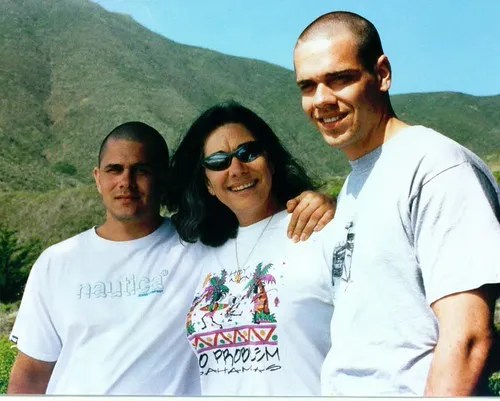
Dustin, Lynn Ann & Daniel Bogard

The photo above is of Lynn Ann Bogard and her two sons, Dustin (left) and Daniél (right). She and her husband Craig were kind enough to talk to me about how they are able to continue on in urban youth ministry after their sons’ deaths. The story begins like this:

Craig and Lynn Ann Bogard grew up in a small, predominantly white community in New Mexico but sensed a call to minister to African American youth in central New Jersey after a short-term mission trip to the area in the early 1970s. Thirty-five years later, despite living through periods of relying solely on God for their next meal, the Bogards are still at it. They have faced the kinds of challenges that only a deep and abiding faith could pull them through — fundraising struggles, misunderstandings about their motives by both blacks and whites, and, most recently, the untimely deaths of their two beloved sons, Daniél, 28, in 2004 and Dustin, 25, in 2007.

I’ve been aware of the Bogards’ Aslan Youth Ministries for many years, but only just met Craig Bogard last month. As I listened to this slight, serious man recount Aslan’s history, what I really wanted to know was: How do you keep ministering to other people’s children when your own were taken from you?

You’ll find the answer to that question and a whole lot more here, and here, at The Huffington Post where the article was reprinted with permission from Urban Faith.

Where Passion and Purpose Align: An Interview with Judge Hatchett @The High Calling

Talking with Judge Glenda Hatchett on behalf of TheHighCalling.org was one of my favorite professional experiences ever. It was not for nothing that she was nominated for an Emmy award this year. Here’s the intro to our interview:

Glenda Hatchett is best known as the Emmy nominated host of Judge Hatchett, a television court show that aired from 2000-2008 and was noted for its creative sentencing approach to justice. Hatchett developed her unique style as Presiding Judge of Georgia ’s Fulton County Juvenile Court, one of the nation’s largest juvenile courts. She surprised even herself when she left a lucrative career at Delta Air Lines to enter public service. Today Hatchett serves on the board of Boys and Girls Clubs of America and the Atlanta Falcons. She is also national spokesperson for the Court Appointed Special Advocates program and travels widely as a motivational speaker.

You can read it here.

Cross-post from NF Endurance Team blog: Why Gabe Will Always Be My NF Hero

It’s a rare photo in which Gabe appears depressed. He was known for his boisterous, charismatic personality. But, from the time he left home for college, he struggled with depression. This photo was taken at my husband’s graduation from a pastoral training program in June 2004. Gabe would have just finished his freshman year at Wheaton College in Illinois.

I write about his depression because, as Endurance Team members, we are focused on overcoming and suicide seems like the antithesis of that. One thing I’d really like to accomplish through my involvement with the team is to help others overcome faulty ideas about depression and suicide. Ideas that I myself once held.

Not long before Gabriel died, I joined the CTF group on Facebook. A young woman posted a comment on the group wall about studies linking NF to psychiatric difficulties. I didn’t think much about it until after Gabe died. Then I began doing research and found one of the studies she may have been referring to. Here it is from PubMed:

Neurofibromatosis type 1 (NF1) is often associated with psychiatric disorders, which are more frequent in NF1 than in general population (33% of patients). Dysthymia is the most frequent diagnosis (21% of patients). There is also a high prevalence of depressive mood (7%), anxiety (1-6%), and personality (3%) disorders. The risk of suicide is four times greater than in the general population. Bipolar mood disorders or schizophrenia appear to be rare. The impaired quality of life associated with NF1 may play an important role in the development of psychiatric disorders. Quality of life assessments may help to identify a population at high risk.

Dysthymia can be defined as depression; despondency or a tendency to be despondent. It certainly describes Gabe at increasingly frequent intervals in the last year of his life. In another study, researchers found no link between the severity of familiar NF symptoms and the severity of psychiatric ones, indicating that something neurological might be going on rather than simple despair over the condition itself.

Since 2002, I have written for a magazine called Christianity Today. One of my articles was about Gabe and a couple others mentioned him. Because I had encountered a good deal of both ignorance and empathy after his suicide, I wrote about his death for the magazine. You can read that article here. It traces a bit of family history, does some education and poses the possibility that Gabe was suffering from bipolar disorder, which a couple of mental health professionals suggested after reading his suicide notes and journal entries. I’m ambivalent about this post-mortem analysis though, because the impulsivity that correlates with his attention deficit disorder combined with his undiagnosed dysthymia could be mistaken for bipolar.

Long before I had a thought about any of this, I wrote about Gabe’s NF in Christianity Today. That article was an investigation into human embryonic stem cell (hESC) research. Through it, I met my friend and NF Endurance Team partner David Brick. David is an hESC researcher at Children’s Hospital of Orange County, CA. When we were training for the Long Beach Half Marathon last year, David did some reading of his own on NF. He found something about the involvement of mast cells in NF. Mast cells are also indicated in asthma and allergies. This got me wondering if Gabe’s severe asthma might also have been a function of his NF. Instead of suffering from three separate diseases—NF, asthma and depression—was he really only suffering symptoms of one nasty disorder? I’d like to know the answer to this question.

The point of my writing about this here is both to alert CTF to these possibilities and to say that Gabe was for all of his life a true NF Hero. He overcame challenges that many of us will never face. The father from whom he inherited neurofibromatosis never acknowledged him and chose not to be a part of his life. He dealt with race issues as well, and was frequently sick and isolated with asthma. NF was always in the background as a concern. And yet, Gabe was incredibly accomplished. You can read about his many accomplishments here.

In one of his suicide notes, he wrote that as much as he kept trying to “pull himself up into the world of real people,” he felt dead inside. That feeling is not failure or a lack of courage; it’s a symptom of clinical depression. A symptom that he did not recognize had a treatment. A symptom he hid well in his lifelong habit of being an overcomer. A symptom I did not understand.

For the sake of others suffering such symptoms, I want to challenge the NF Endurance Team and its members to recognize that our message shouldn’t exclude those suffering from mental illness. Death by suicide is a preventable tragedy, not a lack of character. While we want to be careful not to romanticize or idealize those who die by suicide, we also want to remember that the vast majority of people who take their own lives die from mental illness that is no fault of their own.

So, here’s to my NF Hero, Gabriel Gifford Scheller!

Update: The NYC Half Marathon is just 10 days away and I’ve only raised $350 of my $1000 goal. If you’d like to help me answer the question posed in this post, you can support my efforts here, or you can send a check to: The Children’s Tumor Foundation 95 Pine Street, 16th Floor, New York, N.Y. 10005.

Some Thoughts on Substance at Saddleback

My thoughts on the Saddleback Forum on the Presidency? Overall, I thought John McCain looked and sounded really old. I thought he spoke in sound bites. I thought it was absurd that he had to reach back some forty years for a story about his faith. I agreed with young Brian and Lauren in that he reminded me of a grandpa reliving (and relying on) his glory days rather than a future-focused leader. In short, I thought Obama was the more thoughtful, engaging candidate.

It may surprise some readers that I was not particularly bothered by Obama’s answers on abortion and stem cell research since I’ve been a vocal opponent of both. Life is certainly more precious to me now than ever in light of my son’s death earlier this year. However, like other evangelicals and post-evangelicals, I’m much less likely to base my vote on these issues than I might have been in previous elections. 

The reasons are myriad, but I’ll start with this: there are moments when I feel like a statistic—just another mother of a young, black man who died a tragic, senseless death in the context of a racialized society. Whether I look at his death from a psycho-social perspective or a purely medical one, issues that relate to the quality of life for African Americans are viscerally important to me in this election cycle.

Given my interview focus for this event, I was struck by the disconnect between the predominantly white evangelical audience’s responses and the concerns of their African American brethren, which, in my interviews, centered on the economy and health care. Jobs and good health go together, in case anyone was wondering.

I wish I could write about a particular health insurance nightmare that my family is currently dealing with, but I am not at liberty to do so. The situation is akin to one I blogged about some time ago in regard to a black mother whose teenage son had died from a heart defect. The boy’s brother had the same defect and had already suffered two heart attacks. He could not work and thus could not afford the medication that would keep him alive. He had been repeatedly turned down for Social Security benefits. This situation is unconscionable. It’s also a pro-life issue that hits me where I live.

I’ve wanted to publicly say for a long time that my goal as a pro-life writer is less about legislation and more about letting women know that having their baby will not ruin their life; doing so will enrich life in challenging, wonderful ways. I believe this more now than ever. I have often wondered why we get so upset about the fate of embryos if we really believe their souls, if they have them, go to be with God. My concern in regard to hESC research has, for some time, centered on who we are as human beings and as a society when we view life, even nascient life, as disposable. These issues are, of course, important matters of law about which I come firmly down on the pro-life side. I just no longer buy the argument that this should be the foundational issue upon which one should base their vote.

As an opponent of hESC research and as a patient advocate, I object to science being pursued and politicized because of the abortion debate. Both candidates were wrong on this issue Saturday night. As I reported here in March, hESC researchers themselves are beginning to declare hESCs a dead end in terms of cures. Why then the excessive investment of limited resources? Why is this still even a question worthy of presidential debate? How about instead asking if the candidates favor regulation of the IVF industry? Even some hESC researchers and IVF doctors are asking for this.

Warren asked two unique questions in my view, the one about making adoption easier and the one about human trafficking. I was glad to hear Obama commit to making adoption easier, particularly if it prioritizes children lingering in foster care here in the United States.

On the human trafficking question, I’m a bit more cynical. As a person acquainted with a SoCal mega-church culture that covers up the sexual abuse of minors and punishes those who speak out, this topic sounds like a feel good way to oppose something far away. Sex slaves in Asia. It costs little for the average American to oppose that from an armchair in suburbia. Not so easy to turn in Uncle Ted when he’s providing financial support to a struggling single parent family, or to risk one’s livelihood when Uncle Ted is a well-connected pastor. If I’ve learned three things about sexual abuse of minors when it’s up close and personal, they are 1) people generally won’t talk, 2) when they do, they will be socially punished, and 3) perpetrators are rarely prosecuted. I wonder, also, how many Orange County evangelicals include in their definition of victims of human trafficking, the undocumented migrants who’ve unwittingly sold themselves into slavery to get across the Mexican/US border? 

As to the question of evil, I found both men’s answers frightening for reasons articulated well by Crunchy Con columnist Rod Dreher. Earlier today, he wrote:

Obama’s nuance, it seems to me, is another word for vagueness. Quinn, a liberal, thinks Obama’s taking a pass on answering Warren’s query about when an unborn child (or, if you prefer, the fetus) acquires human rights is a sign of a supple mind. In fact, by refusing to explain his views, Obama was either being purely political, or revealing that he is not a careful or inquisitive thinker about one of the most critical moral and political issues of our time. “Above my pay grade” is a pure dodge. There is a pro-choice answer to that question, one that I happen to disagree with, but that’s at least philosophically valid. Obama chose not to give it. Why? And why is it considered intellectually respectable by the likes of Quinn that Obama declined to give a straight answer to this question? There is a certain kind of intellectual that sees muddleheadedness as a virtue. It’s the classic liberal weakness: to find, or to seem to find, reasons to excuse evil, or to avoid a confrontation for disreputable reasons.

On the other hand, Kristol views McCain’s utter clarity as a sign of virtue. How anybody can emerge from the Bush years and the Iraq experience with the same Manichaean view of the world and America’s role in it is flabbergasting. But there it is. If Obama was too abstracted — and he was — then McCain was too concrete, and his concreteness was itself a form of ideological abstraction. In other words, by seeming to refuse to recognize complexity in the world and the tragic sense at work in our affairs, McCain evidences living in a world of unreality as well.

Nevertheless, as a political matter, McCain’s approach plays much better with Americans. We like a good story, and we like to understand complex matters of morality and policy in terms of story. When Obama made the perfectly reasonable and necessary point that we have inadvertently done evil in the name of good, he should have brought up Abu Ghraib and torture as examples. He should also have spoken of the unplanned and inadvertent evil of getting our soldiers bound up in wars that seemingly have no end, for no compelling national interest. He might have spoken about how our good intentions about expanding home ownership to more Americans led us to foolishly overextend our financial system.

There are many stories Obama could have told about the cost of imprudence, and he could have — and should have — planted doubts among voters about where the high-minded, crusading verities regarding the nature of Evil and the proper response to it has gotten the country. But he missed that opportunity.

Well those are my thoughts about the Saddleback Civil Forum on the Presidency. Whoops. I forgot to mention gay marriage and the war. Tough issues about which I’ll take a pass for now. Last point: I was glad to hear both men prioritize the energy crisis. As to whether or not journalists should be worried that Warren is going to put them out of a job, I do believe the whole “Cone of Silence” non-debacle speaks for itself, in both substance and silliness.

CT & Teddy: I’m Sorry by Gabriel G. Scheller

I\'m Sorry

*******************************************************************************

Dialogue Replay

Teddy: I just watched Watership Down. …  Damn. … I’m sorry.

(note: read the book series instead.)

[©GGS circa 2007, all rights reserved.]