How Far Should Forgiveness Go? @ChristianityToday

Corona Del Mar Baptism

My Christianity Today essay on forgiving corrupt clergy is now available online. It begins like this:

“Forgiving love is a possibility only for those who know that they are not good, who feel themselves in need of divine mercy, who live in a dimension deeper and higher than that of moral idealism, feel themselves as well as their fellow men convicted of sin by a holy God and know that the differences between the good man and the bad man are insignificant in his sight.” —Reinhold Niebuhr, An Interpretation of Christian Ethics

I wish I could believe every one of these words from Reinhold Niebuhr. Instinctually, I don’t, wishing instead for Dante’s hell for certain kinds of sinners—like corrupt pastors who egregiously violate their calling and never repent. In my unregenerate opinion, I believe these types of sinners should be relegated to the eighth and ninth circles of Dante’s Inferno.

I’ve read numerous books on forgiveness. Some of them lead me to conclude that the authors have never known the kind of spiritual betrayal some Christians, including myself, have known. If they did, they could never write the pabulum they are selling.

Read the rest here.

I did an email interview with Michael Newnham, host of The Phoenix Preacher in conjunction with the article. Here’s an important clip:

Phoenix Preacher: There is a point in the article where you suggest that the spiritual betrayal your family experienced may have been a factor in your son taking his own life. Could you address that and also address why such betrayal is so devastating to its victims?

Christine Scheller: There is a difference between triggers and causes of suicide. Triggers are the immediate circumstances to which suicidal people react. I am not saying that spiritual betrayal was a trigger for Gabe’s suicide. It was, however, a significant factor that contributed to the erosion of the spiritual foundations that had once sustained him. There were many other causes, too, including a neurological disease called Neurofibromatosis that is associated with depression and a higher suicide rate, a serious head injury after which he began saying he didn’t feel like himself, an asthma drug that the FDA concluded in 2009 has a definitive link to suicidal ideation, isolation from family and friends after a cross-country move and a very problematic relationship with a girl that was, in fact, the final trigger.

As to the spiritual element, the backlash we experienced at the mega-church after we had to report another staff member for inappropriate behavior with a child was only the most egregious in a long line of betrayals that I wrote about in another article for Christianity Today called “Sorrow, But No Regrets.” The reason such betrayal was so devastating to my son goes back to my first answer. His trust was violated so many times by people claiming to represent God that he eventually shut himself off from Christian community. Even at the end, though, he kept trying to reconnect. The last time was a month or so before he died, when he visited a church and talked to a pastor who proceeded to disparage his parents’ decision to become Anglicans. That was the end of that.

The one thing that still makes me angry is the fact that the situation at the mega-church exhausted and distracted my husband and me to the degree that we were not there for our son to in the way that he needed us to be. We had moved cross-country to train for and enter vocational ministry and, over a three-and-a-half year period, gradually realized that we had sold our home and the apartment building that would fund our retirement, left professional opportunities and dragged our willing kids across the country to be a part of a system that was utterly putrid.

Now, Gabriel died two years after we left the church, but there was media attention and legal action as well as relationships that continued to keep us tied to the church for a couple years. The awful irony is that these situations had finally resolved and I thought we were all beginning to recover, when, in fact the worst was yet to come. I actually view my son’s suicide as the horrific ending to the whole sorry mess.

The whole interview can be found here.

Special thanks to Scot McKnight for recommending Simon Wiesenthal’s The Sunflower: On the Limits and Possibilities of Forgiveness and L. Gregory Jones’ Embodying Forgiveness: A Theological Analysis, both of which I cite in this essay. He also recommended his own book, The Jesus Creed: Loving God, Loving Others, but I regrettably only just dug it out of my storage shed.

[Note: The photo above is of Jeff and another pastor preparing to baptize a new Christian when Jeff was on staff at Calvary Chapel of Costa Mesa.]

Domestic Abuse: Coming to a Church Near You @Her.meneutics

Sin by Silence Poster“How long am I to remain in this relationship?” This is the haunting question 65-year-old Glenda Crosley asks in the documentary, Sin by Silence, about the abusive husband she killed in 1986. She has been in prison for as long as she was married — 24 years — and wonders when her ordeal will be over.

In the film, shot almost entirely inside the California Institution for Women, Crosley says the first time her husband, Sam, “truly got physical” was when she was eight months pregnant with their second child. He shoved her into a wall. Eventually she came to believe that the violence wouldn’t end until one of them was dead. According to The Bakersfield Californian, at the time of Sam’s murder, the couple was separated and having an argument in a parking lot. When Sam walked away from her car to the trunk of his, she believed he was going to get the tire iron he had threatened her with the week before. She rammed him once, drove away, then turned her car and hit him again. He died at the scene.

Elizabeth Leonard, author of Convicted Survivors and professor at Vanguard University, a Christian college in Costa Mesa, California, says in the film that women who leave abusive relationships are often subject to “separation assault” and are 75 percent more likely to be murdered than before they left. So the answer to the question: Why didn’t she just leave? is not a simple one. …

Learn why not (and what you can do to help stop domestic violence) by reading the whole article here.

Pressing Past the Heartbreak @UrbanFaith.com & @HuffingtonPost.com

Dustin, Lynn Ann & Daniel Bogard

The photo above is of Lynn Ann Bogard and her two sons, Dustin (left) and Daniél (right). She and her husband Craig were kind enough to talk to me about how they are able to continue on in urban youth ministry after their sons’ deaths. The story begins like this:

Craig and Lynn Ann Bogard grew up in a small, predominantly white community in New Mexico but sensed a call to minister to African American youth in central New Jersey after a short-term mission trip to the area in the early 1970s. Thirty-five years later, despite living through periods of relying solely on God for their next meal, the Bogards are still at it. They have faced the kinds of challenges that only a deep and abiding faith could pull them through — fundraising struggles, misunderstandings about their motives by both blacks and whites, and, most recently, the untimely deaths of their two beloved sons, Daniél, 28, in 2004 and Dustin, 25, in 2007.

I’ve been aware of the Bogards’ Aslan Youth Ministries for many years, but only just met Craig Bogard last month. As I listened to this slight, serious man recount Aslan’s history, what I really wanted to know was: How do you keep ministering to other people’s children when your own were taken from you?

You’ll find the answer to that question and a whole lot more here, and here, at The Huffington Post where the article was reprinted with permission from Urban Faith.

On Quitting the Circus & Coming Home to the Jersey Shore @HuffingtonPost

A while back I was invited to blog for The Huffington Post Religion channel. I had a nice conversation with an editor who I’d met in 2008 at a professional event. I sent a couple emails in reply and heard nothing back. I submitted the post below last week and heard nothing back. I called and left a message for the PR guy who emailed me when the channel went live and heard nothing back. So I’m posting my introductory The Huffington Post post here. Perhaps someone at The Huffington Post will discover it and get in touch, either to tell me that they want it and/or me or that they don’t. Either way, this lighthearted, but very serious post reflects my current spiritual convictions and my current state of mind, which is contentedly and resolutely conflict averse. So,  if you’re reading, just pretend you are at the swarming open-source site being introduced to me for the very first time. Here’s what I’d have to say:

I was sitting on the front porch of the aluminum-sided duplex I rent from my mama and daddy, talking to my chickens and looking through the rusty old chain link fence, past a neighbor’s immovable pile of junk and the port-o-potty that’s taken root in the yard of a newly manufactured home like it’s a perverse old local pine, at a kid in a hunter green pick-up truck squealing out of the neighborhood and I thought to myself, “This is why people call this town Bricktucky.” It’s an insult that I’ve only recently been introduced to, though I’ve lived here at the Jersey Shore nearly all my life.

Never mind that it’s a short two mile jog from my neighborhood to some of the most expensive beach front real estate in New Jersey and nine miles southeast to the party town where American television is creating the same kind of distorted image of the Jersey Shore and Italian Americans that Neil Postman said it does of everything that matters. There’s a Moose Lodge between me and the summering glitterati and the most prominent Italian American influence that I observe here besides the dominant culinary one is the Roman Catholic Church.

It startled me, for example, after a six year sojourn in Orange County, California, to come home and find the local Gannett affiliate reporting on Ash Wednesday services as if they were a matter for serious consideration. In the land of the mega-church, the impartation of ashes was an opportunity to be identified with him who was despised and rejected, or at least with him who was a religious sideshow oddity.

Speaking of the circus, there is the carnival that is summer at the Jersey Shore and then there is a bucolic day-in, day-out life that nourishes those who live it. The same could be said of American Christianity. The abundant life resides in a parallel universe from the carnival performances of pseudo-celebrities and culture warriors left and right. Sometimes the universes intersect. Often they collide.

I didn’t always know this. I had my favorite Christian authors and radio preachers. I heard a particularly insightful one speak at a conference once. He was getting close to retirement and sprinkled his talk with appeals to buy his books so that he could enjoy his golden years. Another one, whose radio broadcasts nourished my budding faith in the early 1980s, was, twenty-five years later, the only mega-church pastor in an affiliation of them to publicly stand by my husband and me after we publicly confronted his spiritual mentor’s corruption.

You can be assured of one thing only when it comes to successful preachers and authors: they are compelling communicators. They’ve no doubt worked hard to get that book or sermon written while you’ve been lounging at the pool (or, in my case, the coop), but I’ve met and/or interviewed enough authors and speakers to assure you that prominence and godliness don’t go together like Guidos and Guidettes. Your grandma is more likely to be an accurate reflection of the risen Christ than anyone who’s sought and endured the limelight, including me.

You need to know this if you want to live the abundant life our savior promises rather than aspiring to the fun house mirror distortion. Becky Garrison gets this and writes about it in her new book, Jesus Died for This? A Satirist’s Search for the Risen Christ. Garrison is the daughter of an eccentric Episcopalian priest. Although her father preached civil rights in the south when that was a dangerous thing to do, he also reportedly dropped acid with Timothy Leary. She writes, “Dad overloaded his sermons with countercultural slogans that were full of tolerance but light on theology. Without the power of the risen Christ, Dad’s civil rights activism that drew him to the priesthood was reduced to Sesame Street sing-alongs.” About her progressive peers, she says, “When peaceful progressives downplay the life-transforming power of the resurrection, they reduce the words of ‘social justice’ Jesus to just another prophetic voice calling people to repent.” And about herself, she reflects, “I can very easily get caught up in critiquing emergent exercises, progressive power plays, and other ungodly games that I forget to follow the living Christ.”

Garrison’s hyperbolic take on American Christianity reminds me of John Hurwitz’s and Hayden Schlossberg’s take on South Jersey in Harold and Kumar Go to White Castle. You remember when the main characters get lost in the Pine Barrens and battle it out with deer and peculiar country bumpkins? When I wasn’t cringing at their crudity, I was laughing myself silly at the duo’s depiction of my sacred soil, because it was so obviously rooted in a wry love of home. (Hurwitz and Schlossberg are natives of semi-rural Randolph, New Jersey). Likewise, Garrison’s skewering of the religious carnival is rooted in her love for the real thing and the bitter experience of seeing the spotlight shine so brightly on the center ring.

So, just remember, next time you’re reading that new spiritual memoir (or any post of mine): if the message doesn’t turn you back to your own life and its local sources of nourishment, turn your back on it.

Now I gotta’ go pickle those beets I picked yesterday with my mama. She taught me most of what I know about loving God and living the Christian life. That’s why I quit the circus and came home to her.

Thanks for reading.

Update 8/19/2010: The Huffington Post published an earlier version of the post. Thanks HuffPo!

I’m a Child of Urban Ministry @UrbanFaith

I’m alive today because God used an urban ministry to bring my parents together, and to lead our family to a more dynamic faith.

My bio here at UrbanFaith says that I’m a product of urban ministry. Readers might imply from that statement that I came to faith in Christ through an urban outreach program, and if they did they’d be wrong. Although my earliest memories are urban ones, I grew up in a bucolic mile-square beach town that people visit to escape city life. What I mean is that I’m literally a product of urban ministry, and I owe its practitioners a great spiritual debt. …

Read the rest here.

Art That Reveals Our Need for Grace @Her.meneutics

My latest post is up at the Christianity Today women’s blog, and it’s one I really love because the artists  it features are so inspiring (both the film makers and the photographers). I had the privilege of speaking to the artist who took the picture below and communicating by email with a couple others. What a pleasure! I hope this post makes you smile, and causes you to ponder your own limited vision. It begins like this:

After seeing an advertisement for the 8th Annual Garden State Film Festival on Twitter, I requested a press pass, thinking I might screen an inspiring film or two that I could recommend to Her.meneutics readers. The festival director suggested Newt Gingrich’s Rediscovering God in America, which I saw and appreciated, but not nearly as much as two other films. Both reminded me that seeing the world through another person’s eyes is often the route to both empathy and greater self-awareness.

Shooting Beauty introduces viewers to a community of people with cerebral palsy, first through the eyes of an aspiring fashion photographer whose career is diverted as she teaches them how to take pictures, and then through their own and each other’s eyes. The second, Dark Light: The Art of Blind Photographers, defies logic as it highlights the stunning art and unique vision of some of the world’s leading blind photographers. Yes, that’s right, blind photographers. And no, I didn’t believe it either until I saw their work and their processes for myself. Both films tell their stories without either pity or sanctimony. This is a significant accomplishment for filmmakers who don’t travel through life in the dark or by wheelchair.

Shooting Beauty opens with the first person story of Courtney Bent. She initially visits a cerebral palsy day program to photograph its severely disabled clients, but soon discovers that her own limited perspective distorts the images she creates. …

You can read the rest here, and join the conversation either at Her.meneutics or right here at Exploring Intersections.

[Cathedral photo ©Pete Eckert ; all rights reserved. Used with permission.]

A Steel Frame Holds

When my husband and I were dating, I was a 20-year-old single mother and I was determined to finish college because my unplanned pregnancy had forced an unwanted hiatus from school. When we were going through pre-marriage counseling with our pastor, I mentioned this in a session. The pastor said, “You have a baby to take care of,” even as he was encouraging Jeff to extend his 2 year Bible college goal to 4 years. One day, as Jeff and I stood outside the beat up construction trailer that would become our first home, I said, “I will finish college.” He bristled, not because he was unsupportive of my goals (he’s always been that), but because I was making a declaration rather than including him in a decision.

What was implicit rather than explicit in my declaration was a desire to escape a dubious 1970s past. And fear. When my father died of a myocardial infarction at 41 years old, my mother was left with two children to care for on her own. I was terrified of being unprepared for an unpredictable future.

I did finish college, with the help of my mother and my mother-in-law, both of whom babysat, and with the support of my husband, who worked countless hours earning a lucrative income (rather than a degree) so that we were able to pay for my education without incurring any new debt. I finished also because I decided that college would be my hobby. I didn’t go to the gym or the nail salon or on expensive trips. I went to school in my spare time for twelve years and graduated with honors. Only then did Jeff go back to school.

Fast forward a decade and some of my worst fears have come true. My baby is dead and my husband is involuntarily retired due to a physical disability. We’re in the midst of profound grief and profound role reversal. He stays home and I go to work. To make matters worse, my choice of a practical career coincided with historic technological shifts. Journalism is about as unstable and insecure as a career gets. I’ve had to be creative and flexible in order to minimally meet our financial needs. I’ve also had to grapple with that little devil reputation again, because there is a prejudice in our culture toward those, like my husband, who are unable to work. I wrestle with this prejudice myself. And then, there are the emotional challenges of role reversal. Ann Althouse writes this about it:

These deeply embedded sex roles… they don’t change so easily. Being large-minded and flexible and into change isn’t enough. It doesn’t get at the root of what you really feel, and you can’t just feel what you want to feel.

Jeff is one of the smartest, hardest working men I know. Still. He keeps his days full and his mind occupied. He contributes significantly to our family and our community. His strong work history and wise financial decisions have made our continued solvency possible. And yet, we both feel the strain. As much as I’ve always wanted a career, I haven’t wanted one like this. As much as he knows he must respect his limitations, he often ends up writhing in pain from overexertion.

Ann Althouse’s marriage didn’t survive role reversal. My marriage will survive, as it has through a host of other challenges, including the only one that has truly threatened to decimate it: our son’s suicide. We’ll thrive because we love each other and because we have a long history of working through our conflicts, but mostly because God is with us and in us prompting us always to love and forgive.

Planning for the uncertain future is good and wise. It creates a framework upon which to build when the walls of life are blown off. Without structure, chaos reigns. Without love, there’s no point in rebuilding.

Running in the Shadow of 9/11 @Her.meneutics

There isn’t much to say in introduction to this essay except that it’s not what I intended to write. I had thought perhaps I’d get it out of my system and then write a more forward looking piece, but the editors wanted this. Here’s a clip from the middle of the essay:

On Sunday morning, the race began with a seven mile loop of Central Park. We emerged from the park onto 7th Avenue to the sound of cheering crowds. A smile crossed my face so big it made me laugh. Owning Times Square for a moment felt as magical as I imagine it must feel to be a Broadway star. We turned right onto 42nd Street and loped over to the West Side Highway, where we were greeted by showgirls and guys dancing and singing us on to victory. It was about then that my legs began to get heavy and tight, but I ran a really smart race. I paced myself, stayed in the shade, stopped at every fluid station, stretched, and ate packets of salt as advised in the 87 degree heat. Someone later asked if I ever thought of quitting. No! I was having too much fun taking pictures and tweeting as I ran and walked!

Besides, how could I quit with Dribble the World runner Ashley Ten Kate bouncing her basketball a few strides ahead of me for 13.1 miles! According to its website, Dribble the World “exists to save the lives of orphans in sub-Saharan Africa using the game of basketball.” There was also the 13.1 Virgin runner, who I thought was running in support of abstinence until someone who doesn’t write about the sexual revolution and its consequences informed me was probably a first time half-marathoner. Duh.

Sprinting for the finish line a couple hundred yards from Ground Zero, though, I started to cry again. It was as if all the happiness and pathos of my life was represented in that course. …

You’ll have to go to Her.meneutics to read the whole thing.

Images from a Perfect Day: NYC .5 ’09

Ready to Go

Running for Virginity

Running for virginity? (Had to be told, no, running her 1st 13.1!)

Team Mates

Teammates

Fluid Station; Seventh Ave.

Fluid Station, Seventh Ave.

Approaching Times Square on 7th Ave.

Approaching Times Square

Entertainment at 42nd St. & West Side Highway

Entertainment at 42nd St. & West Side Highway

Approaching Mile 10

Approaching Mile 10

Passing World Trade Center Site Near the Finish

Passing World Trade Center site near the finish

Refueling after 2:42:18

Refueling after 13.1 miles in 2:42:18

Cross-post from NF Endurance Team blog: Why Gabe Will Always Be My NF Hero

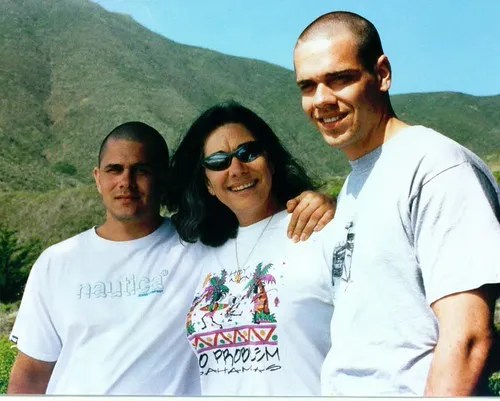
It’s a rare photo in which Gabe appears depressed. He was known for his boisterous, charismatic personality. But, from the time he left home for college, he struggled with depression. This photo was taken at my husband’s graduation from a pastoral training program in June 2004. Gabe would have just finished his freshman year at Wheaton College in Illinois.

I write about his depression because, as Endurance Team members, we are focused on overcoming and suicide seems like the antithesis of that. One thing I’d really like to accomplish through my involvement with the team is to help others overcome faulty ideas about depression and suicide. Ideas that I myself once held.

Not long before Gabriel died, I joined the CTF group on Facebook. A young woman posted a comment on the group wall about studies linking NF to psychiatric difficulties. I didn’t think much about it until after Gabe died. Then I began doing research and found one of the studies she may have been referring to. Here it is from PubMed:

Neurofibromatosis type 1 (NF1) is often associated with psychiatric disorders, which are more frequent in NF1 than in general population (33% of patients). Dysthymia is the most frequent diagnosis (21% of patients). There is also a high prevalence of depressive mood (7%), anxiety (1-6%), and personality (3%) disorders. The risk of suicide is four times greater than in the general population. Bipolar mood disorders or schizophrenia appear to be rare. The impaired quality of life associated with NF1 may play an important role in the development of psychiatric disorders. Quality of life assessments may help to identify a population at high risk.

Dysthymia can be defined as depression; despondency or a tendency to be despondent. It certainly describes Gabe at increasingly frequent intervals in the last year of his life. In another study, researchers found no link between the severity of familiar NF symptoms and the severity of psychiatric ones, indicating that something neurological might be going on rather than simple despair over the condition itself.

Since 2002, I have written for a magazine called Christianity Today. One of my articles was about Gabe and a couple others mentioned him. Because I had encountered a good deal of both ignorance and empathy after his suicide, I wrote about his death for the magazine. You can read that article here. It traces a bit of family history, does some education and poses the possibility that Gabe was suffering from bipolar disorder, which a couple of mental health professionals suggested after reading his suicide notes and journal entries. I’m ambivalent about this post-mortem analysis though, because the impulsivity that correlates with his attention deficit disorder combined with his undiagnosed dysthymia could be mistaken for bipolar.

Long before I had a thought about any of this, I wrote about Gabe’s NF in Christianity Today. That article was an investigation into human embryonic stem cell (hESC) research. Through it, I met my friend and NF Endurance Team partner David Brick. David is an hESC researcher at Children’s Hospital of Orange County, CA. When we were training for the Long Beach Half Marathon last year, David did some reading of his own on NF. He found something about the involvement of mast cells in NF. Mast cells are also indicated in asthma and allergies. This got me wondering if Gabe’s severe asthma might also have been a function of his NF. Instead of suffering from three separate diseases—NF, asthma and depression—was he really only suffering symptoms of one nasty disorder? I’d like to know the answer to this question.

The point of my writing about this here is both to alert CTF to these possibilities and to say that Gabe was for all of his life a true NF Hero. He overcame challenges that many of us will never face. The father from whom he inherited neurofibromatosis never acknowledged him and chose not to be a part of his life. He dealt with race issues as well, and was frequently sick and isolated with asthma. NF was always in the background as a concern. And yet, Gabe was incredibly accomplished. You can read about his many accomplishments here.

In one of his suicide notes, he wrote that as much as he kept trying to “pull himself up into the world of real people,” he felt dead inside. That feeling is not failure or a lack of courage; it’s a symptom of clinical depression. A symptom that he did not recognize had a treatment. A symptom he hid well in his lifelong habit of being an overcomer. A symptom I did not understand.

For the sake of others suffering such symptoms, I want to challenge the NF Endurance Team and its members to recognize that our message shouldn’t exclude those suffering from mental illness. Death by suicide is a preventable tragedy, not a lack of character. While we want to be careful not to romanticize or idealize those who die by suicide, we also want to remember that the vast majority of people who take their own lives die from mental illness that is no fault of their own.

So, here’s to my NF Hero, Gabriel Gifford Scheller!

Update: The NYC Half Marathon is just 10 days away and I’ve only raised $350 of my $1000 goal. If you’d like to help me answer the question posed in this post, you can support my efforts here, or you can send a check to: The Children’s Tumor Foundation 95 Pine Street, 16th Floor, New York, N.Y. 10005.

Speak the word only and my soul shall be healed.


I spend a good deal of time defending evangelicals, both in the real world and in the virtual one. I’ve begun to realize, however, that I’m often defending aspects of evangelicalism that I don’t care for myself. For example, in a discussion that followed my Her.meneutics post on “Hooking Up,” I defended followers of Bill Gothard against some rabid criticism, even though I deplore the sort of legalism Gothard represents. And last year, at Brandeis University, as one of two evangelicals amidst a dozen or more religion journalists doing a fellowship on Judaism, I repeatedly defended evangelicals against negative stereotypes that I myself have pondered in print.

I bring this up because, now that I’m home, I don’t fit easily in some of my old evangelical circles. Not that I ever did, but it’s been a while since I’ve been immersed in certain of our popular religious practices. I find myself shocked at things I once gave ne’er a thought to. I had hoped, for instance, that attending a Bible study led by a dear friend and wonderful teacher would bring me comfort. Unfortunately, I don’t care for the Bible study material we are using. It wants to turn the Bible into a self-help manual and its characters into heroes, and I don’t. I’m also tired of studying the Bible to extrapolate every last ounce of possible meaning out of it. It follows then that I don’t want to rip it into shreds and remake it in my own image. I mostly just want to read it for the comfort and correction I find in it.  So, there’s that and then the study group is composed of women from both sides of two church splits I lived through. There’s nothing awkward in this, except that I get a clear picture of where I’ve been and see pretty clearly that I no longer belong there.  I love and appreciate those places, but rarely find comfort in their forms of worship, whereas I always find comfort in the Anglican liturgy. Always. Never once in my three years as an Anglican has it failed to do its work on me. I live for Sunday worship because Sunday worship imbues me with the power and peace I need to live. (Worship is about God, but it gives back.)

I mention this because it relates to the topic at hand. That topic is pain. Deep, abiding psychic, spiritual, emotional pain that sometimes lasts for days on end.

Last night I was in that kind of pain, and so I picked up Nancy Guthrie’s book, Hearing Jesus Speak into Your Sorrow. I’m skeptical, not of Nancy mind you, but of my evangelical tribe’s tendency toward weak tea. I began reading nonetheless.

In chapter 3, she deals with those who would suggest that our children ( hers, and mine by inference) who died would have been healed if only we (or they) had had more faith. Nancy chose the story of Jesus healing the leper in Mark 1: 40-42 as her text for dealing with this issue. She came across the passage in the months after her daughter Hope died and says it hurt her feelings to think that Jesus was not willing to heal her child. I know exactly what she means. On the morning Gabe died, I said something to God that I don’t recall ever saying to Him before. I lay in my bed, and said, “God, if I were honest, I’d tell you I don’t think you love me anymore. How could you let my children …” A little while later, I said something harsh to Gabe about him wearing a dirty, smelly shirt to work again, and then went for a long prayer walk so that I could get my thoughts back in line with the truth of God’s word and affirm my trust in His love for me and my children. Before the day was done, my son was dead.

Nancy’s implicit trust in God led her to dig deeper into the Scripture to find out what Jesus was really communicating through his miracles (particularly the healing miracles). She came to the conclusion that if Jesus’s healing ministry had been mostly about healing physical sickness, it would have been more pervasive and central to his focus. Also, physical healing is by nature temporary and God didn’t come to earth for a temporary fix. In John 20: 30-31, we learn that the purpose of Jesus’s miracles is that we might believe, and believing, “have life by the power of his name.” Jesus’s priority was our deliverance from the ultimate source of our suffering and that is the sin that separates us from God. About the fall, Nancy writes:

Into the purity of the world God created, sin brought a poison that penetrated everything. And into the relationship we enjoyed with God, sin built a barrier. We went from being at peace with God to feeling threatened by him. Guilt and fear took over where innocence and openness had once ruled.

Ever been there? I have, at least once in the past 24 hours. And yet, she reminds us,

There is a day coming when death and disease will be healed for good. That is our sure hope in the midst of sorrow.

The passage that penetrated my pain last night is this one:

When Jesus said, “I am willing. Be healed!” to the leper, he was saying that he wants to cleanse us from the pervasive sin that will prove eternally fatal without his healing touch.

And now I realize that Jesus turns toward me when I call out to him for healing. Now I can hear him lovingly responding to me, saying, “I am willing. Be healed.” He is at work in my life, bringing healing to the wounded places where sin has left its ugly mark. He certainly isn’t finished yet, but I know the day is coming when his work in me will be complete.

I’ve also come to peace realizing that Jesus did not withhold his healing touch from Hope or Gabe. He has taken them to himself and will, at the resurrection, give them glorious bodies (Philippians 3:21). And this is no get-God-off-the-hook cop-out. It is everything we would ask for and long for.

It is the last paragraph that stuck with me as I went into today. I don’t want get-God-off-the-hook cop-outs. I want the truth. And the truth is that Gabe’s brain was sick from neurofibromatosis, from years of asthma-related oxygen deprivation, from inordinate guilt emanating from suicidal depression, from … The truth is his resurrected body will be tumor-free. The truth is the impulsivity and feelings of aggression that are common to both NF patients and suicide victims will be gone forever. The truth is he will breathe easy and never again have to say no to an invitation because of a household pet. The truth is he now knows and will for all eternity know that he is loved and lovable and lovely. The truth is it’s not my fault.

I didn’t process all of that last night. I simply held the last paragraph in my mind and went to sleep. This morning, I was still in pain.  At church, neither the opening hymns nor the visiting priest bade well for healing, and yet heal the liturgy did. I took note when the priest used alternate phrasing in the prayer we say before taking communion. Phrasing that echoes what Nancy wrote about from Mark 1. It is a sentence that I silently add every week and keep wishing our rector would use instead of the other. It is a piece of the reason why the liturgy never fails to do its work on me. There is power in the prayer:

Lord, I am not worthy to receive you, but speak the word only and my soul shall be healed.

He is willing, and so I am healed when I take his body and blood into my own in faith. There is power in the blood. One mustn’t forget that. Afterwards, we echoed these sentiments again as we sang the African-American Spiritual, There is a Balm in Gilead. It goes:

There is a balm in Gilead, to make the wounded whole. There is a balm in Gilead to heal the sin-sick soul.

Sometimes I feel discouraged, and think my work’s in vain, but then the Holy Spirit revives my soul again.

There is a balm in Gilead, to make the wounded whole. There is a balm in Gilead to heal the sin-sick soul.

If you cannot preach like Peter, if you cannot pray like Paul, you can tell the love of Jesus and say, “He died for all.”

There is a balm in Gilead, to make the wounded whole. There is a balm in Gilead to heal the sin-sick soul. …

Sometimes I feel discouraged and think my work has been in vain, but then the Holy Spirit revives my soul again. I cannot preach like Peter; I grapple with too many negative triggers and questions. I cannot pray like Paul; I don’t know how anymore, except in the most general terms. I can tell the love of Jesus though, and say, “He died for all.” For all the broken, battered and bruised. For all the sin-sick lonely souls. For all the high and mighty liars. For all the orphaned, starving children. For me. For you. For Nancy. For her Gabe. For mine. For evangelicals and our critics.  For every tribe—past, present and future. There is a balm in Gilead to make the wounded whole. There is a balm in Gilead to heal the sin-sick soul.

Notice, if you will, that the day’s healing was found in drinking from deep evangelical wells.

Racing for Research Again!


Guess who’s walk/jogging for neurofibromatosis research again? You’ve got it! I landed a coveted spot on the NF Endurance Team for the New York City Half-Marathon on August 16th, which doesn’t leave me much time to train or fund raise. If you helped us raise more than $4500 last year, thanks! If you weren’t able to give then and are able to now, here’s a word from team coordinator Bob Skold on why you should go ahead and write that check:

Recent advances in NF research are moving us significantly closer to reaching the goal of FDA-approved treatments for neurofibromatosis (NF). Research grant monies are now being used to fund basic and translational research with an eye on developing drug therapies.  Dr. Bruce Korf, one of the foremost NF research scientists states, “We now more or less understand the activity of the NF gene in the cell and are beginning to use that information to develop new treatments. I believe we’re at a point where we can look forward to effective treatments for NF1, NF2 and Schwannomatosis in the reasonable near future.”

The NFET is the largest CTF program funding NF research; indeed all donations to the NF Endurance Team are restricted for use in the CTF science and research programs. The NFET continues its commitment to advancing NF Research, now providing close to 1/3 of the funds to support the annual CTF research budget.  Following last year’s record $1.2 million raised, we are pleased to continue with this level of projected funding and to apply team donations to partially fund promising and top-priority CTF research initiatives in 2009.

For more specific information please go to our Team Fundraising Dollars at Work section on our Team web page. Our Team’s fund-raising success is an investment that can offer a world of possibilities to someone with NF. We are helping solve the NF Puzzle one mile at a time, one clinical trial at a time, one potential drug therapy at a time.

In fact, the New England Journal of Medicine just published a study that promises hope for NF 2 sufferers, like Bob. He has lost most of his hearing from the disorder.

I’ll keep you posted as to my progress. I hope to raise at least $1000 and to better my time from Long Beach by at least 30 minutes. You can get to know some of my team-mates at the team blog. I’ll be contributing there as well.

Here’s the link to my fund raising page. All you need to make a difference is a credit card and a willing heart!

Here are my previous posts on NF.